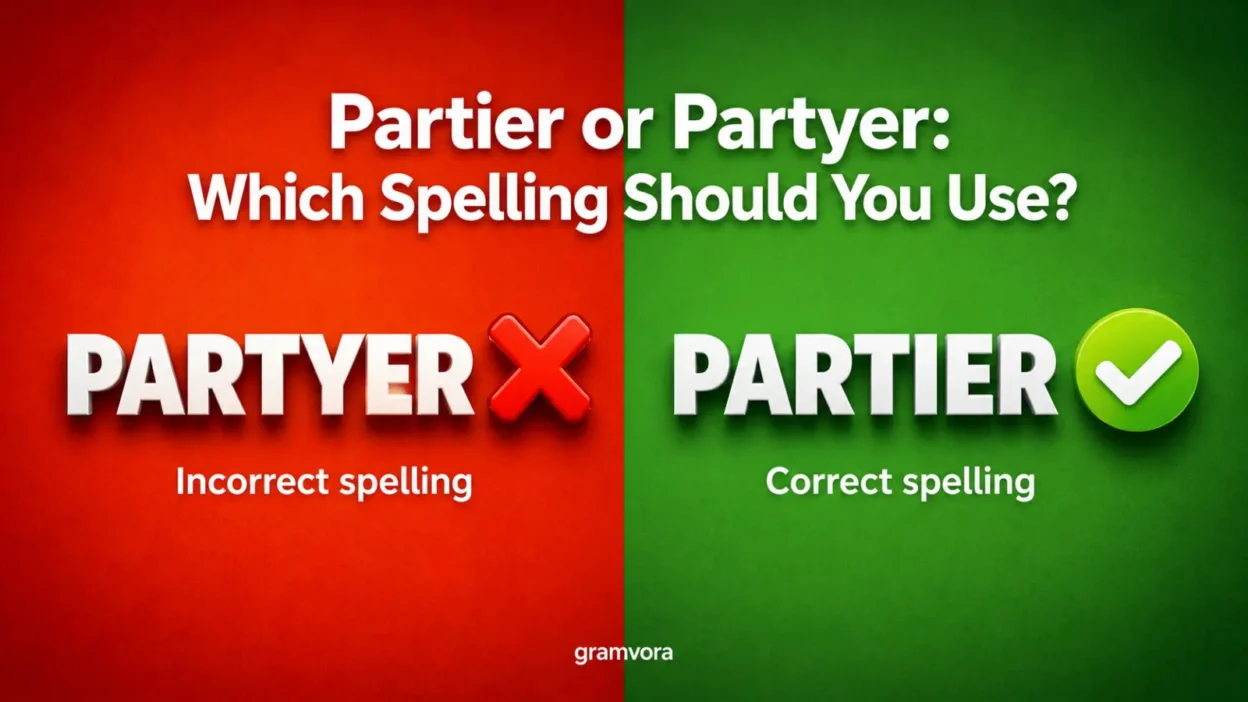
Partier or partyer is a real spelling-choice question because both forms appear in English.
The simple answer for most US writing: partier is usually the better-looking and more familiar choice. It follows the common spelling pattern seen when party becomes partied or partying.
Still, partyer is not useless or imaginary. It is also listed as a spelling for a person who attends parties or parties often. The safest advice is this: use partier in normal writing, but do not assume partyer is a different word.
Quick Answer
Use partier when you want the spelling most readers expect in everyday US English.
Use partyer only if your source, editor, dictionary preference, or house style uses it.
Both spellings name the same kind of person: someone who goes to parties, enjoys parties, or parties often.
They are pronounced the same in normal speech: PAR-tee-er.
Why People Confuse Them
The confusion comes from the base word party.
Many English words ending in y change the y to i before an ending. That is why we write partied, not partyed. This pattern makes partier look natural.
But English also has agent nouns formed by adding -er to a word. From that angle, party + er can produce partyer. That is why both spellings have support.
So the confusion is understandable. This is not a case where one form has a totally separate meaning.
Key Differences At A Glance
| Context | Best Choice | Why |
|---|---|---|
| Everyday US writing | partier | Looks natural and is widely recognized |
| School or workplace writing | partier | Less likely to distract readers |
| Dictionary-based writing that follows a specific entry | partyer or partier | Use the spelling your chosen source prefers |
| Casual texts | partier | Clear and familiar |
| Quoting a source that uses partyer | partyer | Keep the original spelling |
| Talking about meaning | either spelling | Both refer to the same kind of person |
Are They the Same Word?
Yes. Partier and partyer are spelling variants of the same noun.
They do not have separate meanings. A partier is not a different type of person from a partyer. Both mean a person who attends parties, enjoys parties, or parties often.
The difference is mainly spelling preference. In modern US writing, partier often feels smoother because it matches the spelling change many readers expect after a final y.
Compact comparison:
- partier: common-looking spelling; best choice for most general US writing
- partyer: accepted variant in some references; may look odd to many readers
- meaning: the same
- pronunciation: the same
- part of speech: mainly a noun
US vs UK Preference
There is no clean, simple US-vs-UK split here like color and colour.
The better answer is that dictionary treatment is mixed. Some references prefer partyer as the main form, while others give strong coverage to partier.
For a US audience, partier is the practical spelling to use when you want your sentence to look natural and avoid a pause from the reader. Partyer may be understood, but it can look unusual because many people expect the y in party to shift before the ending.
Which Spelling Should You Use?
Choose partier for most writing.
That includes emails, school papers, blog posts, captions, workplace notes, and general articles.
Use partyer only when you have a clear reason. For example, a publication style sheet may prefer it, or you may be quoting a line that already uses it.
Do not switch between the two in the same piece. Pick one spelling and stay consistent.
When One Spelling Looks Wrong
Partyer often looks wrong because people compare it with words like partied and parties. Since those forms change y to i, readers may expect partier too.
But spelling patterns in English are not always strict rules. A word can look less expected and still appear as a recognized variant.
The practical point is simple: partier is less distracting. Partyer may be defensible, but it can make some readers stop and question the spelling.
Common Mistakes (and Quick Fixes)
Mistake: Treating partier and partyer as different meanings.
Fix: They mean the same thing.
Mistake: Calling partyer impossible in all English.
Fix: Say it is less common-looking or less preferred for everyday US writing.
Mistake: Using both spellings in one article.
Fix: Choose one spelling and keep it consistent.
Mistake: Writing party-er with a hyphen.
Fix: Use partier or partyer, not a hyphenated form.
Mistake: Using the word in serious contexts where it sounds too casual.
Fix: Use partygoer, guest, or attendee if you need a more neutral tone.
Everyday Examples
She was known as the biggest partier in her dorm.
The neighbors complained because a group of loud partiers stayed outside after midnight.
He used to be a regular partier, but now he prefers quiet dinners.
The event drew tourists, music fans, and late-night partiers.
In casual writing, partier will usually look more natural than partyer.
If a quote uses partyer, keep that spelling inside the quote.
Dictionary-Style Word Details
Verb
- partier: Not commonly used as a verb in standard US English. It is mainly a noun.
- partyer: Not commonly used as a verb in standard US English. It is mainly a noun.
The verb is party: They party on weekends.
Noun
- partier: A person who attends parties, enjoys parties, or parties often.
- partyer: Same meaning, with a different spelling preference.
- partiers
- partyers
For most US writing, partiers is the better choice.
Synonyms
Closest plain alternatives:
- partygoer
- reveler
- celebrant
- merrymaker
- guest
- clubgoer, when the setting is clubs or nightlife
Helpful opposites:
- homebody
- killjoy
- party pooper
These alternatives do not match every sentence. Partygoer is the closest neutral choice. Reveler sounds more formal or news-like. Party animal is more casual and stronger.
Example Sentences
- partier: Maya was a cheerful partier, but she always left before things got too loud.
- partyer: The article described him as a regular partyer during his college years.
- partier: The hotel asked late-night partiers to move inside.
- partyer: Some style choices allow partyer, but many readers expect partier.
Word History
Both spellings come from party plus the person-making ending -er.
The spelling difference comes from two competing instincts. One keeps the base word visible: party + er = partyer. The other follows the familiar final-y spelling change: party + er = partier.
That is enough history for normal use. There is no need to treat the two spellings as separate words.
Phrases Containing
- partier: late-night partier, regular partier, college partier, group of partiers
- partyer: late-night partyer, regular partyer, college partyer, group of partyers
In everyday US writing, the partier versions look more natural.
FAQs
1. Is it spelled partier or partyer?
The correct and more common spelling is partier. It refers to someone who enjoys attending or taking part in parties. Partyer is a rare alternative spelling and is generally considered less standard.
2. What does partier mean?
A partier is a person who enjoys social events, celebrations, or nightlife. The word can describe someone who frequently attends parties or someone who simply participates in a specific celebration.
3. Is partyer a real word?
Yes, partyer can be understood because it follows the pattern of adding “-er” to “party,” but it is uncommon. Most English speakers and dictionaries prefer partier.
4. Why is partier spelled with an “i”?
The spelling partier comes from adding the suffix -er to the verb party while keeping the pronunciation clear. Similar examples include words like plier from “ply” and supplier from “supply.”
5. Can I use partier in formal writing?
Yes, partier is acceptable, but it is more common in casual writing. In formal contexts, alternatives like party attendee, guest, or participant may sound more professional.
6. What is the plural form of partier?
The plural form is partiers. For example: “The partiers enjoyed the music and celebration.”
7. Is partier a positive or negative word?
The meaning depends on context. It can describe someone who enjoys having fun and socializing, but it may also suggest excessive partying if used negatively.
8. What is the difference between a partier and a party animal?
A partier is simply someone who attends or enjoys parties. A party animal usually describes someone who parties very frequently and enthusiastically, often to an extreme level.
Conclusion
For modern US English, partier is the best spelling for most situations.
Partyer is a real variant, but it can look odd to many readers. The two spellings have the same meaning and the same pronunciation. They are mainly different spelling choices, not different words.