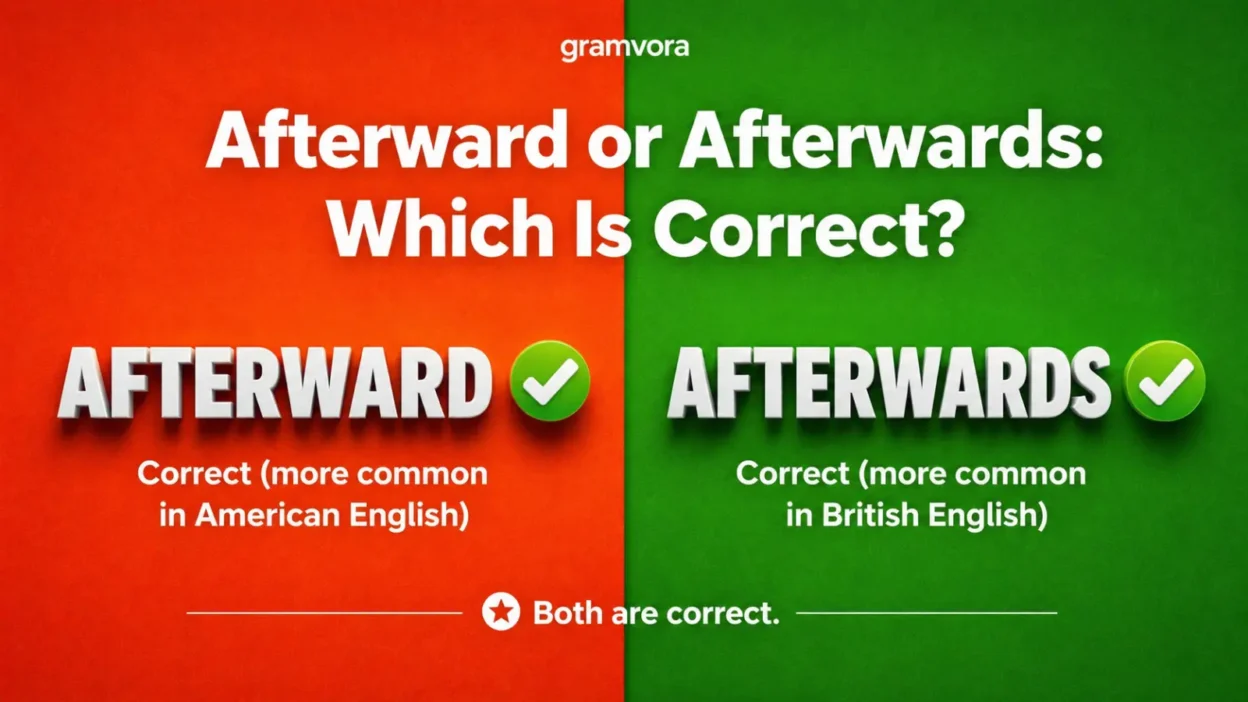
Afterward and afterwards are both correct words. They mean the same thing: later or at a later time.
For US English, afterward is usually the better choice. It sounds more natural in American writing, especially in school, business, journalism, and polished online content.
Afterwards is also standard English, but it sounds more British to many US readers.
Quick Answer
Use afterward in American English.
Use afterwards if you are writing for a British or international audience that prefers that form.
The difference is not meaning. The difference is mainly regional style.
| Form or Pattern | Best Use | Why |
|---|---|---|
| afterward | Standard US English | It is the usual American form. |
| afterwards | British English or broader international use | It is common and standard outside the US. |
| afterword | A note at the end of a book | It is a different word, not a time adverb. |
What Is Correct?
Both afterward and afterwards are correct adverbs.
Correct:
I called her afterward.
Correct:
I called her afterwards.
For a US audience, the first sentence is the stronger everyday choice. The second sentence is not wrong, but it may sound less American.
The Core Grammar Rule
Afterward and afterwards are adverbs. They tell when something happens.
They usually refer to something that happens after another event.
Example:
We had dinner, and afterward we went for a walk.
In that sentence, afterward tells when the walk happened. It happened after dinner.
You do not need a noun after afterward or afterwards. That is one reason they work differently from after when after is used as a preposition.
Correct:
We talked afterward.
Correct:
We talked after the meeting.
Incorrect:
We talked afterward the meeting.
When Each Form Is Correct
Use afterward when writing in standard American English.
Examples:
The meeting ended at 3, and we talked afterward.
She apologized afterward.
I felt better afterward.
Use afterwards when writing in British English or when matching a source, quotation, title, or house style that uses that form.
Examples:
They stayed for tea afterwards.
He called me soon afterwards.
The team discussed the results afterwards.
In US writing, either form can be understood. But mixing both forms in one article, email, or report looks inconsistent.
When It Is Incorrect or Less Natural
Afterwards is not usually incorrect in US English. It is just less natural for many American readers.
Less natural in US writing:
We finished the project and celebrated afterwards.
More natural in US writing:
We finished the project and celebrated afterward.
The truly incorrect mistake is using afterward before a noun.
Incorrect:
I’ll call you afterward lunch.
Correct:
I’ll call you after lunch.
Correct:
I’ll call you afterward.
Meaning, Structure, or Emphasis Differences
There is no real meaning difference between afterward and afterwards.
Both mean “later” or “after that.”
They also do not create a clear formality difference. Afterward is not more formal because it has no s. Afterwards is not more casual because it has an s.
The useful difference is audience:
- US audience: choose afterward.
- UK audience: afterwards may sound more natural.
- Mixed audience: choose one form and use it consistently.
Real-World Examples
The class ended, and we talked afterward.
I sent the report afterward.
She was nervous before the interview but relieved afterward.
We grabbed coffee afterward.
The power went out during the storm and came back on afterward.
The team reviewed the video afterward.
In each example, afterward means that the action happened later.
You could replace afterward with afterwards, and the basic meaning would stay the same. For US writing, though, afterward is the cleaner choice.
Common Mistakes (and Quick Fixes)
One common mistake is treating afterward like after.
Incorrect:
We met afterward work.
Correct:
We met after work.
Correct:
We met afterward.
Another mistake is confusing afterward with afterword.
Afterword means a short section at the end of a book. It does not mean later.
Incorrect:
I called him afterword.
Correct:
I called him afterward.
Correct:
The author added an afterword to the book.
Grammar Rule Details
Rule
Use afterward or afterwards as an adverb meaning “later.” In US English, prefer afterward.
Correct Usage
Place afterward after the action it refers to, or at the start of a clause when the order is clear.
Correct:
We talked afterward.
Correct:
Afterward, we walked to the train.
Correct:
She finished the form and checked it afterward.
Incorrect or Less Natural Usage
Do not put afterward directly before a noun.
Incorrect:
I’ll see you afterward class.
Correct:
I’ll see you after class.
Correct:
I’ll see you afterward.
In US writing, afterwards is usually less natural, not wrong.
Less natural:
He emailed me afterwards.
More natural:
He emailed me afterward.
Examples
We cleaned the kitchen afterward.
He looked tired afterward.
The kids played outside afterward.
I forgot to ask about the invoice, so I emailed afterward.
They argued during the meeting but shook hands afterward.
Common Mistakes
Do not use afterword when you mean afterward.
Do not use afterward before a noun.
Do not switch between afterward and afterwards in the same piece unless you have a clear reason.
Exceptions
There are no major grammar exceptions for normal US writing.
The main exception is style choice. If a publication, teacher, editor, or brand guide asks for afterwards, follow that style. The word is still standard English.
Quick Test
Ask: “Can I replace this word with later?”
If yes, use afterward in US English.
I called her later.
I called her afterward.
If a noun comes next, use after, not afterward.
After lunch.
After the game.
After work.
Usage Notes
For American readers, afterward is the safest choice.
Afterwards may sound British, but it is not a grammar error. Avoid saying it is “wrong.” A better explanation is: afterward is preferred in US English, while afterwards is more common in British English.
FAQ
Is afterward or afterwards correct in US English?
Both are correct, but afterward is preferred in US English. It sounds more natural to most American readers.
Is afterwards wrong?
No. Afterwards is standard English. It is just less typical in American writing.
Do afterward and afterwards mean the same thing?
Yes. Both mean later or after that. The difference is usage, not meaning.
Can I start a sentence with afterward?
Yes.
Example:
Afterward, we went out for pizza.
Use a comma after afterward when it starts the sentence and introduces the next action.
What is the difference between afterward and afterword?
Afterward means later.
Afterword means a closing note or section at the end of a book.
Example:
I called afterward.
The author wrote an afterword.
Conclusion
For US English, use afterward.
Afterwards is also correct, but it is more strongly linked with British English and may sound less natural in American writing.