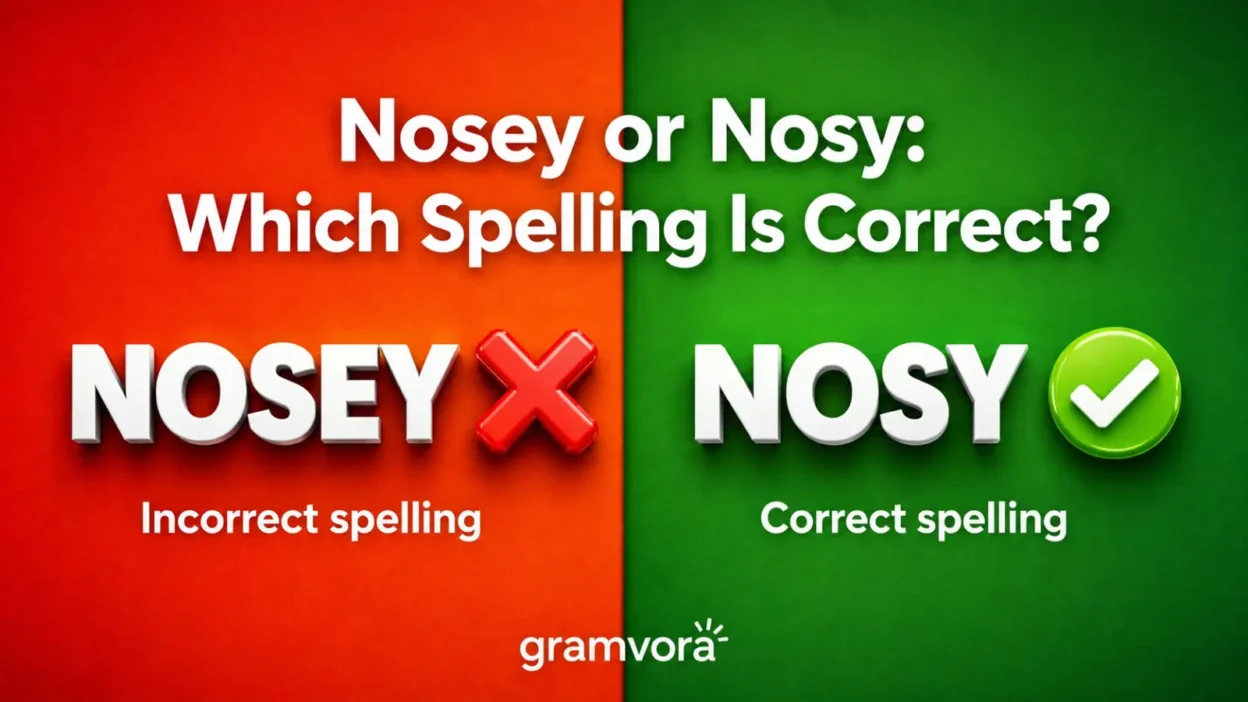
If you are choosing between nosey or nosy, use nosy for standard US English.
Both spellings refer to the same idea: someone who is too interested in other people’s private business. The difference is mainly spelling preference, not meaning.
For American readers, nosy looks cleaner, more common, and more standard. Nosey is still recognized, but it can look informal, old-fashioned, or less polished in US writing.
Quick Answer
Nosy is the best choice in American English.
Nosey is a real variant spelling, but it is not the safest default for US writing. Use it only if you are quoting someone, following a house style, or writing in a casual voice where that spelling fits.
There is no useful meaning difference between the two. A nosy neighbor and a nosey neighbor are doing the same thing: asking too many personal questions or showing too much interest in private matters.
Why People Confuse Them
The confusion makes sense because nosey looks as if it keeps the full word nose before adding -y.
That feels logical. A person who is nosy is often imagined as someone “sticking their nose” into someone else’s business.
But English spelling does not always keep the full base word. In modern standard use, nosy is the spelling most US readers expect.
The two spellings also sound the same. They are both pronounced like NOH-zee. Because there is no sound difference, the choice only matters in writing.
Key Differences At A Glance
| Context | Best Choice | Why |
|---|---|---|
| Standard US writing | nosy | It is the preferred modern spelling. |
| School or workplace writing | nosy | It looks more polished and expected. |
| Casual texts or social posts | nosy | Still the safer default. |
| Quoting someone who wrote “nosey” | nosey | Keep the original spelling in a quote. |
| British or informal style | nosey or nosy | “Nosey” appears as a variant, but “nosy” is widely understood. |
| Consistent editing | choose one | Do not switch between spellings in the same piece. |
Are They the Same Word?
Yes. Nosey and nosy are spelling variants of the same word.
Both describe someone who pries, snoops, asks personal questions, or shows too much curiosity about things that do not concern them.
There is no standard rule that makes nosey more intense, rude, friendly, or playful than nosy. Any difference in tone usually comes from the sentence, not the spelling.
For example:
“She asked about my rent, my salary, and my dating life.”
In that sentence, the behavior is intrusive whether you call it nosy or nosey.
US vs UK Preference
For US English, choose nosy.
That is the clearest recommendation for American readers. It is the spelling that usually fits emails, articles, school papers, workplace messages, and edited prose.
Nosey is accepted as a variant, and it may appear in British or informal writing. Still, you should not treat this as a strict rule that Americans use only nosy and British writers use only nosey. Real usage is mixed.
The safer way to think about it is simple: nosy is the standard choice, especially in the United States. Nosey is a recognized variant that may look less standard to many US readers.
Which Spelling Should You Use?
Use nosy unless you have a clear reason not to.
Here is the practical choice:
| Feature | nosey | nosy |
|---|---|---|
| Meaning | Too curious about private matters | Too curious about private matters |
| Pronunciation | NOH-zee | NOH-zee |
| Best US choice | No | Yes |
| Standard edited style | Less preferred | Preferred |
| Good for quotes | Yes, if original | Yes, if original |
| Risk in US writing | May look informal | Low risk |
If you are writing for a US audience, nosy will almost always serve you better.
When One Spelling Looks Wrong
Nosey may look wrong to American readers because they are more used to seeing nosy.
That does not mean nosey is fake. It means the spelling may distract the reader.
This matters most in polished writing. In a resume, report, article, customer email, or school assignment, a distracting variant can make the sentence feel less careful.
In a text message, the risk is smaller:
“Sorry if this is nosey, but did you move?”
Most people will understand it. Still, nosy is the better default:
“Sorry if this is nosy, but did you move?”
Common Mistakes (and Quick Fixes)
Do not call nosey a totally wrong spelling. It is a variant.
Better: “Use nosy as the standard US spelling.”
Do not switch spellings in the same piece.
Weak: “My nosey neighbor is always nosy about my packages.”
Better: “My nosy neighbor is always asking about my packages.”
Do not create a meaning difference that is not there.
Weak: “Nosey means playful curiosity, but nosy means rude curiosity.”
Better: “Both spellings mean overly curious or intrusive.”
Do not use either spelling when you mean healthy interest.
Weak: “Thanks for being nosy about my new job.”
Better: “Thanks for being interested in my new job.”
Everyday Examples
“I do not want to sound nosy, but are you moving?”
“Our nosy neighbor notices every delivery on the block.”
“The group chat got nosy after Maya posted one vacation photo.”
“He asked a nosy question about how much the car cost.”
“My aunt can be nosy, but she usually means well.”
“That was too nosy for a first conversation.”
“You can ask how I am doing without getting nosy.”
“She ignored the nosy comments and changed the subject.”
These examples use nosy because they are written for standard US English.
Dictionary-Style Word Details
Verb
• nosey: Not commonly used as a verb in standard US English. Use it as an adjective spelling variant.
• nosy: Not commonly used as a verb in standard US English. Use it as an adjective.
The verb idea is usually expressed with phrases like snoop, pry, or stick your nose into something.
Noun
• nosey: Not commonly used as a regular noun in standard US English. It may appear in fixed informal expressions or as part of a nickname-like label, but that is not the main use.
• nosy: Not commonly used as a regular noun in standard US English. The normal form is the adjective.
The related noun is nosiness, meaning the quality of being too curious about other people’s private business.
Synonyms
• nosey: Same word, variant spelling. Closest plain alternatives include prying, intrusive, snooping, meddling, and overly curious.
• nosy: Same meaning. Closest plain alternatives include prying, intrusive, snooping, meddling, and overly curious.
Useful opposites include respectful, discreet, and mindful of privacy. These are practical opposites, not perfect one-word matches in every sentence.
Example Sentences
• nosey: “I do not mean to be nosey, but did something happen at work?”
• nosy: “I do not mean to be nosy, but did something happen at work?”
• nosey: “The note sounded a little nosey.”
• nosy: “The note sounded a little nosy.”
For US writing, the nosy versions are smoother and more standard.
Word History
• nosey: This spelling keeps the full word nose, which may be why it feels natural to some writers. It is recognized as a variant.
• nosy: This is the standard spelling to use in modern US English.
The word is tied to the idea of putting one’s nose into other people’s affairs. Beyond that, a short spelling guide does not need a detailed origin story. The practical point is that both spellings exist, but nosy is the safer modern choice for US readers.
Phrases Containing
• nosey: nosey neighbor, nosey question, nosey comment. These are understandable, but less preferred in US writing.
• nosy: nosy neighbor, nosy question, nosy coworker, nosy relative, nosy comment. These are the better choices for standard US English.
The phrase nosy neighbor is especially common because it names a familiar situation: someone nearby who wants to know too much about your private life.
FAQs
1. Is it nosy or nosey?
Nosy is the more common and generally preferred spelling in American English. Nosey is also a recognized variant, but it is less common.
2. Is “nosey” a correct spelling?
Yes. Nosey is a valid spelling of the word. However, nosy is usually the better choice for American English.
3. What does nosy mean?
Nosy means overly curious about other people’s private business or personal affairs.
Example:
My neighbor is always asking nosy questions.
4. What is the difference between nosy and nosey?
There is no meaningful difference in meaning. Nosy and nosey are spelling variants of the same adjective.
5. Which spelling is preferred in American English?
Nosy is the preferred spelling for most American English writing. It is shorter and more commonly used in US dictionaries and everyday writing.
6. Is “nosey” British English?
Nosey is used in British English, but it is not exclusively British. Both nosy and nosey can be found in English-language writing.
7. Does nosy mean rude?
It can. Calling someone nosy usually suggests that the person is asking questions or showing interest in matters that are private and not their concern.
Example:
I don’t want to be nosy, but are you moving?
8. Is nosy a formal word?
Nosy is an informal word. It is common in everyday conversations, emails, social media, and casual writing. For formal writing, alternatives such as overly inquisitive or intrusive may be more appropriate.
9. What is the plural of nosy?
Nosy is an adjective, so it does not normally have a plural form. You can say nosy people or nosy neighbors.
Example:
Those nosy neighbors keep asking about our plans.
10. Which spelling should I use: nosey or nosy?
For most American English writing, choose nosy. Use nosey if you are following a source, publication, or style that specifically prefers that variant. Both spellings have the same basic meaning.
Conclusion
For nosey or nosy, choose nosy in American English.
Both spellings mean the same thing, and both point to someone who is too curious about private matters. The difference is not grammar or meaning. It is spelling preference.