
Family relationship terms can become confusing because cousin labels depend on both shared ancestors and generation levels. “1st cousin once removed” and “second cousin” describe different family connections, even though both involve cousins.
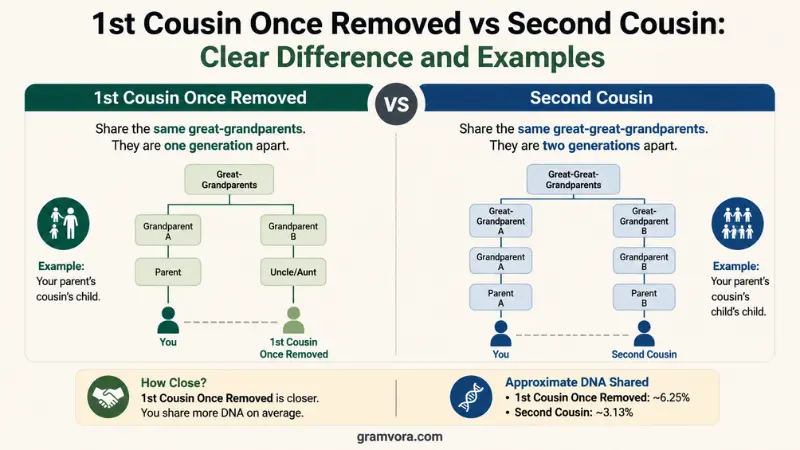
The main difference is that a first cousin once removed involves a one-generation gap, while a second cousin usually describes two people in the same generation who share great-grandparents.
Quick Answer
A 1st cousin once removed is a cousin relationship where the two people are one generation apart. This can be your first cousin’s child or your parent’s first cousin.
A second cousin is someone in your same generation who shares the same great-grandparents as you. Use “second cousin” when both relatives are equally distant from the shared ancestors.
Why People Confuse Them
People often confuse these terms because both describe relatives beyond an immediate first-cousin relationship. The word “removed” does not mean the person is less related or less important. It shows a difference in generations.
For example, your first cousin’s child is not your second cousin. That person is your first cousin once removed because the family connection moves down one generation.
Key Differences At A Glance
| Feature | 1st Cousin Once Removed | Second Cousin |
|---|---|---|
| Generation | One generation apart | Same generation |
| Shared ancestor | Usually a grandparent connection through one cousin line | Great-grandparents |
| Common example | Your first cousin’s child | Your parent’s cousin’s child |
| Main idea | Cousin relationship plus a generation gap | Cousins in the same generation |
| Context | Best Choice | Why |
| Your cousin has a child | 1st cousin once removed | The child is one generation below you |
| You share great-grandparents with someone | Second cousin | Both of you are equally distant from the ancestors |
| Your parent has a first cousin | 1st cousin once removed | Your parent’s generation is one level above yours |
| Two relatives descend from siblings several generations back | Second cousin | They share great-grandparents |
Meaning and Usage Difference
1st cousin once removed combines two ideas: the cousin level and a generation difference. The “first cousin” part identifies the shared family line, while “once removed” means one generation separates the relatives.
Second cousin means two people share great-grandparents but are not siblings, parents, or first cousins. Both people are normally in the same family generation.
The easiest way to decide is to find the closest shared ancestor. Then compare how many generations each person is from that ancestor.
Tone, Context, and Formality
Both terms are neutral family relationship terms. They are commonly used in genealogy, family records, ancestry discussions, and everyday conversations about relatives.
In casual speech, many people simply say “cousin” when the exact relationship is not important. The more specific terms are useful when discussing a family tree or explaining how two relatives are connected.
Which One Should You Use?
Use 1st cousin once removed when there is a one-generation difference between you and the cousin connection.
Use second cousin when you and the other person are in the same generation and your closest shared ancestors are great-grandparents.
When One Choice Sounds Wrong
Calling your first cousin’s child your second cousin is usually incorrect because the generation difference matters. That person is a first cousin once removed.
Calling someone a second cousin when they are your parent’s first cousin also misses the generation difference. Your parent and that person are first cousins, making them your first cousin once removed.
Common Mistakes (and Quick Fixes)
Mistake: Thinking “removed” means less related.
Fix: Remember that “removed” only describes a generation gap.
Mistake: Counting the number of family connections instead of generations.
Fix: Start with the shared ancestor and count each person’s distance from it.
Mistake: Assuming every distant cousin is a second cousin.
Fix: Second cousin has a specific family-tree meaning.
Everyday Examples
- Your aunt’s child is your first cousin.
- Your first cousin’s daughter is your 1st cousin once removed.
- Your mother’s first cousin is your 1st cousin once removed.
- Your grandparent’s sibling’s grandchild is your second cousin.
- Two children of first cousins are second cousins to each other.
Dictionary-Style Word Details
Verb
• 1st cousin once removed: Not commonly used as a verb in standard US English. It is a noun phrase describing a family relationship.
• Second cousin: Not commonly used as a verb in standard US English. It is a noun phrase describing a family relationship.
Noun
• 1st cousin once removed: A noun phrase for a cousin relationship separated by one generation.
• Second cousin: A noun phrase for a relative who shares great-grandparents with you and is generally in the same generation.
Synonyms
• 1st cousin once removed: Closest plain alternatives include “a cousin one generation apart” or “a first cousin separated by one generation.”
• Second cousin: Closest plain alternatives include “a relative who shares great-grandparents” or “a same-generation cousin with shared great-grandparents.”
Exact synonyms are not usually used because these terms describe specific family relationships.
Example Sentences
Your first cousin’s son is considered your 1st cousin once removed.
I met my second cousin at a family reunion since we share the same great-grandparents.
Because of the generation difference, her grandfather’s cousin is her 1st cousin once removed.
Word History
The terms are built from traditional family relationship language. The word “removed” is used to show a generation difference in cousin relationships. Specific historical development of these exact labels is not necessary to understand their modern use.
Phrases Containing
• first cousin once removed
• second cousin
• second cousin once removed
• first cousin twice removed
FAQs
A 1st cousin once removed has a one-generation difference from you. This could be your first cousin’s child or your parent’s first cousin. A second cousin is usually someone in your same generation who shares the same great-grandparents as you.
Yes, a 1st cousin once removed is generally considered a closer family relationship than a second cousin because the shared family connection is one generation nearer. However, both relationships can vary slightly depending on the exact family tree.
No. Your first cousin’s child is your 1st cousin once removed, not your second cousin. The word “removed” shows that you and the person are in different generations.
“Once removed” means there is a one-generation gap between two relatives. The relatives may share the same family line, but one person is a generation above or below the other.
Yes. Your parent’s first cousin is your 1st cousin once removed because your parent and that person are first cousins, while you are one generation below them.
Find your closest shared ancestor. If you and another person share the same great-grandparents and you are both in the same generation, that person is your second cousin. A family tree can make this relationship easier to identify.
Conclusion
The difference between 1st cousin once removed and second cousin comes down to generations. A first cousin once removed has a one-generation gap, while a second cousin is usually in the same generation with shared great-grandparents.
When you know the shared ancestor and each person’s generation level, choosing the correct term becomes much easier.


[…] Now imagine that person’s child. That child is one generation below the original second cousin. The child can be your second cousin once removed. […]