The words poopy and poopie often confuse English learners and even native speakers. They sound almost identical, appear in similar situations, and come from the same informal root word “poop.”
But even though they are closely related, they are not used in exactly the same way.
In everyday American English, these two words show a subtle difference in function, tone, and context. One is more descriptive, while the other is more affectionate and noun-like, especially in speech directed at children.
Understanding that difference helps you choose the right word naturally without sounding awkward or overly childish.
Quick Answer
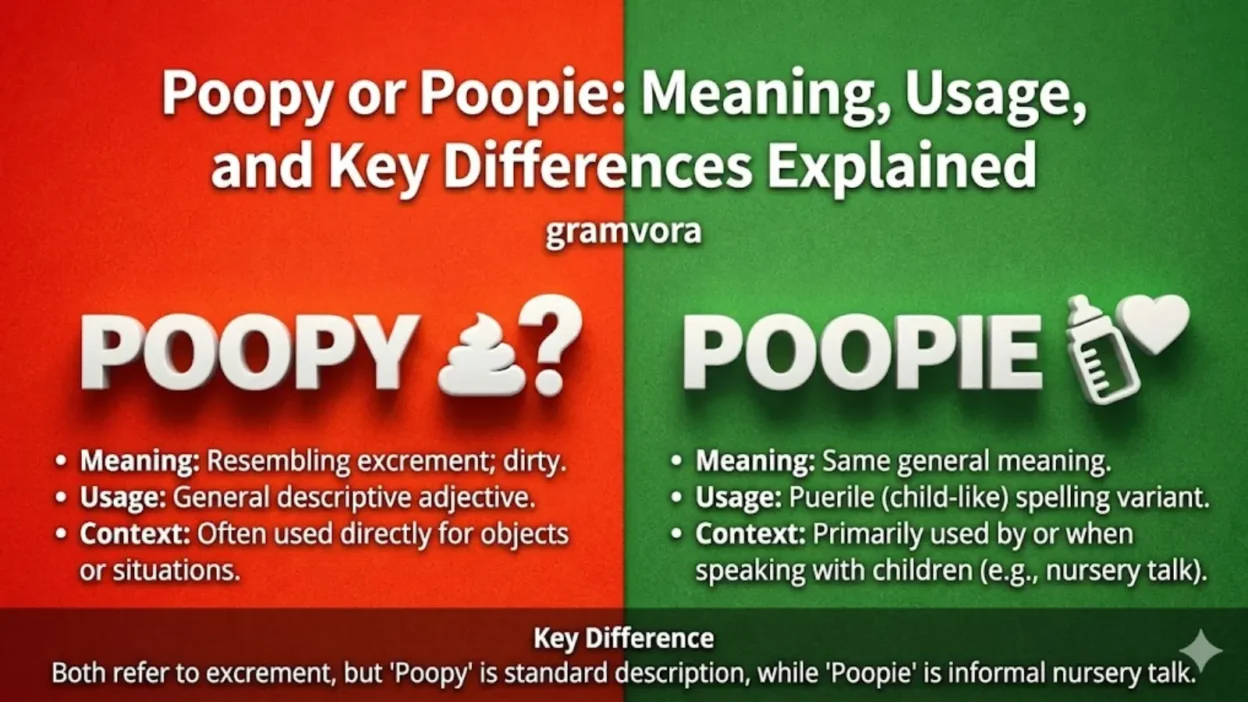
- Poopy = mainly used as an adjective (describes something dirty or related to poop)
- Poopie = mainly used as a noun (a playful or child-friendly way to say poop itself)
In simple terms:
- You describe things as poopy
- You name the thing itself as poopie
Both are informal and mostly used in casual or family settings.
Why People Confuse Them
The confusion happens for several reasons:
First, both words come from the same base: poop.
Second, they are both used in informal speech, especially around children.
Third, pronunciation is nearly identical. In most American English accents, both sound like “POO-pee.”
Finally, many speakers use them interchangeably in casual situations without thinking about grammar roles.
Because of this overlap, people assume they are just spelling variations of the same word. In reality, they function slightly differently in everyday usage.
Key Differences At A Glance
| Context | Poopy | Poopie |
|---|---|---|
| Basic function | Describes something | Names the substance |
| Grammar role | Adjective | Noun (informal) |
| Tone | Casual, descriptive | Cute, child-directed |
| Common users | Adults, parents, general speech | Adults speaking to children |
| Example idea | “poopy diaper” | “make a poopie” |
Meaning and Usage Difference
The main difference lies in how the words function in a sentence.
Poopy
Poopy is primarily an adjective. It describes something that is dirty, unpleasant, or related to poop.
Common uses:
- poopy diaper
- poopy shoes
- poopy smell
- poopy mess
It can also be used more loosely to describe something unpleasant in a childish or humorous way:
- “That’s a poopy situation.”
- “Today is a poopy day.”
It is slightly more flexible and widely recognized in general informal English.
Poopie
Poopie is more often used as a noun, especially in child-centered speech. It refers directly to the poop itself in a softened or playful form.
Common uses:
- “The baby made a poopie.”
- “There’s a poopie in the diaper.”
- “Clean up the poopie.”
This form is especially common in households with toddlers because it sounds less harsh.
In short:
- Poopy = describing quality
- Poopie = naming the object
Tone, Context, and Formality
Neither word belongs in formal English.
You would avoid both in:
- Academic writing
- Medical reports
- Professional emails
- News writing
Instead, both belong in:
- Family conversations
- Parenting speech
- Child-directed language
- Humor between friends
Tone differences
- Poopy feels slightly more neutral and descriptive
- Poopie feels more affectionate and childlike
For example:
- “The diaper is poopy” → simple observation
- “The baby made a poopie” → softer, child-friendly tone
This difference is subtle but noticeable in spoken English.
Which One Should You Use?
The correct choice depends on what you are trying to express.
Use “poopy” when:
- You are describing something
- You want a more general informal tone
- You are not speaking directly to a child
- You are referring to mess or dirtiness
Example:
- The dog has poopy paws.
- That shirt is poopy after playing outside.
Use “poopie” when:
- You are talking to a toddler
- You are naming the poop itself
- You want a soft, playful expression
- You are using baby talk
Example:
- Did you make a poopie?
- Time to change the poopie.
When One Choice Sounds Wrong
Sometimes using the wrong form can sound unnatural, even if people understand you.
Sounds awkward
- The baby made a poopy.
- The diaper is poopie.
Sounds natural
- The baby made a poopie.
- The diaper is poopy.
This happens because English speakers instinctively match:
- Poopy → description
- Poopie → noun in child speech
Even if grammar rules are flexible, usage patterns are consistent.
Common Mistakes (and Quick Fixes)
Mistake 1: Using poopie as an adjective
❌ The poopie shoes are dirty
✔ The poopy shoes are dirty
Mistake 2: Using poopy as a noun in baby talk
❌ The baby made a poopy
✔ The baby made a poopie
Mistake 3: Using either word in formal writing
❌ The patient has poopy stool
✔ The patient has stool contamination (or clinical term)
The key fix is matching tone and role, not just spelling.
Everyday Examples
Poopy in real use
- The puppy tracked poopy footprints through the house.
- My kid stepped in something poopy at the park.
- That’s a poopy situation with the broken toy.
- The diaper is very poopy right now.
- The bathroom smells poopy after the accident.
Poopie in real use
- The toddler announced, “I made a poopie!”
- There’s a poopie in the diaper already.
- Mom cleaned the poopie quickly.
- The child pointed at the poopie and laughed.
- Time to throw away the poopie diaper.
These examples reflect how American families typically use both words in daily speech.
Dictionary-Style Word Details
Verb
- Poopy: Not commonly used as a verb in standard American English
- Poopie: Not used as a verb in standard usage
Both forms function almost entirely as adjective/noun-style informal words.
Noun
- Poopy: Rarely used as a noun; sometimes understood informally
- Poopie: Common informal noun meaning poop in child-directed speech
Synonyms
Poopy (closest plain alternatives):
- dirty
- messy
- soiled
- unpleasant
Poopie (closest plain alternatives):
- poop
- stool (neutral)
- waste (formal)
- number two (informal)
Antonym idea (context-based):
- clean (for poopy descriptions)
Example Sentences
Poopy
- The floor is poopy after the dog came inside.
- That was a poopy accident in the kitchen.
- His shoes are poopy from the garden.
Poopie
- The baby made a poopie before nap time.
- There’s a poopie in the diaper.
- She said “poopie” and giggled.
Word History
Both words come from the informal base “poop,” which is used in English as a childish or softened term for feces.
- Poopy developed as a descriptive form meaning “covered with poop” or “dirty.”
- Poopie developed as a softened, affectionate noun form, often used in child speech.
Neither word has a formal historical or literary origin in standard language use. Their development is tied to spoken, informal English.
Phrases Containing
Poopy
- poopy diaper
- poopy pants
- poopy mess
- poopy day
Poopie
- make a poopie
- little poopie
- baby poopie
- clean the poopie
Conclusion
The difference between poopy and poopie is small but meaningful in everyday speech.
- Poopy describes something dirty or unpleasant
- Poopie refers to the poop itself in a softer, child-friendly way
Both are informal, but each has a clear role in natural American English.
A simple way to remember it:
- If you are describing → use poopy
- If you are naming → use poopie
That small distinction is enough to use both words confidently in real-life conversation.