
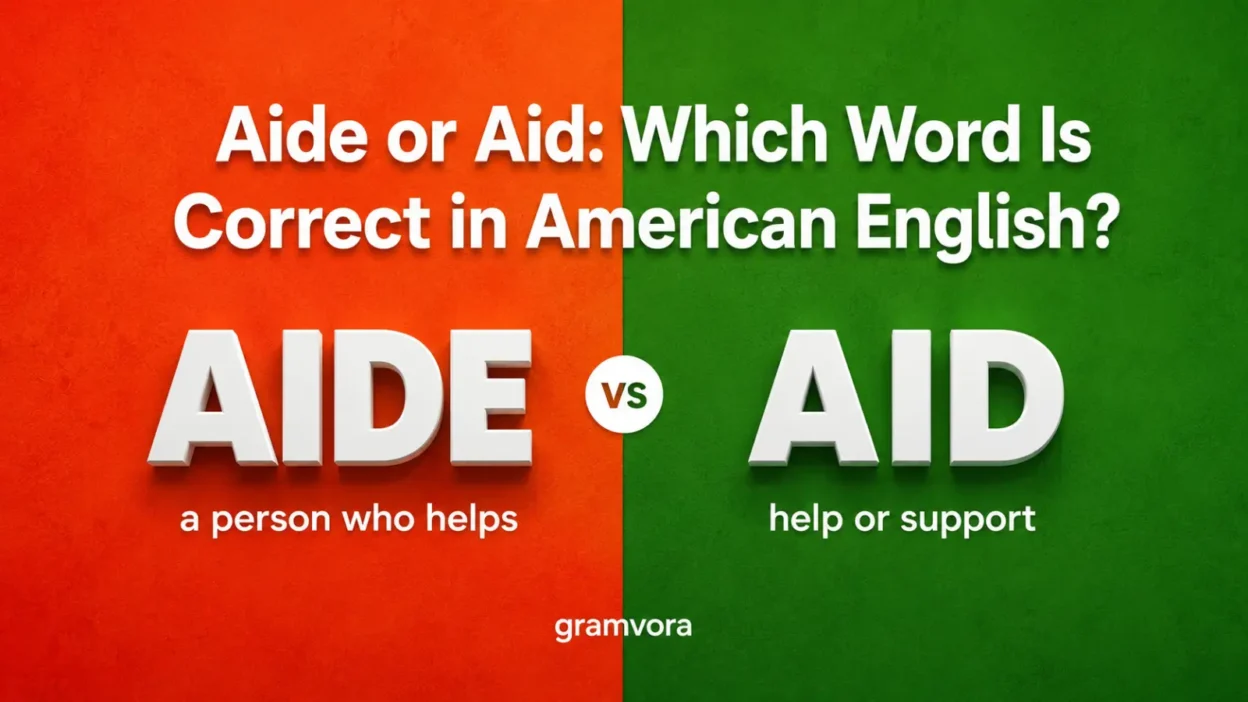
Aide or aid is confusing because the two words sound exactly the same. They also both connect to the idea of help. Still, they are not always used the same way.
The clearest difference is simple: aid usually means help, support, or to help. Aide means a person who helps, often as a job or official role. In careful American English, this difference matters.
Quick Answer
Use aid when you mean help, support, relief, or the act of helping. Use aide when you mean a person who helps someone, especially in a school, medical, political, or professional role.
Correct: “The town received emergency aid.”
Correct: “The senator’s aide answered the call.”
Why People Confuse Them
People confuse aide and aid for three main reasons.
First, they are pronounced the same: ayd. You cannot hear the spelling difference in speech.
Second, both words relate to help. An aide gives aid. Aid may come from a person, a group, money, supplies, or a tool.
Third, aid can sometimes appear as a noun for a helper in American English, as in “teacher’s aid.” However, aide is usually the clearer and more standard choice when you mean a person in a helping role.
Key Differences At A Glance
| Context | Best Choice | Why |
|---|---|---|
| Help or support | aid | Aid means assistance, relief, or support. |
| To help someone | aid | Aid works as a verb meaning to help or assist. |
| A person who helps | aide | Aide means an assistant or helper. |
| School helper | aide | “Teacher’s aide” is clearer for a person. |
| Medical helper | aide | “Nurse aide” or “home health aide” names a person. |
| Emergency help | aid | Use aid for relief, supplies, money, or care. |
| Helping device | aid | Use aid for a tool, such as a hearing aid. |
| Political assistant | aide | Use aide for a senator’s aide or White House aide. |
Meaning and Usage Difference
Aid has two main uses. As a noun, it means help, assistance, relief, or something that helps. You can receive financial aid, emergency aid, medical aid, or legal aid. A chart can be a visual aid. A hearing aid is a device that helps someone hear.
As a verb, aid means to help or assist. For example, a volunteer can aid storm victims. A guide can aid visitors. A new system can aid workers by making a task easier.
Aide is a noun. It means a person who assists someone. A teacher’s aide helps in a classroom. A nurse aide helps with patient care. A political aide helps an elected official or public leader.
Here is the compact comparison:
| Feature | aid | aide |
|---|---|---|
| Main meaning | help, support, or to help | a helper or assistant |
| Common role | noun and verb | noun |
| Refers to a person? | sometimes, but less clear | yes |
| Best use | assistance, relief, tools, action | job title or helper role |
Tone, Context, and Formality
Aid sounds slightly more formal than help when used as a verb. “The program aids families” sounds more formal than “The program helps families.” In everyday speech, people often use help, but aid is common in news, law, government, schools, health care, and public service writing.
As a noun, aid is normal in many serious or practical contexts. Examples include foreign aid, financial aid, legal aid, first aid, and emergency aid.
Aide often appears in job titles and official roles. It sounds natural in phrases like teacher’s aide, nurse aide, home health aide, presidential aide, and campaign aide. It usually refers to a person with a support role, not the help itself.
Both words are pronounced the same: ayd. Pronunciation does not help you choose the spelling, so rely on meaning.
Which One Should You Use?
Use aid when the sentence is about help itself.
Examples:
“Students can apply for financial aid.”
“The Red Cross provided aid after the flood.”
“The video was a useful aid during training.”
Use aid as a verb when someone or something helps.
Examples:
“The new checklist will aid the hiring team.”
“Doctors worked to aid the injured driver.”
Use aide when the sentence is about a helper.
Examples:
“The teacher’s aide helped students with reading.”
“The mayor’s aide prepared the briefing notes.”
“A home health aide visits her father each morning.”
A simple memory tip: aide ends in e, and employee starts with e. An aide is often an employee or assistant. Aid is the help that person gives.
When One Choice Sounds Wrong
First aide sounds wrong because first aid means basic medical help. The word refers to care or treatment, not a person.
Visual aide usually sounds wrong because a chart, slide, picture, or diagram is a visual aid. It is a helpful tool, not a helper.
Financial aide is usually wrong unless you are talking about a person whose job title is unusual or informal. Money for school is financial aid.
Presidential aid can be misunderstood. If you mean help given to a president, aid may fit. If you mean a person who works for the president, use presidential aide.
Teacher’s aid may appear in some American use, but teacher’s aide is clearer when you mean the classroom helper.
Common Mistakes (and Quick Fixes)
Mistake: “She works as a classroom aid.”
Better: “She works as a classroom aide.”
Why: The sentence means a person who helps.
Mistake: “The charity sent aide after the storm.”
Better: “The charity sent aid after the storm.”
Why: The sentence means help or relief.
Mistake: “He used a hearing aide.”
Better: “He used a hearing aid.”
Why: A hearing aid is a device.
Mistake: “The senator’s aid wrote the statement.”
Better: “The senator’s aide wrote the statement.”
Why: The sentence means an assistant.
Mistake: “The course includes several job aides.”
Better: “The course includes several job aids.”
Why: Job aids are tools, guides, or checklists that help people work.
Everyday Examples
“Students filled out forms for financial aid before the deadline.”
“The school hired a new teacher’s aide for the first-grade classroom.”
“The training video is a useful aid for new employees.”
“The governor’s aide called reporters after the meeting.”
“Neighbors rushed to aid the family after the fire.”
“The nurse aide checked the patient’s room before lunch.”
“The map served as a visual aid during the presentation.”
“The company donated emergency aid after the tornado.”
“A campaign aide scheduled the candidate’s next event.”
“The new software will aid the team during inventory.”
“She keeps a first-aid kit in her car.”
“The home health aide helps her grandmother with daily tasks.”
Dictionary-Style Word Details
Verb
aide: Not commonly used as a verb in standard American English. Do not write “She aides the team” when you mean “She helps the team.”
aid: Commonly used as a verb meaning to help, assist, support, or make something easier.
Example: “The grant will aid small businesses.”
Noun
aide: A noun meaning a person who helps or assists, often in a job, school, medical, political, or official role.
Example: “The principal spoke with the teacher’s aide.”
aid: A noun meaning help, assistance, relief, support, or a device that helps. In some American use, it can also mean a helper, but aide is clearer for a person.
Example: “The family received legal aid.”
Synonyms
aide: Closest plain alternatives include assistant, helper, attendant, support worker, and deputy in some official contexts. A clear opposite depends on context, but supervisor or leader may contrast with aide in workplace roles.
aid: Closest plain alternatives include help, assistance, support, relief, and backing. As a verb, close alternatives include help, assist, and support. Useful opposites include hinder, block, impede, and harm, depending on the sentence.
Example Sentences
aide: “A classroom aide helped the students finish the reading activity.”
aide: “The mayor’s aide sent the updated schedule.”
aide: “Her mother now has a home health aide three days a week.”
aid: “The city asked for federal aid after the storm.”
aid: “This chart is a helpful aid for explaining the process.”
aid: “The new policy may aid families who need childcare.”
Word History
aide: The word is connected to French forms meaning help or helper. In English, it became strongly associated with an assistant, including military and official assistants. Do not overread the history; the modern choice depends on meaning.
aid: The word also comes through older French and Latin roots connected to helping. In modern English, it is the broader word for help, support, relief, a helping device, or the act of helping.
Phrases Containing
aide:
- teacher’s aide
- nurse aide
- home health aide
- presidential aide
- campaign aide
- senior aide
- aide-de-camp
aid:
- first aid
- financial aid
- legal aid
- emergency aid
- foreign aid
- humanitarian aid
- visual aid
- hearing aid
- aid and abet
- come to someone’s aid
FAQs
Is it aide or aid?
Both words are correct, but they mean different things. Use aid when you mean help, support, relief, or the act of helping. Use aide when you mean a person who helps someone, especially in a job or official role.
What is the main difference between aide and aid?
The main difference is that aid usually means help, while aide means a helper. For example, “The city received aid after the storm” means the city received help. “The senator’s aide answered questions” means an assistant answered questions.
Is it teacher’s aide or teacher’s aid?
Teacher’s aide is the clearer and more standard choice when you mean a person who helps a teacher. You may see teacher’s aid in some use, but aide is better for a classroom assistant.
Is it first aid or first aide?
The correct phrase is first aid. It means basic medical help given before full medical treatment is available. Do not write first aide unless you are referring to a person in a very specific title, which is uncommon.
Can aid be used as a verb?
Yes. Aid can be a verb meaning to help or assist. For example, “The new program will aid families with childcare costs.” Aide is not normally used as a verb in standard American English.
Is aide always a person?
Yes, aide normally refers to a person who helps. Common examples include teacher’s aide, nurse aide, home health aide, campaign aide, and presidential aide.
Is it visual aid or visual aide?
The correct phrase is visual aid. A chart, image, slide, map, or diagram is an aid because it helps explain something. It is not an aide because it is not a person.
How can I remember aide vs aid?
Use this simple reminder: an aide is a person, and aid is help. If you can replace the word with “assistant,” use aide. If you can replace it with “help,” use aid.
Conclusion
The choice between aide and aid is easy once you focus on meaning. Use aid for help, support, relief, a helping device, or the action of helping. Use aide for a person who helps, especially in a job or official role.
The sentence “The aide provided aid” shows the difference clearly. The aide is the helper. The aid is the help.
[…] Mistake: Thinking treck is a regional spelling.Fix: Use trek in standard American English. […]