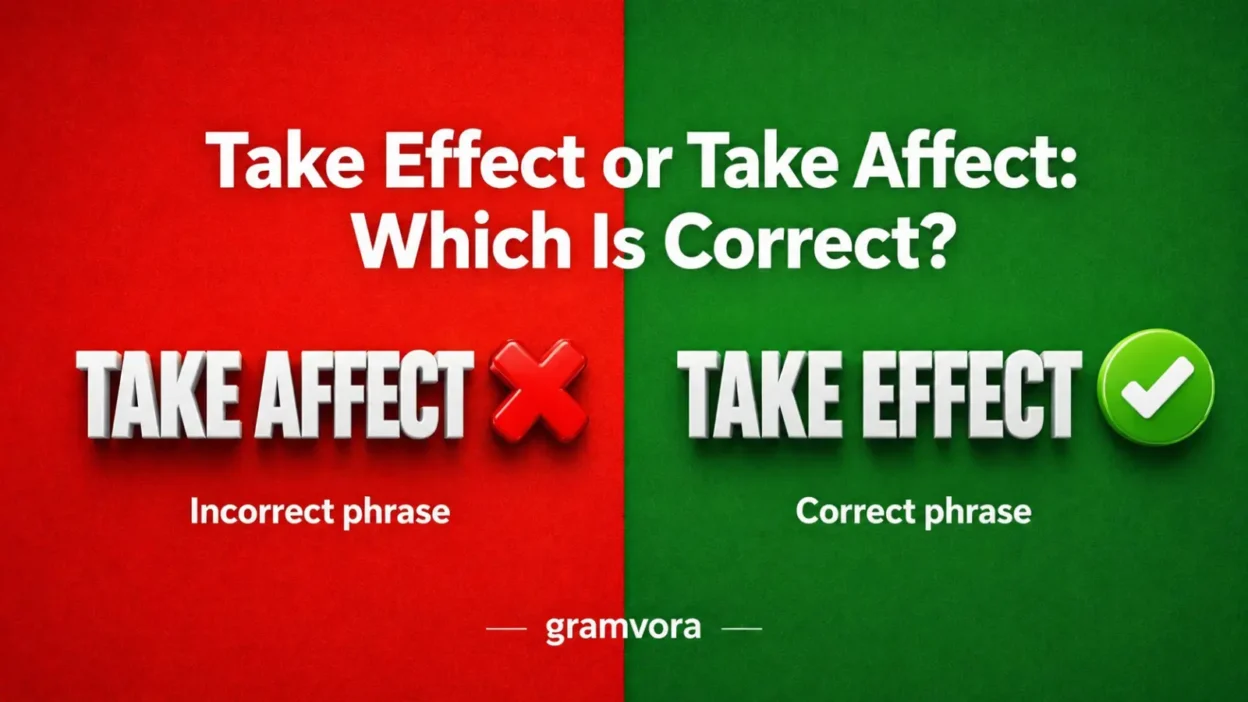
The correct phrase is take effect.
Use take effect when something starts working, starts applying, or begins to produce results.
Take affect is not the standard phrase in everyday US English. It is usually a mistake caused by mixing up affect and effect.
Write:
Correct: The new policy will take effect on Monday.
Incorrect: The new policy will take affect on Monday.
Quick Answer
Use take effect almost every time.
It works for rules, laws, policies, medicine, changes, updates, contracts, and decisions.
Take affect looks similar, but it does not fit the usual grammar of the phrase. In this expression, effect works as a noun meaning a result, operation, or active force. The phrase means that something starts to have that result.
Simple rule:
If you mean “start working” or “become active,” write take effect.
Why People Confuse Them
People confuse take effect and take affect because affect and effect sound almost the same.
There is also a grammar trap. In many sentences, affect is a verb and effect is a noun.
Example:
The delay may affect the launch.
The delay had an effect on the launch.
But in take effect, the word after take is part of a fixed phrase. You are not saying that something “takes influence.” You are saying it begins to work or apply.
Key Differences At A Glance
| Context | Best Choice | Why |
| A law begins on a certain date | take effect | The law becomes active |
| A medicine starts working | take effect | The medicine begins producing results |
| A policy starts applying | take effect | The policy becomes operative |
| A software change becomes active | take effect | The change starts working |
| A contract begins | take effect | The agreement starts to apply |
| Everyday writing | take effect | This is the standard phrase |
| Clinical psychology noun use | affect | Rare noun use, but not the usual phrase “take affect” |
Meaning and Usage Difference
Take effect means to become active, start working, or begin to apply.
Examples:
The rent increase will take effect July 1.
The pain reliever should take effect within 30 minutes.
The new security rule takes effect after the update.
Take affect is not the normal phrase for this meaning. The word affect is usually a verb meaning to influence or change something.
Example:
The storm may affect flights tonight.
There is also a noun affect, used mainly in psychology to mean a person’s outward emotional state or experience of feeling. That noun does not make take affect a natural phrase for laws, medicine, rules, or updates.
So the real difference is simple: take effect is the correct phrase; take affect is usually an error.
Tone, Context, and Formality
Take effect works in formal and casual writing.
It sounds natural in:
- legal notices
- workplace emails
- school policies
- medical instructions
- software updates
- contracts
- news reports
- everyday speech
Examples:
Your benefits change will take effect next pay period.
The parking rule takes effect tomorrow morning.
Take affect sounds wrong in standard US writing unless you are discussing the word affect itself. It may also look careless in a work email, policy memo, school paper, or public notice.
Pronunciation does not need much attention here because the full phrases sound very similar in normal speech. The problem usually appears in writing.
Which One Should You Use?
Use take effect when the subject is a thing that starts working or starts applying.
Use it with:
- a law
- a rule
- a policy
- a medicine
- a treatment
- a change
- an update
- a decision
- a contract
- a plan
Examples:
The dress code will take effect next semester.
The new password rules take effect at midnight.
The medication took effect faster than expected.
Do not use take affect for these meanings.
If you need affect, use it as a verb in a different structure:
The rule may affect employees who work remotely.
The medicine can affect your sleep.
When One Choice Sounds Wrong
Take affect sounds wrong when you mean “begin” or “start working.”
Wrong: The refund policy will take affect Friday.
Right: The refund policy will take effect Friday.
Wrong: The new dose should take affect soon.
Right: The new dose should take effect soon.
Wrong: The settings will take affect after restart.
Right: The settings will take effect after restart.
A useful test is to replace the phrase with start working.
The medicine should start working soon.
The medicine should take effect soon.
That test does not support take affect.
Common Mistakes (and Quick Fixes)
Mistake 1: Using take affect after a date
Wrong: The rule will take affect on May 1.
Right: The rule will take effect on May 1.
Mistake 2: Using affect because the sentence feels active
Wrong: The update will take affect after you restart.
Right: The update will take effect after you restart.
Mistake 3: Treating effect as always wrong after a verb
The word effect is correct here because it belongs to the phrase take effect.
Mistake 4: Forgetting the different structure with affect
Wrong: The delay had an affect on the project.
Right: The delay had an effect on the project.
Also right: The delay may affect the project.
Everyday Examples
The new schedule will take effect next Monday.
Your insurance coverage takes effect after the first payment clears.
The caffeine took effect halfway through the meeting.
The city’s parking changes will take effect this summer.
The app update will take effect after you log out and back in.
The company’s remote-work policy takes effect at the start of the quarter.
The allergy medicine did not take effect right away.
The revised contract will take effect once both sides sign it.
Dictionary-Style Word Details
Verb
take effect: A verb phrase meaning to become active, start working, or begin to apply.
Example: The changes will take effect tonight.
take affect: Not commonly used as a standard verb phrase in US English. Use affect by itself when you mean “influence.”
Example: The delay may affect our timeline.
Noun
take effect: The phrase contains effect, a noun in this structure. It points to operation, result, or active impact.
Example: The rule is now in effect.
take affect: The word affect can be a noun in psychology, but that is a different use. It refers to emotion or outward emotional expression, not a rule or medicine starting to work.
Example: The clinician noted a flat affect.
Synonyms
take effect: closest plain alternatives: start working, begin, become active, start applying, come into force.
take affect: No exact synonym as a standard phrase, because it is usually not the correct wording for “start working.”
Helpful contrast:
affect as a verb: influence, change, impact.
effect as a noun: result, outcome, impact.
Example Sentences
take effect:
The new tax rule will take effect next year.
The medication should take effect soon.
The settings take effect after you restart the device.
take affect:
Not standard for the meaning “start working.”
Wrong: The policy will take affect tomorrow.
Right: The policy will take effect tomorrow.
Word History
take effect: The phrase is built on effect, a word long used for a result, outcome, or operation. The phrase developed around the idea that something begins to have force or produce results.
take affect: There is no widely accepted separate phrase history for take affect in standard US English. It is best treated as a modern spelling and word-choice error, except when someone is deliberately discussing the noun affect in a psychology context.
Phrases Containing
take effect:
- take effect immediately
- take effect on
- take effect after
- take effect once
- take effect soon
- take effect at midnight
take affect:
No common standard phrases. In ordinary writing, replace it with take effect when you mean “start working” or “become active.”
FAQs
1. Is it “take effect” or “take affect”?
The correct phrase is “take effect.” Use it when something becomes active, starts working, or begins producing a result. “Take affect” is not the standard phrase.
2. What does “take effect” mean?
“Take effect” means to become active, begin to apply, or start producing a result. For example, “The new policy will take effect next Monday.”
3. Is “take affect” ever correct?
In standard English, “take affect” is generally incorrect when you mean “become active” or “start working.” The correct expression is “take effect.”
4. Why do people confuse “affect” and “effect”?
The words look and sound very similar, and both are related to change or influence. However, affect is usually a verb, while effect is usually a noun.
5. What is an example of “take effect”?
“The new law will take effect on January 1.” Here, “take effect” means the law will officially become active.
6. Should I say “takes effect” or “takes affect”?
Use “takes effect.” For example: “The new schedule takes effect tomorrow.”
7. Is “took effect” correct?
Yes. “Took effect” is the past-tense form of “take effect.” Example: “The new rule took effect last week.”
8. Is “taken effect” correct?
Yes. “Taken effect” is also correct when used with the appropriate helping verb. Example: “The changes have taken effect.”
9. What is the difference between “affect” and “effect”?
Affect is usually a verb meaning “to influence,” while effect is usually a noun meaning “a result or change.” For example, “The weather affected our plans,” but “The weather had an effect on our plans.”
Conclusion
For take effect or take affect, the correct choice is take effect.
Use take effect when a rule, law, medicine, update, contract, or change begins to work or apply.
Avoid take affect in standard US English. The word affect is usually a verb meaning to influence, and its rare noun use belongs mostly to psychology. It does not fit the everyday phrase for something becoming active.