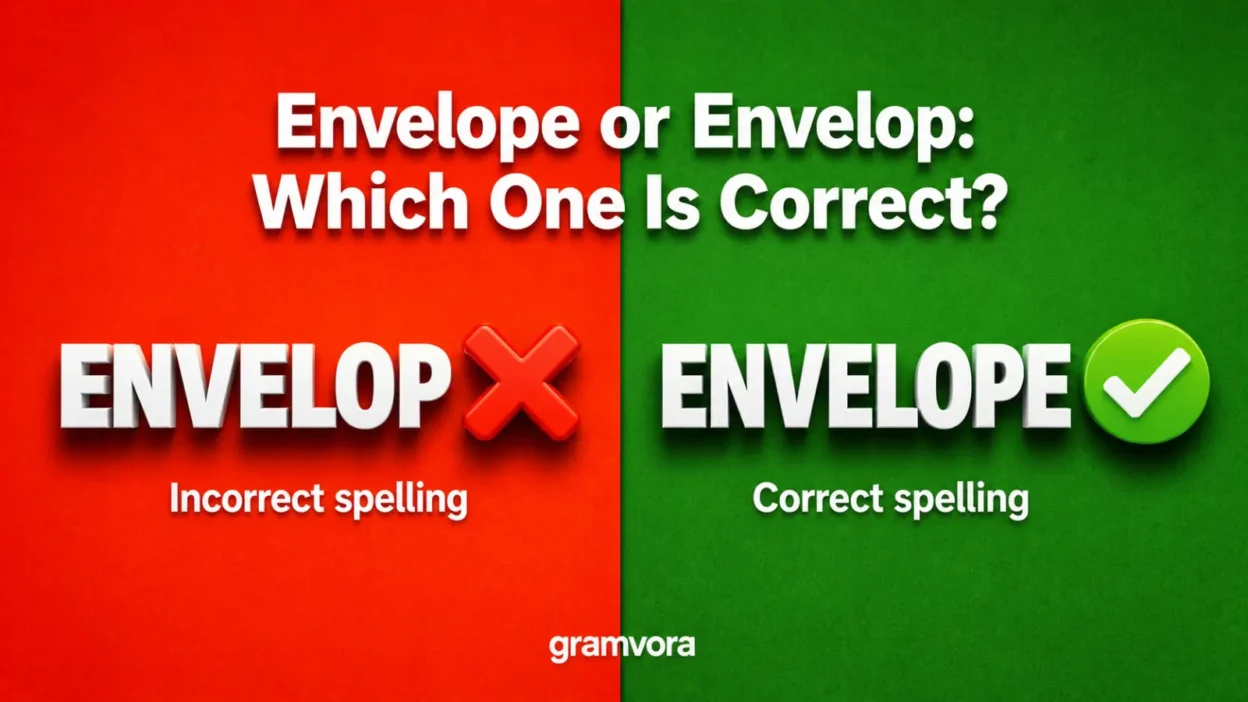
Envelope or envelop is a common mix-up because the words look almost the same. One extra e changes the word’s job in a sentence.
Both words are correct, but they are not used the same way. Envelope is usually a noun. Envelop is a verb.
Quick Answer
Use envelope when you mean the paper container for a letter, card, bill, or document.
Use envelop when you mean to cover, surround, wrap, or close in around something.
Correct: I put the check in an envelope.
Correct: Fog began to envelop the road.
The easiest rule is this: an envelope is a thing; envelop is an action.
Why People Confuse Them
People confuse envelope and envelop because they share most of the same letters. They also have related meanings. An envelope can enclose something, and to envelop something means to enclose or surround it.
The difference is grammar. Envelope names an object or covering. Envelop describes what something does.
Pronunciation can also add to the confusion. In everyday US English, envelope is often said like EN-vuh-lohp or AHN-vuh-lohp. Envelop is usually said like in-VEL-uhp, with the stress on the second syllable.
Key Differences At A Glance
| Context | Best Choice | Why |
|---|---|---|
| Mailing a letter | envelope | It names the paper container. |
| A card, bill, or invitation | envelope | It is a physical item. |
| Fog covering a street | envelop | It shows an action. |
| Smoke surrounding a room | envelop | It means to cover or surround. |
| A feeling taking over someone | envelop | It can be used figuratively. |
| “Push the ___” | envelope | This is the fixed phrase. |
Here is the compact difference:
- Envelope: a noun; usually a flat paper container.
- Envelop: a verb; to cover, wrap, surround, or enclose.
- Envelope can also mean a covering or limit in special uses.
- Envelop is not the item you mail a letter in.
Meaning and Usage Difference
Envelope most often means a flat paper container used for mail. You can seal an envelope, address an envelope, open an envelope, or put something in an envelope.
Example: Please sign the form and return it in the enclosed envelope.
Envelop means to cover or surround something completely or almost completely. It is often used with fog, smoke, darkness, warmth, silence, fear, or mystery.
Example: Smoke started to envelop the kitchen.
The words can feel related because both involve covering or enclosing. Still, they do different jobs in a sentence.
Say envelope when you can point to the thing.
Say envelop when something is doing the covering.
Tone, Context, and Formality
Envelope is a normal everyday word. It works in casual, business, school, and legal writing.
Example: The HR forms are in the envelope on your desk.
Envelop is also standard, but it sounds a little more descriptive. You may see it in news writing, fiction, weather reports, and polished descriptions.
Example: A thick haze enveloped the skyline by noon.
In casual speech, many people would say covered or surrounded instead of enveloped. In writing, envelop can sound smooth and precise when the meaning is “covered all around.”
Which One Should You Use?
Choose envelope if you mean:
- a paper mail container
- a packet or covering
- the phrase push the envelope
- a special technical boundary or outer layer
Choose envelop if you mean:
- cover completely
- surround on all sides
- wrap in or as if in a covering
- take over a place, person, or feeling
Correct: The wedding invitation came in a cream-colored envelope.
Correct: Warm air seemed to envelop the patio after sunset.
If you are writing for work, this simple test helps: if you need a or an before the word, you probably want envelope. If you need a word after a subject, like fog, smoke, or darkness, you probably want envelop.
When One Choice Sounds Wrong
Envelope sounds wrong when the sentence needs an action.
Wrong: The fog will envelope the valley.
Better: The fog will envelop the valley.
Envelop sounds wrong when the sentence needs a thing.
Wrong: Put the receipt in the envelop.
Better: Put the receipt in the envelope.
Also keep the phrase push the envelope as written. Do not write push the envelop. In that phrase, envelope means a limit or boundary that someone is trying to go beyond.
Common Mistakes (and Quick Fixes)
Mistake: Please mail the form in the envelop.
Fix: Please mail the form in the envelope.
Mistake: Rain clouds began to envelope the city.
Fix: Rain clouds began to envelop the city.
Mistake: The package came in a padded envelop.
Fix: The package came in a padded envelope.
Mistake: The news envelope her in worry.
Fix: The news enveloped her in worry.
Use enveloped for the past tense of the verb.
Correct: The room was enveloped in silence.
Everyday Examples
Envelope examples:
I forgot to put a stamp on the envelope.
The school sent the report card in a sealed envelope.
Please write your return address on the front of the envelope.
She tucked the gift card into a small red envelope.
The startup wants to push the envelope with its new design.
Envelop examples:
A heavy fog began to envelop the highway.
The smell of fresh coffee seemed to envelop the kitchen.
Darkness will envelop the trail after sunset.
Cheers enveloped the stadium after the final shot.
A sense of calm enveloped the room.
Dictionary-Style Word Details
Verb
Envelope: Not commonly used as a verb in standard modern US English. Some dictionaries record rare verb use meaning to put in an envelope or enclose, but most readers expect envelop for the action.
Envelop: A standard verb. It means to cover, surround, wrap, or enclose completely or nearly completely.
Example: Dust can envelop a construction site on a windy day.
Noun
Envelope: A standard noun. It usually means a flat paper container for mail. It can also mean an outer covering, a boundary, or a special limit in certain fields.
Example: The documents are inside the envelope.
Envelop: Not commonly used as a noun in standard US English. Use envelope when you mean the object.
Synonyms
Envelope: Closest plain alternatives include container, wrapper, covering, packet, or sleeve, depending on context. For a mail item, mailing envelope or paper sleeve may fit.
Envelop: Good alternatives include surround, cover, wrap, enclose, engulf, and shroud. Use engulf when the covering feels forceful or overwhelming. Use shroud when the tone is darker or more mysterious.
Clear antonyms do not always fit envelope because it is usually a thing. For envelop, possible opposites include uncover, expose, or reveal, depending on the sentence.
Example Sentences
Envelope: The offer letter arrived in a plain white envelope.
Another example: Do not open the envelope until everyone is in the room.
In everyday expressions: The phrase “push the envelope” means to test limits.
Envelop: Fog may envelop the bridge during the early commute.
A different use: The blanket seemed to envelop the child in warmth.
In another context: A strange silence enveloped the office after the announcement.
Word History
Envelope: The word is connected with older French forms related to wrapping or enclosing. That history helps explain why the noun means something that holds or covers another thing.
Envelop: This verb is also connected with the idea of wrapping or enclosing. The shared background explains the similar spelling, but modern usage separates the two words clearly.
The useful takeaway is not the history. It is the present-day split: envelope is usually the noun, and envelop is the verb.
Phrases Containing
Envelope:
Push the envelope means to test or go beyond accepted limits.
Example: The director likes to push the envelope with bold camera work.
Back-of-the-envelope means rough, quick, or informal, often about an estimate or calculation.
Example: We made a back-of-the-envelope estimate before asking for a full quote.
Envelop:
Enveloped in fog, enveloped in smoke, enveloped in darkness, and enveloped in silence are common patterns.
Example: By 6 a.m., the neighborhood was enveloped in fog.
FAQs
1. What is the difference between envelope and envelop?
Envelope is usually a noun that means a paper container used for holding letters or documents. Envelop is a verb that means to completely cover, surround, or wrap something.
2. Is “envelop” the same as “envelope”?
No. They have different meanings and uses. “Envelope” refers to an object, while “envelop” describes an action of covering or surrounding something.
3. How do you use envelope in a sentence?
Examples:
- I placed the letter inside the envelope.
- She wrote the address on the front of the envelope.
4. How do you use envelop in a sentence?
Examples:
- Dark clouds began to envelop the sky.
- The warm blanket helped envelop the child in comfort.
5. Why do people confuse envelope and envelop?
People often confuse them because they look almost identical and come from the same word origin. The extra “e” at the end changes the word from a verb (envelop) into a noun (envelope).
6. Is envelope pronounced differently from envelop?
Yes. In most American English usage, envelope is pronounced “EN-vuh-lope” when referring to the paper container, while envelop is pronounced “en-VEL-up” as a verb meaning to surround or cover.
7. Which word should I use for a letter cover?
Use envelope. For example: “Please put the document in an envelope.”
8. Which word means to surround or cover something completely?
Use envelop. For example: “Fog began to envelop the mountains.”
9. Can envelope be used as a verb?
In modern English, envelope is not normally used as a verb. The correct verb form is envelop.
Conclusion
Use envelope for the thing you mail, seal, open, or write an address on.
Use envelop for the action of covering, surrounding, wrapping, or closing in.
The words are both correct, but they are not interchangeable in standard US English. For most sentences, the choice is simple: envelope is a noun; envelop is a verb.