
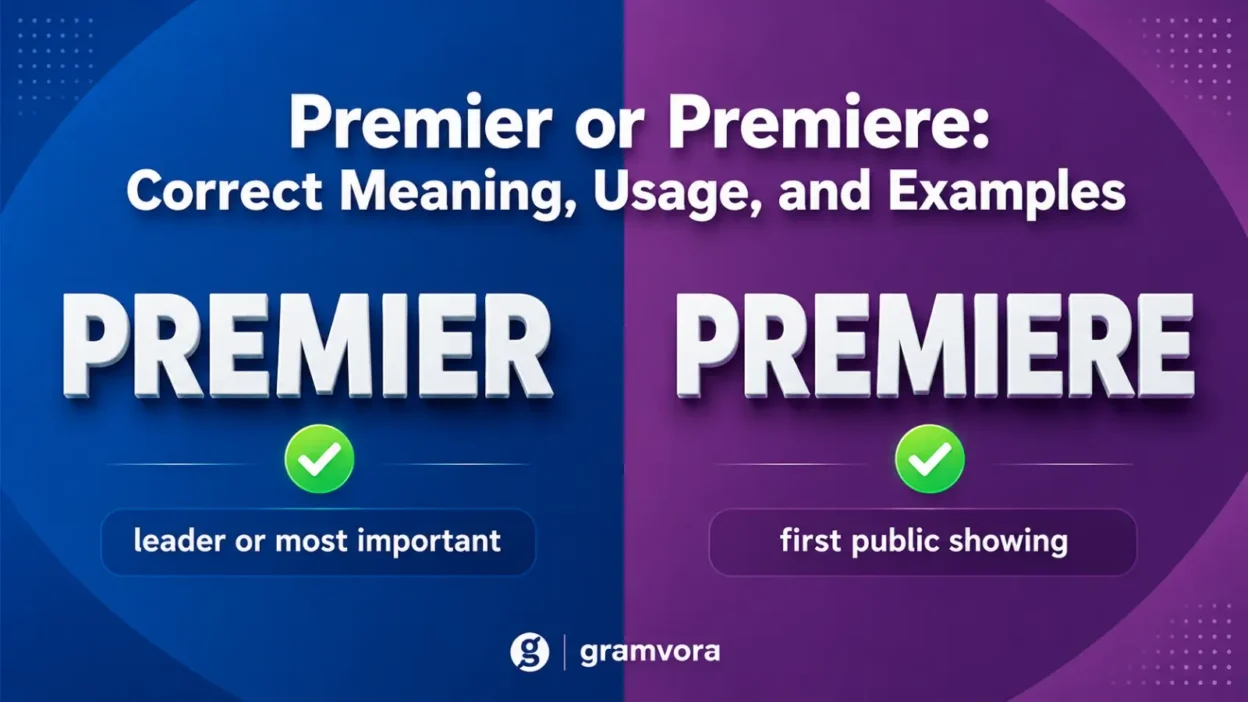
Premier or premiere depends on what you mean. Use premier for something leading, top-level, first in importance, or for a government leader. Use premiere for the first public showing of a movie, show, play, song, or similar work.
These words look almost the same, and they can both connect to the idea of “first.” However, they do not work the same way in modern US English. The safest rule is simple: premier usually describes status, while premiere usually names or describes a debut.
Quick Answer
Use premier when you mean leading, best, most important, or a government leader. Use premiere when you mean the first public performance, showing, episode, or release of a creative work. A company can be a premier provider, but a film has a premiere.
Why People Confuse Them
People confuse premier and premiere because both words come from the idea of being first. They also look nearly identical. The final e in premiere is easy to miss, especially in fast writing.
Another reason is entertainment writing. You may see both premier episode and premiere episode in real use. That overlap creates doubt. Even so, season premiere is the more natural choice when you mean the first episode of a season.
The clearest split is this: premier points to rank or importance, while premiere points to a first public showing.
Key Differences At A Glance
| Context | Best Choice | Why |
|---|---|---|
| A top company or service | premier | It means leading, best, or most important. |
| A movie’s first public showing | premiere | It names a debut or first showing. |
| A TV season’s first episode | premiere | It means the first episode shown to the public. |
| A government leader | premier | It can mean a chief minister or prime-minister-type leader. |
| A new play shown for the first time | premiere | It can be a noun or verb for a first performance. |
| A first-rate hospital, school, or firm | premier | It describes high status or quality. |
| A work being shown for the first time | premiere | It is the standard verb for debuting publicly. |
Meaning and Usage Difference
Premier is most often an adjective. It means leading, best, first in importance, or highest in status.
Correct: She works for a premier law firm in Chicago.
Correct: This is one of the premier hospitals in the region.
Premier can also be a noun. In that use, it means a government leader, especially in countries or regions that use that title.
Correct: The premier met with business leaders on Monday.
Premiere is most often a noun. It means the first public showing or performance of something, especially a movie, play, show, opera, or episode.
Correct: We watched the series premiere last night.
Correct: The film’s premiere drew a large crowd.
Premiere can also be a verb. It means to have or give a first public showing.
Correct: The documentary will premiere next month.
Correct: The theater will premiere the new musical in April.
A compact way to remember it: premiere has an extra e, like entertainment and event.
| Feature | premier | premiere |
|---|---|---|
| Main meaning | leading, best, first in importance | first public showing or debut |
| Common role | adjective; also noun | noun; also verb |
| Best fit | quality, status, rank, government | movies, shows, plays, episodes, releases |
| Example | a premier university | a movie premiere |
Tone, Context, and Formality
Premier sounds polished and promotional when it describes a business, service, event, school, or professional. It often appears in ads, company pages, news writing, and formal descriptions.
Example: The hotel markets itself as a premier downtown destination.
Because premier can sound like marketing language, do not use it when you only mean “good.” Save it for something that is truly leading, top-level, or presented that way.
Premiere sounds natural in entertainment, arts, media, and release contexts. It fits movies, plays, TV shows, music videos, documentaries, podcasts, and similar public releases.
Example: The new series will premiere on Friday.
Pronunciation can add to the confusion. In US English, both words are often pronounced very similarly, like prih-MEER. Because sound does not always help, meaning and sentence role matter more than pronunciation.
Which One Should You Use?
Choose premier when the sentence is about rank, quality, importance, or leadership.
Use premier for:
• a premier brand
• a premier school
• a premier provider
• a premier event
• a provincial premier
• the premier of a country or region
Choose premiere when the sentence is about a first public showing, release, or performance.
Use premiere for:
• a movie premiere
• a season premiere
• a world premiere
• a series premiere
• a play premiere
• a show that will premiere next week
Here is the easiest test: if you can replace the word with debut, use premiere. If you can replace it with leading, top, or most important, use premier.
Correct: The band will premiere its new single tonight.
Test: The band will debut its new single tonight.
Correct: She joined a premier research center.
Test: She joined a leading research center.
When One Choice Sounds Wrong
Premier sounds wrong when you are naming a first public showing.
Incorrect: We attended the movie premier.
Correct: We attended the movie premiere.
Premiere sounds wrong when you mean leading, top-level, or best in status.
Incorrect: It is a premiere accounting firm.
Correct: It is a premier accounting firm.
Be careful with “first episode” language. Season premiere and series premiere are standard choices because they name the first episode or first showing. The phrase premier episode may appear, but it can sound less clear because premier usually suggests rank or importance, not a broadcast debut.
Better: The season premiere airs tonight.
Less clear: The season premier airs tonight.
Common Mistakes (and Quick Fixes)
Mistake: Using premier for a movie opening.
Fix: Use premiere when you mean the first public showing.
Incorrect: The actor walked the red carpet at the film premier.
Correct: The actor walked the red carpet at the film premiere.
Mistake: Using premiere as a fancy word for “best.”
Fix: Use premier for leading quality or status.
Incorrect: They hired a premiere design agency.
Correct: They hired a premier design agency.
Mistake: Forgetting that premiere can be a verb.
Fix: Use premiere for “debut publicly.”
Correct: The new comedy will premiere in September.
Mistake: Using premier as the normal verb.
Fix: In standard US writing, use premiere as the verb.
Less natural: The show will premier next spring.
Better: The show will premiere next spring.
Mistake: Capitalizing premier every time.
Fix: Capitalize it when it is part of an official title before or with a name. Keep it lowercase in general use.
General: The premier spoke at the meeting.
Title style: Premier Smith spoke at the meeting.
Everyday Examples
The company wants to become a premier name in home security.
The documentary will premiere at a film festival this fall.
We booked a table at one of the city’s premier restaurants.
The show’s season premiere answered last year’s biggest question.
She attended the premiere with her parents and two friends.
The clinic is known as a premier center for sports medicine.
The new play will premiere in Boston before moving to New York.
The premier announced a new education plan.
That app is a premier choice for small business scheduling.
The podcast’s premiere episode introduced the host and format.
Dictionary-Style Word Details
Verb
• premier: Not commonly used as a verb in standard US English. Some references record it as a less common variant of premiere, but premiere is the clearer and safer verb for “to debut publicly.”
Example: The film will premiere on Friday.
• premiere: Commonly used as a verb. It means to have or give a first public showing, release, or performance.
Example: The network will premiere the new drama in October.
Noun
• premier: A noun meaning a government leader, similar to a prime minister or chief minister in certain political systems.
Example: The premier held a press conference after the vote.
• premiere: A noun meaning a first public showing, performance, or episode.
Example: The premiere sold out within an hour.
Synonyms
• premier: Closest plain alternatives include leading, top, foremost, first-rate, chief, and principal. For a government leader, a close alternative may be prime minister or chief minister, depending on the country or region.
Clear opposites for the adjective include minor, lesser, or secondary, depending on the sentence.
• premiere: Closest plain alternatives include debut, first showing, opening, first performance, and launch. As a verb, close alternatives include debut, open, or be released, depending on context.
A direct antonym is not always natural. In some contexts, finale, closing performance, or last episode may work as an opposite idea.
Example Sentences
• premier: The conference is one of the premier events for young entrepreneurs.
• premier: She trained at a premier medical school.
• premier: The premier answered questions from reporters.
• premiere: The movie’s premiere was held in Los Angeles.
• premiere: The series will premiere on Sunday night.
• premiere: We watched the premiere episode together.
Word History
• premier: The word comes through French from a Latin root connected with “first” or “principal.” In English, it developed uses tied to being first in rank, importance, or time. Its noun use for a government leader comes from the idea of a “first minister.”
• premiere: The word comes from French and is tied to the idea of a first public performance. In modern US English, the plain spelling premiere is normal. The accented form première may appear in some formal or French-influenced contexts, but it is not needed for ordinary US writing.
Phrases Containing
• premier: premier brand, premier provider, premier destination, premier event, premier school, premier hospital, premier service, premier league, provincial premier.
• premiere: movie premiere, world premiere, season premiere, series premiere, red-carpet premiere, premiere episode, premiere date, premiere night, premiere screening.
FAQs
Is it premier or premiere?
Use premier when you mean leading, best, most important, or a government leader. Use premiere when you mean the first public showing, episode, release, or performance of something.
What is the difference between premier and premiere?
Premier is usually about rank, quality, or importance. For example, a premier company is a leading company. Premiere is about a debut. For example, a movie premiere is the movie’s first public showing.
Is it season premier or season premiere?
The better choice is season premiere. It means the first episode of a TV season. Season premier is less clear because premier usually describes rank or importance, not a first broadcast.
Can premiere be used as a verb?
Yes. Premiere can be a verb meaning to appear, be shown, or be performed publicly for the first time. Example: “The new series will premiere next Friday.”
Can premier mean first?
Yes, premier can mean first in rank, importance, or status. However, it is not the best word for a first public showing. Use premiere for movies, shows, plays, episodes, and releases.
Is premiere only used for movies?
No. Premiere can refer to the first public showing or performance of a movie, TV show, play, opera, song, documentary, episode, or other creative work.
Is premier a noun or an adjective?
Premier is most often an adjective, as in “a premier university.” It can also be a noun for a government leader, as in “the premier spoke to reporters.”
Which is correct: movie premier or movie premiere?
The correct phrase is movie premiere. A premiere is the first public showing of a movie. Movie premier is usually incorrect in this context.
Conclusion
Use premier when you mean leading, top-level, first in importance, or a government leader. Use premiere when you mean a first public showing, performance, episode, or release.
The cleanest memory trick is this: premier is about position, while premiere is about a public debut. So a company can be a premier provider, but a show has a premiere.

[…] Corrected example: […]