
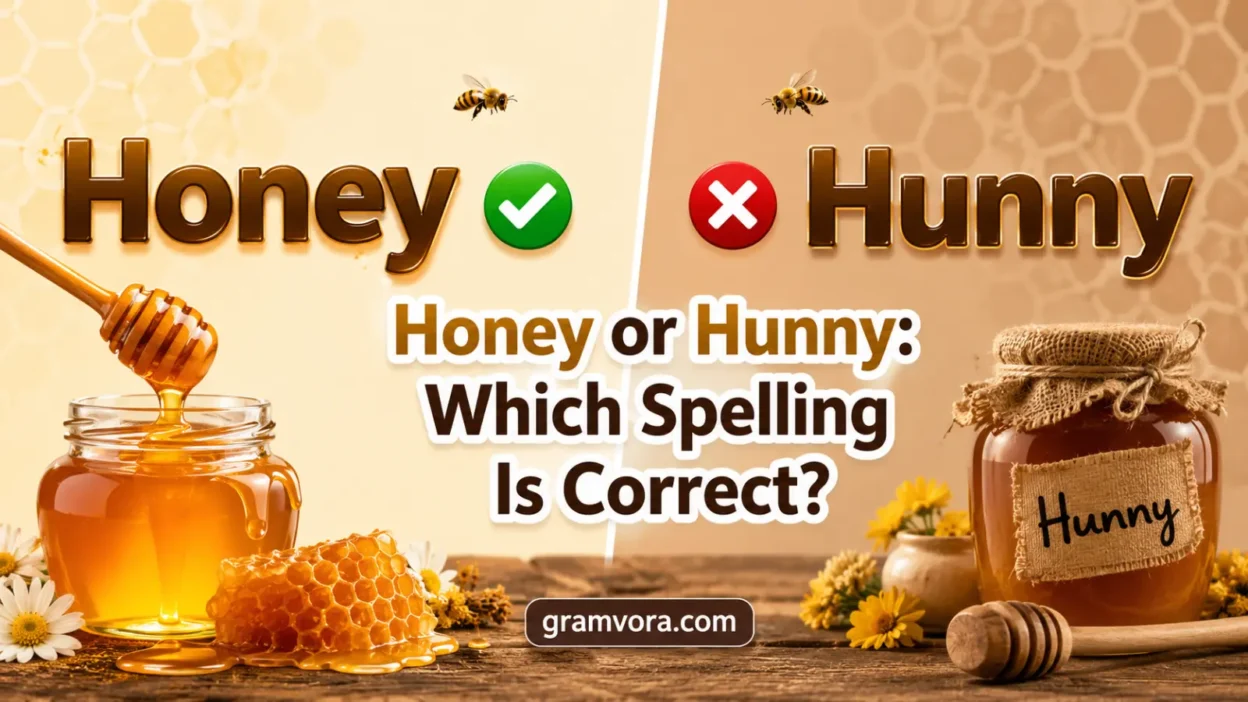
Honey is the standard English spelling. It can name the sweet substance made by bees or serve as an affectionate name for someone.
Hunny is a playful, informal spelling used mainly when addressing a loved one. It is recognized in that limited context, but it is not an equal replacement for honey in every sentence.
The safest choice in American English is therefore honey.
Quick Answer
Use honey in recipes, food writing, schoolwork, business communication, and ordinary edited English. It is also correct when speaking affectionately to someone.
Use hunny only when you deliberately want a cute, personal, or highly informal spelling in a text, card, nickname, social caption, or creative work.
You can write, “Good night, honey,” in any normal personal context. “Good night, hunny” is possible, but it signals playful styling rather than standard spelling.
Why People Confuse Them
The main source of confusion is pronunciation. Both forms are normally read as HUH-nee.
Because the first syllable sounds like hun, some writers assume that the word should contain a u. English spelling does not always match sound directly, however. The established spelling is honey.
Informal messages also encourage creative spelling. People regularly alter words to make them look warmer, cuter, or more personal. In that setting, hunny may feel natural even though honey remains the standard form.
Key Differences At A Glance
| Context | Best Choice | Why |
|---|---|---|
| Bee-made food | Honey | This is the only standard spelling for the substance |
| Recipe or product label | Honey | Food-related writing requires the established form |
| Affectionate address | Honey | Standard, natural, and widely accepted |
| Playful private message | Honey or hunny | Hunny is possible as an intentional informal spelling |
| School or professional writing | Honey | Hunny may look careless or overly personal |
| Character name or chosen nickname | Use the official spelling | Proper names may intentionally use Hunny |
Are They the Same Word?
They overlap only in the affectionate sense.
- Honey: The standard word for the bee-made substance, a loved person, an affectionate form of address, and several related uses.
- Hunny: An informal respelling of honey when it refers to or addresses someone affectionately.
- Shared feature: Both are normally pronounced HUH-nee when used as a pet name.
This means they are not fully interchangeable. Hunny can represent affectionate honey, but it does not normally represent the food.
“Please add honey to my tea” is standard. “Please add hunny to my tea” looks like a spelling mistake unless the unusual spelling is part of a joke, quotation, brand, or fictional design.
US vs UK Preference
There is no established American-versus-British division here.
Honey is standard in both US and UK English. Both varieties use it for the sweet substance, and both can use it as a term of affection.
Hunny is informal wherever it appears. It is not the normal American spelling while honey is British, nor is it the other way around.
A British dictionary may record hunny as an alternative affectionate spelling, but that does not make it a specifically British form. Its defining feature is informality, not region.
Which Spelling Should You Use?
Choose honey when correctness, clarity, or a neutral appearance matters.
That includes recipes, ingredient lists, school assignments, articles, business documents, informational pages, and messages to people who may not recognize the playful spelling.
You can also use honey in romantic or family communication:
“Drive safely, honey.”
“Thanks for helping me, honey.”
Choose hunny only when the spelling is intentional. It may fit a private message, decorative card, social caption, character voice, pet name, or registered personal name.
Even in those settings, honey remains correct. You never need to change it to hunny when referring to someone you love.
When One Spelling Looks Wrong
Hunny looks wrong when the sentence is about food:
“Add two tablespoons of hunny” should be “Add two tablespoons of honey.”
It can also look unsuitable in formal or neutral communication. A restaurant menu, science report, nutrition article, or school paper should use honey.
By contrast, honey does not become incorrect in an affectionate message. Some writers think honey must name the food and hunny must name a person. That distinction is false.
“Honey, are you coming home?” is completely standard.
The unusual form may be correct as a proper name. If a person, pet, business, song, or fictional object is officially named Hunny, preserve that spelling.
Common Mistakes (and Quick Fixes)
Mistake: Using hunny for the food.
Write honey when discussing bees, cooking, flavor, ingredients, or sweeteners.
Mistake: Believing hunny is required for a loved one.
Standard honey already works as a term of affection.
Mistake: Treating the forms as US and UK variants.
Use honey in standard writing in both varieties of English.
Mistake: Correcting every proper name.
Do not change Hunny when it is someone’s chosen name, a brand spelling, or part of a title.
Mistake: Using playful spelling in the wrong setting.
A private text may say hunny. A client email, academic paper, or formal notice normally should not.
Everyday Examples
At breakfast, Mia asked, “Could you pass the honey?”
A local beekeeper sells raw honey at the Saturday market.
“Honey, your phone is ringing,” Jordan called from the kitchen.
My grandmother often ends her messages with, “Take care, honey.”
A playful text might read, “Good morning, hunny. I hope you slept well.”
The caption “Weekend with my hunny” is informal but understandable.
The recipe requires honey, lemon juice, and warm water.
The teacher corrected hunny to honey because the paragraph described a beehive.
Dictionary-Style Word Details
Verb
Honey: It can function as a verb meaning to sweeten something with honey. It can also describe speaking to someone in an overly flattering or coaxing way. This verb is uncommon in ordinary conversation.
Example: The glaze was honeyed before it was brushed onto the vegetables.
Hunny: It is not commonly used as a verb in standard American English. Do not replace verbal honey with hunny.
Noun
Honey: A standard noun for the sweet substance produced by bees. It can also refer to a loved person or be used to address someone affectionately.
Examples include “a jar of honey” and “Are you ready, honey?”
Hunny: An informal noun or form of address representing affectionate honey. It is mainly found in personal, playful, or stylized writing.
It is not the standard noun for the bee-made substance.
Synonyms
For affectionate honey, close alternatives include sweetheart, darling, dear, sweetie, and love.
The same affectionate alternatives can apply to hunny, because hunny represents that particular sense of honey.
For the food meaning, there is no exact everyday synonym. Sweetener is a broader category and does not mean exactly the same thing.
There is no clear antonym that applies naturally to the full range of either spelling.
Example Sentences
I stirred a little honey into the oatmeal.
“You did a wonderful job, honey,” her father said.
The sauce has a mild honey flavor.
“Miss you, hunny,” she wrote in the private message.
Because Hunny is his chosen stage name, the unusual spelling is intentional.
The greeting card read, “Happy anniversary to my hunny.”
Word History
Honey has deep roots in English. Earlier forms appeared in Middle English and Old English. The established spelling eventually became honey, while the word also developed an affectionate sense.
Hunny is best understood as a sound-based or playful respelling of affectionate honey. It reflects the word’s pronunciation rather than a separate regional spelling tradition.
No precise historical date is needed to choose between them today. The practical distinction is clear: honey is standard, while hunny is limited and informal.
Phrases Containing
Honey appears in many established compounds and expressions, including honey bee, honey jar, raw honey, honey-colored, honey glaze, and the land of milk and honey.
It also appears in familiar forms of address such as “Thanks, honey” and “Honey, I’m home.”
Hunny does not commonly appear in established standard compounds. It is more likely to occur in personal phrases such as “my hunny,” “good night, hunny,” or “love you, hunny.”
Those phrases are stylistic choices, not formal fixed expressions.
FAQs
Is Honey or Hunny the Correct Spelling?
Honey is the correct standard spelling. Use it for the sweet substance made by bees and as an affectionate name for someone. Hunny is an informal, playful spelling used mainly in personal messages, nicknames, or creative writing.
Can You Call Someone Hunny?
Yes, you can call someone hunny in a casual or affectionate message. However, the spelling looks playful rather than standard. Honey is also completely correct when addressing a partner, child, friend, or family member.
Does Hunny Mean the Same Thing as Honey?
They share the same meaning only when referring to a loved person. Hunny does not normally refer to the sweet food made by bees. For recipes, ingredients, drinks, or beekeeping, always use honey.
Is Hunny a Real Word?
Some dictionaries record hunny as an informal alternative spelling of affectionate honey. It is not the standard spelling and should usually be avoided in formal, academic, or professional writing.
Is Honey American and Hunny British?
No. Honey is the standard spelling in both American and British English. Hunny is not a regional spelling difference. It is simply an informal or stylized form used in affectionate contexts.
Should I Write Honey or Hunny in a Text Message?
Both may work in a personal text message. Choose honey for the natural, standard spelling. Choose hunny only when you want the message to look especially cute, playful, or personal. When you are unsure, use honey.
Conclusion
Choose honey in almost every situation. It is the standard spelling for the sweet substance made by bees and for an affectionate way of addressing someone.
Hunny is possible only as a deliberate informal spelling for a loved person, nickname, proper name, or creative context. It is not the standard form for food, and it is not a regional alternative used instead of honey in American or British English.
When you are uncertain, write honey.


