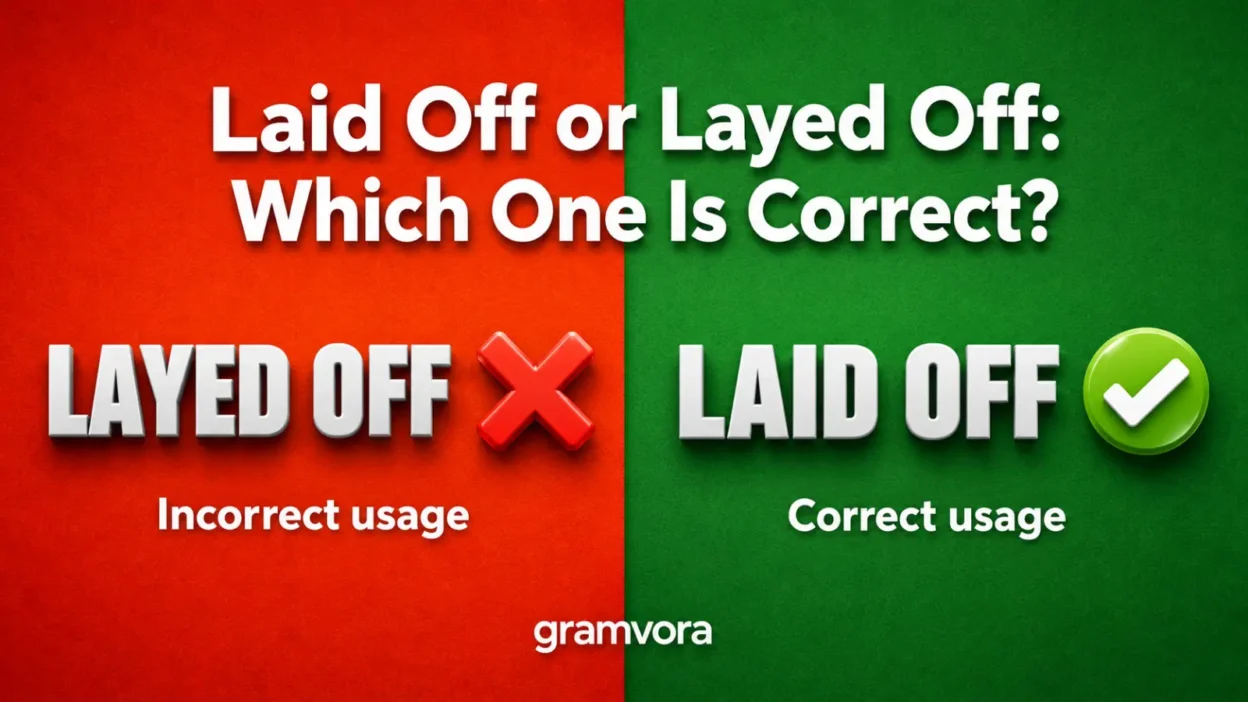
The correct choice is laid off.
Use laid off when you mean that someone lost a job because an employer cut positions, reduced staff, closed a role, or had less work available.
Layed off is not the standard form in modern US English for this meaning. It may look logical because many English verbs add -ed in the past tense, but lay is irregular. The past tense and past participle are laid, not layed.
Quick Answer
Write:
Correct: I was laid off last month.
Incorrect: I was layed off last month.
The phrase comes from lay off, a phrasal verb. In the past tense or passive voice, it becomes laid off.
So the choice is simple in normal writing:
laid off = correct
layed off = avoid
This applies in resumes, emails, texts, LinkedIn posts, job applications, and workplace writing.
Why People Confuse Them
People confuse laid off and layed off because they sound almost the same. In everyday speech, both would be heard as “layd off.”
The spelling mistake also feels natural because many verbs use -ed:
work → worked
call → called
help → helped
But lay does not follow that regular pattern. Its standard past form is laid.
That is why laid off is correct even though layed off may look like it should work.
Key Differences At A Glance
| Feature | laid off | layed off |
|---|---|---|
| Standard in US English | Yes | No |
| Job-loss meaning | Yes | Not standard |
| Best for professional writing | Yes | No |
| Grammar role | Past/passive form of “lay off” | Nonstandard spelling for this phrase |
| Example | She was laid off after the merger. | She was layed off after the merger. |
The main difference is not tone or meaning. It is correctness. Laid off is the accepted form. Layed off is a mistake in this context.
Meaning and Usage Difference
Laid off means an employer ended someone’s job, often because of business needs rather than personal performance.
For example:
Marcus was laid off when the company closed its Dallas office.
That sentence does not automatically mean Marcus did anything wrong. It points to the employer’s decision and the business situation.
Layed off tries to express the same idea, but it is not the standard wording. Readers will usually understand it, but many will see it as an error.
Pronunciation is a small reason for the confusion. Laid off is pronounced like “layd awf.” Since layed would sound the same, the mistake often appears in writing, not speech.
Tone, Context, and Formality
Laid off is neutral and professional. It works in formal and casual contexts.
You can use it in a resume note, job interview, email, news story, or everyday conversation.
Examples:
I was laid off during a company restructuring.
Several employees were laid off after the contract ended.
My brother got laid off, so he is looking for a new role.
Layed off has no useful tone advantage. It does not sound more casual, warmer, or more modern. It only looks incorrect.
In careful writing, especially anything job-related, always use laid off.
Which One Should You Use?
| Context | Best Choice | Why |
|---|---|---|
| Resume or cover letter | laid off | It is the standard professional form. |
| Email to a recruiter | laid off | It sounds clear and correct. |
| Text to a friend | laid off | Casual writing still uses the standard spelling. |
| News or business writing | laid off | It is the accepted public-facing form. |
| Talking about job cuts | laid off | It clearly points to employment loss. |
| Writing about one affected worker | laid off | It fits both active and passive sentences. |
| Describing workers before a noun | laid-off | Use a hyphen before a noun: “laid-off employees.” |
| Any modern US-English context | laid off | “Layed off” should be replaced. |
Use laid off almost every time this question comes up.
When One Choice Sounds Wrong
Layed off sounds wrong once you know the verb pattern:
lay → laid → laid
So these sentences should be fixed:
Wrong: I got layed off on Friday.
Right: I got laid off on Friday.
Wrong: The company layed off 40 workers.
Right: The company laid off 40 workers.
Wrong: She had been layed off before the holidays.
Right: She had been laid off before the holidays.
The mistake becomes more noticeable in professional writing because job loss is already a serious topic. Correct wording helps the sentence feel clear, respectful, and polished.
Common Mistakes (and Quick Fixes)
One common mistake is adding -ed to lay.
Mistake: layed off
Fix: laid off
Another mistake is mixing up laid off and layoff.
Use laid off as a verb phrase:
The company laid off several workers.
Several workers were laid off.
Use layoff as a noun:
The layoff affected several departments.
A third mistake is forgetting the hyphen before a noun.
Write:
laid-off employees
a laid-off worker
But after a verb, keep it open:
The employees were laid off.
Everyday Examples
I was laid off after my team lost a major client.
Nina got laid off, but she found a new job within six weeks.
The company laid off part of its support staff.
Several laid-off employees attended the career workshop.
He said he was laid off, not fired.
After being laid off, Maya updated her resume and contacted former coworkers.
The manager explained that the workers were laid off because the store was closing.
Layed off should not appear in these sentences. Replace it with laid off.
Dictionary-Style Word Details
Verb
laid off: A past-tense or past-participle form of the phrasal verb lay off. It can appear in active voice or passive voice.
Active: The company laid off 25 employees.
Passive: Twenty-five employees were laid off.
layed off: Not standard as the past-tense or past-participle form for this job-loss meaning in modern US English. Use laid off instead.
Noun
laid off: Not commonly used as a noun. It is a verb phrase. Before a noun, it can work as a hyphenated adjective: laid-off workers.
layed off: Not commonly used as a noun in standard US English.
For the noun, use layoff:
The layoff affected the sales team.
Synonyms
laid off: Closest plain alternatives include let go, dismissed because of job cuts, let go because of downsizing, and released from a position.
These are not always exact. Fired can mean job loss, but it often suggests performance or conduct problems, so it is not the same as laid off.
Clear opposites include hired, retained, and kept on.
layed off: No exact synonyms are needed because this is not the standard form. Replace it with laid off.
Example Sentences
laid off: I was laid off when the company reduced its marketing team.
laid off: The factory laid off night-shift workers after demand dropped.
laid off: A few laid-off employees were invited back when business improved.
layed off: This spelling is not standard for the job-loss meaning. Write laid off instead.
Word History
laid off: The form laid is the established past tense and past participle of lay. The job-loss phrase comes from the phrasal verb lay off.
layed off: This form appears when writers regularize lay as if it worked like regular verbs such as play → played. For modern US job-loss usage, that regularized form is not standard.
A safe way to remember it is:
lay off → laid off
Phrases Containing
laid off:
get laid off
be laid off
laid off from work
laid off after restructuring
laid-off employee
laid-off worker
layed off:
No standard phrases should use this form for job loss. Use the matching laid off phrase instead.
FAQs
Is it laid off or layed off?
Laid off is correct. Layed off is not the standard spelling in modern US English.
Correct: I was laid off last month.
Incorrect: I was layed off last month.
Why is “laid off” correct?
Laid is the standard past tense and past participle of lay in this phrase. Since lay off is the base form, the past form becomes laid off.
Present: The company may lay off workers.
Past: The company laid off workers.
Is “layed off” ever acceptable?
No, not in standard modern writing. Readers may understand what you mean, but layed off will look like a spelling or grammar error.
What does “laid off” mean?
Laid off means an employer stopped employing someone, usually because of business reasons such as budget cuts, restructuring, slow sales, or lack of work. It usually does not mean the person did something wrong.
Is being laid off the same as being fired?
Not exactly. Laid off usually points to a company reason. Fired often points to a performance, behavior, or policy reason. In everyday speech, people may use them loosely, but they are not the same in tone.
Can I say “I got laid off”?
Yes. I got laid off is natural in everyday US English.
Example: I got laid off after the company lost a major client.
For a more formal tone, use:
I was laid off during a company restructuring.
Should I use “laid off” on a resume or LinkedIn?
Yes, but keep it professional and brief.
Good example: Position eliminated due to company-wide layoffs.
Another option: Laid off as part of a department restructuring.
Avoid writing layed off, especially in job applications or professional profiles.
Is “laid off” one word or two?
Laid off is two words when used as a verb phrase.
Example: Several employees were laid off.
The noun is usually layoff as one word.
Example: The company announced a layoff.
Some dictionaries also show lay-off with a hyphen, but layoff is common as the noun in US usage.
What is the difference between “lay off” and “laid off”?
Lay off is the base verb form.
Laid off is the past tense or past participle form.
Examples:
The company may lay off 50 workers.
The company laid off 50 workers.
Fifty workers were laid off.
What is a simple way to remember the correct spelling?
Use this pattern:
lay off → laid off → has laid off
Not:
Conclusion
Use laid off, not layed off.
Laid off is the correct standard form when someone loses a job because an employer cuts positions, restructures, closes a role, or no longer has enough work.
Layed off may seem logical, but it is not the accepted form for this meaning. The reason is simple: lay has the past form laid, not layed.