In everyday American conversation and online writing, few words spark as much quiet debate as the surprised exclamation we all use. Is it spelled whoa or woah? You see both versions scrolling through social media feeds, popping up in text messages from friends, and occasionally showing up in articles or books.
For many people in the United States, the choice feels minor until an editor, teacher, or careful reader points it out. This comprehensive guide examines the real differences between whoa and woah specifically for US English users in 2026. We will look at standard preferences, how each spelling functions in different situations, and practical advice to help you choose confidently every time.
Whether you are drafting a professional email, writing a school paper, posting on social media, or simply want to understand why one version feels more natural, this article covers everything you need. By the end, you will know exactly when each spelling fits best and how to avoid common pitfalls that can make your writing look less polished.
Quick Answer
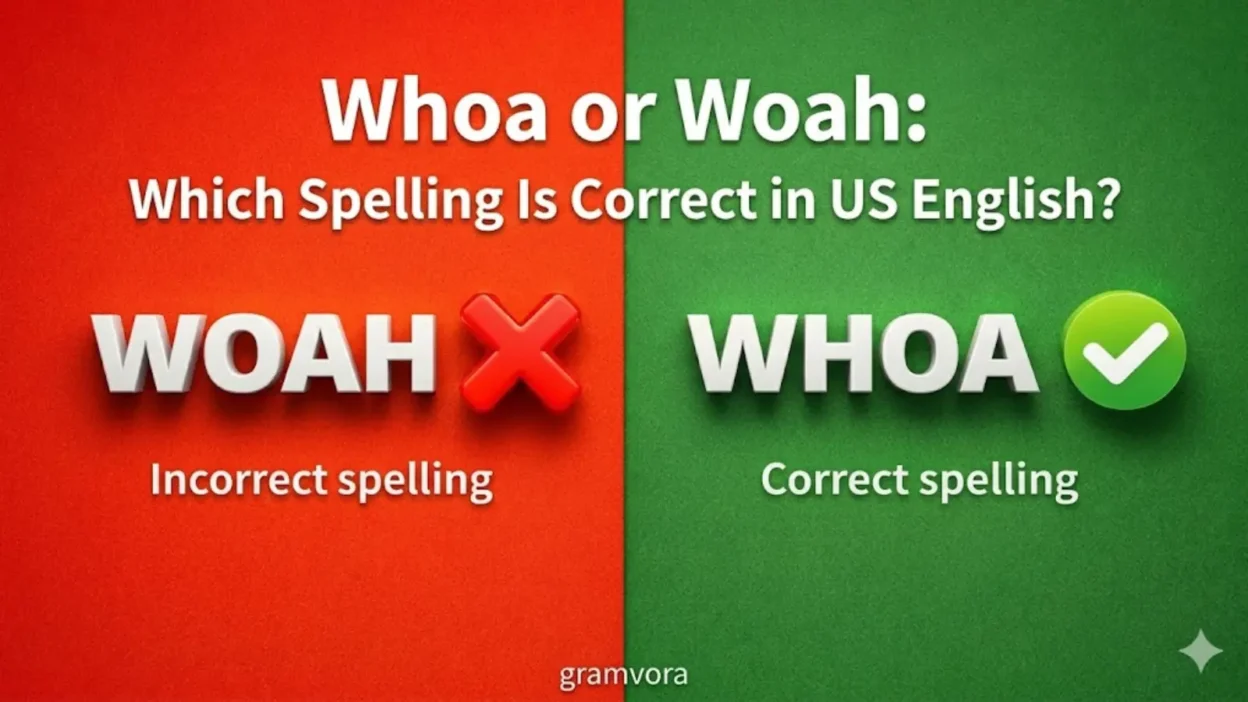
Whoa is the standard and preferred spelling in US English. Major dictionaries and style guides recognize it as the correct primary form. Woah is a newer, informal variant that appears more frequently in casual digital spaces but is generally considered nonstandard or less preferred in American writing.
Both spellings are pronounced the same and express similar ideas, but whoa remains the safer, more widely accepted choice across most contexts in the United States. Use whoa unless you are deliberately going for a very relaxed, phonetic style in personal texting or memes.
Why People Confuse Them
The confusion between whoa and woah comes down to how the word sounds versus how it has traditionally been written. When spoken, the word comes out as roughly “woe” with a long “o” sound. Many people naturally spell it phonetically as woah because that matches the pronunciation more closely in their minds.
Social media and texting have accelerated this mix-up. Quick typing on phones often leads to phonetic spellings, and seeing woah repeatedly in comments and posts makes it feel normal. Younger writers especially encounter woah more often through memes, TikTok captions, and casual online conversations.
Regional influences also play a role. While US English strongly favors whoa, some exposure to British or Australian English online introduces woah more frequently. Without checking a dictionary, people assume both are equally fine or that they might carry slightly different shades of meaning.
Another factor is the emotional nature of the word itself. As an interjection, it bursts out during moments of surprise or when needing to stop something quickly. In the heat of the moment, precise spelling takes a backseat, leading to repeated use of whichever version first comes to mind.
Key Differences At A Glance
| Context | Best Choice | Why |
|---|---|---|
| Professional emails, reports, school essays | Whoa | Accepted as standard by US dictionaries and editors |
| News articles and published books | Whoa | Traditional spelling preferred in edited US content |
| Social media posts and memes | Whoa (preferred) or Woah | Woah appears in informal digital spaces but can look less polished |
| Text messages to friends | Either, but Whoa safer | Depends on your personal style and audience |
| Commands to stop (horses, people, situations) | Whoa | Classic usage with stronger traditional roots |
| Expressing amazement or shock | Whoa | Consistent across formal and informal writing |
Feature Comparison
- Spelling & Acceptance: Whoa is established and standard. Woah is a variant still gaining traction.
- Formality Level: Whoa works across all levels. Woah stays mostly casual.
- Audience Perception: Whoa appears more professional. Woah can signal younger or very informal tone.
- Pronunciation: Identical for both (/woʊ/).
- Versatility: Both can express stop/slow down or surprise, but whoa has broader acceptance.
Meaning and Usage Difference
Both whoa and woah serve primarily as interjections—short words that express sudden feelings or commands without fitting into standard sentence grammar. They do not change form based on tense, number, or subject like verbs or nouns typically do.
The core meanings remain consistent:
- A command to slow down, stop, or pause (originally used with horses).
- An expression of surprise, shock, amazement, or disbelief.
Whoa has a longer track record as the dominant spelling in American English for both uses. Writers and speakers rely on it comfortably in everything from casual talk to dialogue in novels. Woah carries exactly the same meanings but often feels more like a modern, phonetic reinterpretation that has grown popular through informal channels.
Pronunciation note: Both versions sound identical—rhyming with “woe,” “no,” or “so.” The “h” remains silent, which sometimes confuses new learners who might over-pronounce it. This shared sound explains why the spelling debate continues despite clear dictionary preferences.
In terms of grammar, neither word functions commonly as a verb or noun in standard usage, though creative or slang contexts occasionally stretch them (for example, “That plot twist was a total whoa moment”). These extensions remain informal and rare.
Tone, Context, and Formality
Whoa carries a neutral, classic American tone that fits comfortably in most situations. You can use it in journalism, fiction dialogue, business communication (sparingly), and everyday speech without raising eyebrows. It feels timeless rather than trendy.
Woah, by contrast, leans strongly toward casual, digital-native territory. It appears often in tweets, Instagram captions, Reddit threads, and text chains among friends. Some readers interpret woah as a deliberate stylistic choice signaling informality or youth culture, while others simply see it as a common misspelling.
In highly formal contexts—legal documents, academic papers, corporate reports—neither interjection appears frequently, but if one must be used in quoted dialogue, whoa is the expected choice. Using woah there could distract careful readers or suggest less attention to detail.
Context also influences repetition. People often say “whoa, whoa, whoa” to emphasize stopping or processing big news. This repetition works identically with either spelling but looks cleaner with the standard form.
Which One Should You Use?
For most people writing in the United States, default to whoa. It is the version that major references support, editors expect, and careful readers prefer. This choice eliminates unnecessary questions about correctness and keeps your writing looking polished.
Reserve woah for very specific situations:
- Highly casual texting with friends who also use it.
- Matching the style of a particular online community or meme format.
- Creative writing where you want to show a character’s informal or younger voice.
When writing for mixed audiences, schoolwork, or anything that might be graded or professionally reviewed, whoa is always the safer bet. Consistency matters too—pick one spelling and stick with it throughout a piece rather than switching back and forth.
Many experienced writers recommend this simple test: If you would feel comfortable using the word in a cover letter or important email, choose whoa. If it is a quick reaction in a group chat, the variant might slide by unnoticed.
When One Choice Sounds Wrong
Woah in formal or edited US writing often stands out as nonstandard and can subtly undermine the writer’s credibility. Readers familiar with traditional spelling may pause or judge the text as less professional.
Conversely, whoa rarely sounds wrong anywhere. Even in the most casual settings, it feels appropriate and clear. The only time it might feel slightly off is if you are intentionally trying to match a very trendy, phonetic-heavy online aesthetic where woah dominates the visual flow.
In spoken English, the spelling does not matter at all—both versions sound identical. The “wrong” feeling only appears in written form when the spelling clashes with audience expectations or context level.
Common Mistakes (and Quick Fixes)
Here are frequent errors people make with these words and straightforward ways to correct them:
- Treating woah as equally standard in all contexts → Fix: Default to whoa for anything important.
- Believing the spellings have different meanings (some think woah is only for surprise while whoa is only for stopping) → Fix: Recognize they share all the same uses.
- Forgetting punctuation → Fix: Use an exclamation point for strong reactions: Whoa!
- Confusing whoa with woe (which means deep sorrow or trouble) → Fix: Remember whoa is the reaction word, while woe relates to misfortune.
- Overusing the word in formal writing → Fix: Replace some instances with clearer phrases like “That’s surprising” or “Hold on a moment.”
- Inconsistent spelling within the same document → Fix: Choose whoa and apply it uniformly.
Another subtle mistake involves regional assumptions. Some Americans exposed to international content start favoring woah without realizing US standards still lean toward the traditional form.
Everyday Examples
Let’s look at realistic modern examples across different situations in American life:
Casual Conversation “Whoa, you ran a marathon last weekend? That’s impressive!” A friend might respond: “Whoa, slow down—I need to catch my breath after that story.”
Social Media Post “Whoa, the new coffee shop downtown has the best lattes I’ve ever tasted. Highly recommend!” A comment might read: “Whoa, adding this to my weekend plans right now.”
Professional or School Setting In an email: “Whoa, the project deadline moved up? Let’s regroup on Monday.” In a student paper’s dialogue: “Whoa, I didn’t see that coming in the story,” said Jamal.
Driving or Everyday Commands “Whoa, easy there! That car almost cut us off.” A parent teaching a teen to drive: “Whoa, whoa—watch your speed around this curve.”
Strong Surprise Reactions “Whoa! The lottery numbers just matched three of mine.” “That ending was intense. Whoa, I need a minute to process it.”
Meme or Very Casual Style You might see: “Woah, hold up—did that really just happen?” in a TikTok caption or group chat.
Repeated for Emphasis “Whoa, whoa, whoa—not so fast with the details. Start from the beginning.”
These examples show how naturally whoa flows in American English while woah fits specific relaxed digital moments.
Additional scenarios:
- Sports commentary: “Whoa, what a catch by the outfielder!”
- Tech reaction: “Whoa, this new phone update completely changed the interface.”
- Family dinner: “Whoa, that’s the biggest turkey I’ve ever seen on our table.”
Dictionary-Style Word Details
Verb
- Whoa: Not commonly used as a verb in standard US English. It functions almost exclusively as an interjection.
- Woah: Same limitation—not used as a verb in standard English.
Noun
- Whoa: Occasionally appears informally as a noun in phrases like “a real whoa moment” meaning a surprising or shocking instance. This usage remains slangy and uncommon.
- Woah: Even rarer in noun form, following the same informal pattern but with less overall acceptance.
Synonyms
- Whoa: Closest plain alternatives include “wow,” “stop,” “hold on,” “hey,” or “slow down” depending on context.
- Woah: Shares the same closest alternatives.
Antonyms are not strongly defined since this is an interjection, but contrasting ideas might include calm affirmations like “okay,” “go ahead,” or mild reactions like “meh.”
Example Sentences
- Whoa: “Whoa, that thunderstorm came out of nowhere!”
- Woah: “Woah, check out the size of that truck!” (casual online style)
- “Whoa there, let’s think about this before making any big decisions.”
- “The price increase left me saying whoa out loud in the store.”
- “Whoa, you finished the entire project already? Amazing work.”
More extended examples: In a story: “She pulled the reins tight and shouted, ‘Whoa!’ bringing the horse to a sudden stop.” In reaction to news: “Whoa, I had no idea you were moving across the country next month.”
Word History
Whoa traces back through variations of earlier interjections like “ho” used to gain attention or signal stopping. It became established in American English as the command for horses in the 19th century and later expanded to general expressions of surprise. Woah emerged as a phonetic alternative in more recent decades and has gained visibility through informal writing, though it has not achieved full standard status in major US references.
Phrases Containing
- Whoa: “Whoa, nelly!” (classic way to tell someone to slow down), “like whoa” (slang for extremely or intensely), “whoa there,” “holy whoa.”
- Woah: The same phrases occasionally appear with this spelling in very casual contexts, but they are far less common.
FAQs
1. Is woah ever correct in American English?
It is not considered standard but appears acceptably in very casual personal communication. Most style guides and dictionaries recommend whoa.
2. Do whoa and woah have different meanings?
No. They express the same ideas of stopping/slowing or showing surprise.
3. How do you pronounce the word?
Both are pronounced /woʊ/, rhyming with “woe” or “no.” The “h” is silent.
4. Can I use whoa in academic writing?
Sparingly in dialogue or quotes. It is an interjection best suited for informal or creative contexts rather than formal analysis.
5. Why has woah become more popular recently?
Increased online and text-based communication favors quick phonetic spellings, plus exposure to international English variants.
6. What is the difference between whoa and wow?
Whoa often implies a need to pause or stronger astonishment, while wow focuses more purely on admiration or pleasant surprise.
7. How can I remember the correct spelling?
Think “who” (the question word) + “a” = whoa. This mnemonic works well for many people.
Conclusion
Choosing between whoa and woah ultimately comes down to audience, context, and your goals as a writer or speaker in American English. Whoa stands as the reliable, standard choice that works effectively across nearly all situations in the United States. It provides clarity, professionalism when needed, and broad recognition.
Woah serves a purpose in very informal digital environments where phonetic spelling feels natural and expected. However, for most purposes—especially anything that matters professionally or academically—whoa remains the stronger option.
Understanding this distinction helps eliminate hesitation when that moment of surprise or need to pause hits. Next time you reach for the word, you can type with confidence knowing your choice fits both the moment and modern US English expectations. Clear communication wins every time, and the right spelling supports that goal effectively.