One small spelling difference can change how polished your writing looks. A common example is the confusion between occurring or occuring.
At first glance, both look almost identical. But only one is accepted in standard English. The other is a frequent spelling mistake that shows up in emails, essays, and everyday writing.
This guide clears up the confusion in a simple way. You’ll see which form is correct, why the mistake happens, and how to avoid it every time you write.
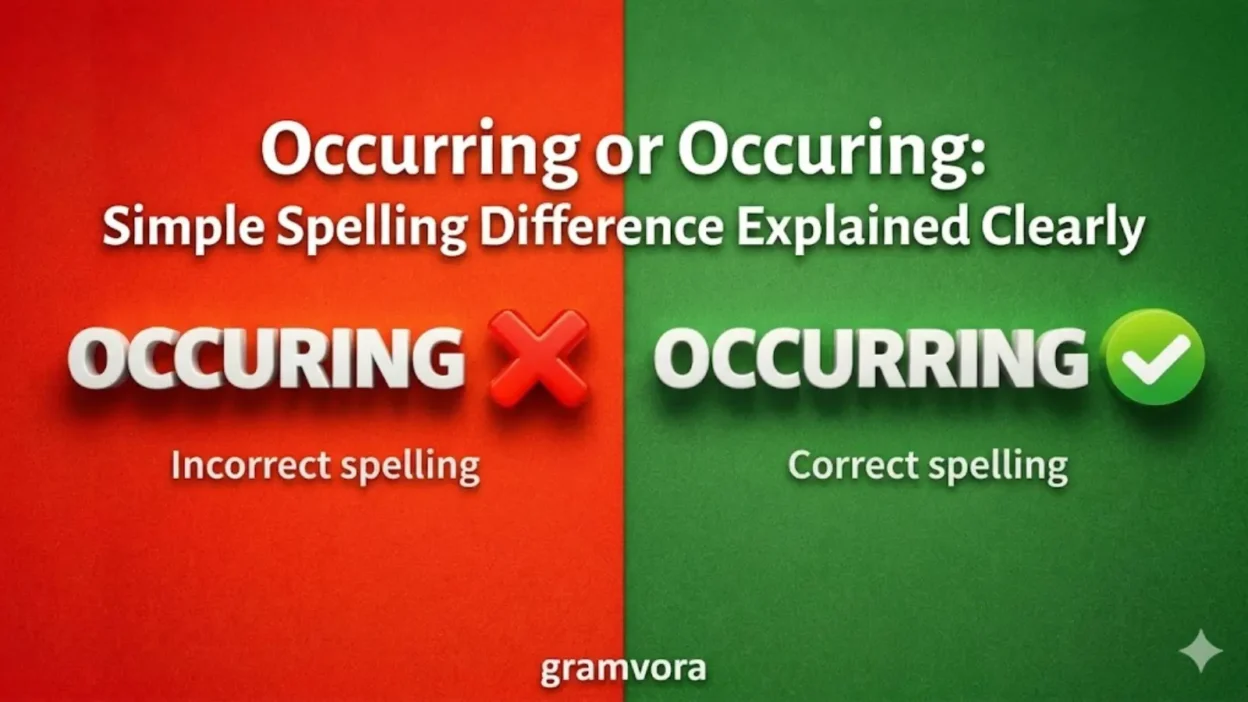
Quick Answer
The correct spelling is: occurring.
The incorrect spelling is: occuring.
Only occurring is used in standard English.
Why People Confuse Them
The confusion is actually very understandable.
English spelling often changes when verbs take different forms. With “occur,” the ending changes when you add -ing. That’s where the mistake happens.
The correct transformation is:
- occur → occurring
The mistake happens when writers forget to double the final “r,” leading to:
- ❌ occuring
Another reason is that spoken English doesn’t clearly show double letters, so people write what they “hear” instead of what is grammatically required.
Key Differences At A Glance
| Feature | occurring | occuring |
|---|---|---|
| Correct spelling | Yes | No |
| Accepted in English | Yes | No |
| Meaning | Something happening | No valid meaning |
| Usage level | Formal + informal writing | Spelling error |
| Grammar role | Verb form (present participle) | Not recognized |
This table shows the simplest truth: only one form belongs in real writing.
Meaning and Usage Difference
There is no meaning difference between the two words because only one is correct.
Occurring
This means something is happening or taking place.
Examples:
- Events are occurring around the world.
- Changes are occurring in the system.
Occuring
This is not a valid English word. It does not appear as a standard form in dictionaries. It has no accepted meaning or usage.
So the real comparison is not meaning—it is correctness.
Tone, Context, and Formality
Occurring
This word fits all writing situations:
- School writing
- Business communication
- Academic essays
- Casual conversation
It is neutral and widely accepted.
Occuring
This form should not be used in any context. It is treated as a spelling error in all forms of writing.
Even in informal texting, it is still considered incorrect.
Which One Should You Use?
Always choose occurring.
Use it when you mean:
- Something is happening now
- Something is taking place over time
- An event or process is active
Examples:
- “A meeting is occurring right now.”
- “New issues are occurring during testing.”
There is no situation where “occuring” is correct.
When One Choice Sounds Wrong
“Occuring” immediately looks off to fluent English readers.
Even if the meaning is clear, the spelling signals a mistake. In academic or professional writing, this can affect how polished your work appears.
“Occurring,” on the other hand, feels natural and correct in every sentence.
Common Mistakes (and Quick Fixes)
Here are the most common errors:
- ❌ occuring
✔ occurring - ❌ “Things are occuring quickly”
✔ “Things are occurring quickly” - ❌ forgetting double letters
✔ remember the base word stays “occur”
Easy memory trick
Think of it like this:
The word already has a double “r” in “occur.”
When adding -ing, nothing is removed.
So it becomes:
oc + curr + ing → occurring
Everyday Examples
Here are natural, modern examples you might see in daily writing:
- “Strange events are occurring in the neighborhood.”
- “Delays are occurring due to weather conditions.”
- “The meeting is occurring online this afternoon.”
- “Small changes are occurring in the update.”
- “No problems are occurring during setup.”
Each one uses the correct spelling naturally.
Comparison Table
| Context | Best Choice | Why |
|---|---|---|
| Academic writing | occurring | Correct standard spelling required |
| Emails | occurring | Professional clarity |
| Text messages | occurring | Still correct, even in casual use |
| Any writing situation | occurring | Only accepted form |
This shows something simple: there is no scenario where “occuring” wins.
Feature Comparison
| Feature | occurring | occuring |
|---|---|---|
| Letter pattern | Double “r” | Missing “r” |
| Recognition | Standard English | Spelling error |
| Clarity | Clear and correct | Confusing or incorrect |
| Acceptance | Universal | Not accepted |
Dictionary-Style Word Details
Verb
- occurring: Present participle of “occur,” meaning something is happening or taking place.
- occuring: Not a valid verb form in standard English.
Noun
- occurring: Rarely used as a noun on its own; usually part of verb phrases like “something occurring.”
- occuring: Not used as a noun.
Synonyms
- occurring: happening, taking place, unfolding, arising, developing
- occuring: no valid synonyms because it is not correct English
Closest plain alternatives for “occurring”:
- happening
- going on
Example Sentences
- “Unexpected events are occurring across the region.”
- “No errors are occurring in the system today.”
- “A major change is occurring in the market.”
- Incorrect: “Unexpected events are occuring across the region.”
Word History
The verb “occur” comes from older Latin roots meaning “to run toward” or “to happen.” Over time, English developed consistent spelling patterns for verb endings.
When forming the -ing version, English often keeps doubled consonants when needed for correct pronunciation and structure. That’s why “occur” becomes “occurring.”
The incorrect form “occuring” likely comes from dropping one “r” by mistake, not from any historical or accepted variation.
Phrases Containing
Here are common expressions using the correct form:
- currently occurring events
- naturally occurring substances
- frequently occurring problems
- rapidly occurring changes
- ongoing occurring processes
All standard usage includes the double “r.”
FAQs:
1. Which is correct: occurring or occuring?
Occurring is correct. “Occuring” is a spelling mistake.
2. Why is “occurring” spelled with two r’s?
Because the base word “occur” already ends in a double “r,” and English keeps it when adding -ing.
3. Is “occuring” ever correct in English?
No. “Occuring” is not accepted in standard English.
4. What does “occurring” mean?
It means something is happening or taking place.
5. Is “occurring” British or American English?
It is correct in both American and British English.
6. Why do people misspell “occurring”?
Because they forget to double the “r” when adding -ing to “occur.”
7. How do you use “occurring” in a sentence?
Example: “Changes are occurring in the system right now.”
8. Is “occurring” a verb or adjective?
It is a verb form (present participle) of “occur.”
9. Can “occurring” be used in formal writing?
Yes. It is fully correct and commonly used in formal writing.
10. What is the base word of “occurring”?
The base word is “occur.”
11. Is “occurring” commonly used in daily English?
Yes. It is used in everyday speech and writing.
12. What is the easiest way to remember the spelling?
Remember: “occur” already has a double “r,” so keep it when adding -ing → occurring.
13. Is there any difference in meaning between occurring and occuring?
No. Only “occurring” has meaning; “occuring” is incorrect.
14. Can I use “occurring” in academic essays?
Yes. It is the correct and expected form in academic writing.
15. What is a simple example sentence with “occurring”?
“The meeting is occurring online this afternoon.”
Conclusion
The difference between occurring or occuring is simple but important.
Only occurring is correct in English. The other form is a spelling mistake caused by missing a double letter. Once you remember that the base word “occur” already contains a double “r,” the correct spelling becomes easy to retain.
Clear writing depends on small details like this—and getting them right makes your communication stronger and more professional.