
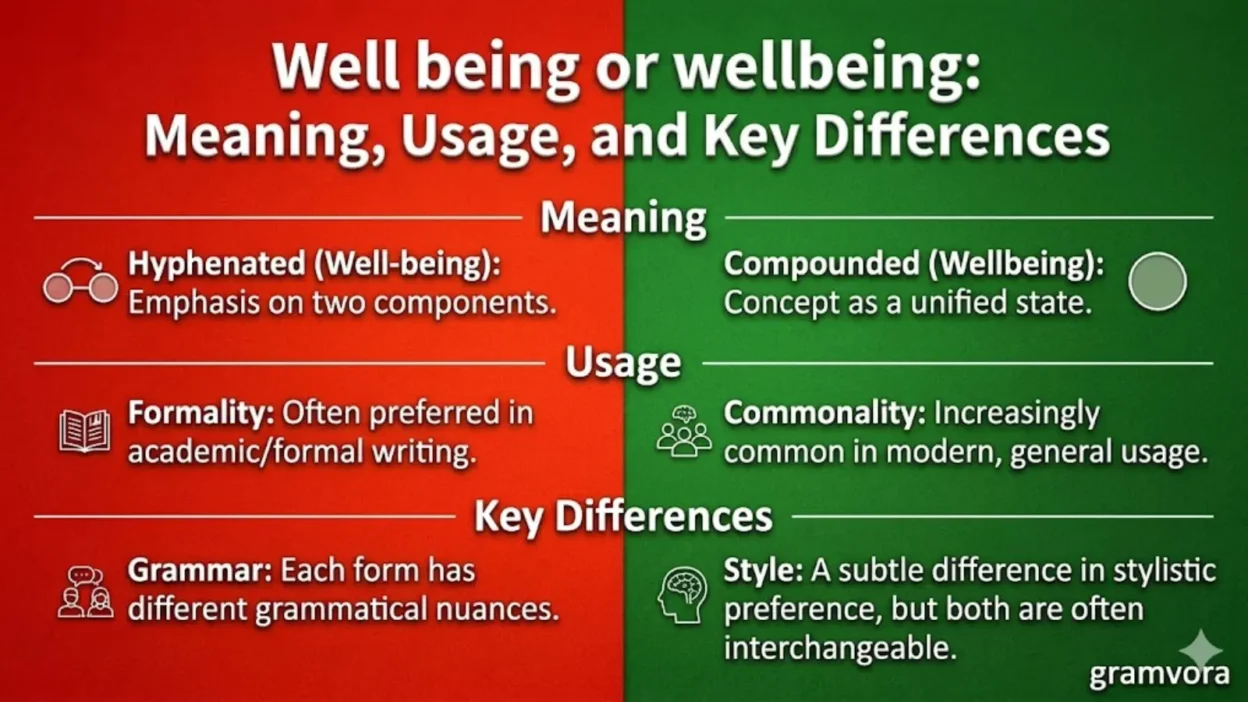
The choice between well being or wellbeing confuses many writers, even experienced ones. At first glance, it looks like a spelling issue. In reality, it is more about writing style, formatting tradition, and modern language change.
Both forms refer to the same idea: how healthy, happy, and balanced someone is in life. But the way they appear in writing is different, and that difference can affect tone, clarity, and how polished your sentence feels.
In everyday US English, you will see both versions. Some writers prefer the traditional hyphen. Others use the modern single-word form. This guide breaks everything down in a simple, practical way so you never feel uncertain again when choosing between them.
Quick Answer
Both well-being and wellbeing mean the same thing.
- well-being = traditional, hyphenated form used in formal writing
- wellbeing = modern, simplified form used in everyday writing
Neither changes meaning. The difference is style, not definition.
If you are unsure, well-being is still the safest choice in formal or academic writing.
Why People Confuse Them
The confusion happens because English spelling rules are not fixed forever. They evolve.
Years ago, many compound words were written with hyphens:
- well-being
- co-operation
- re-enter
Over time, some of these dropped hyphens and became single words in everyday use:
- cooperation
- reenter
- wellbeing (in modern usage contexts)
So now both forms exist side by side. That creates uncertainty for writers who want to sound correct and natural at the same time.
Another reason for confusion is consistency. Different websites, books, and organizations choose different styles. There is no single universal rule that everyone follows in casual writing.
Key Differences At A Glance
| Feature | well-being | wellbeing |
|---|---|---|
| Structure | Hyphenated compound | Single word form |
| Tone | More formal | More modern and casual |
| Usage setting | Academic, professional writing | Blogs, websites, modern communication |
| Visual style | Slightly heavier | Cleaner and faster to read |
Meaning and Usage Difference
The meaning is identical. Both describe a person’s overall state of health, happiness, and life balance.
What changes is how the word is presented in writing.
well-being
This is the more traditional form. The hyphen shows that two words (“well” and “being”) are working together as a single idea. It is often used in:
- academic papers
- official reports
- edited publications
- structured writing environments
It feels careful and precise.
wellbeing
This is the modern simplified form. The hyphen is removed, and the word becomes visually smoother. It is often used in:
- online articles
- blogs
- wellness websites
- casual professional writing
It feels lighter and more contemporary.
Important point
Neither form changes meaning. You are not choosing between two different ideas—you are choosing between two styles of writing the same idea.
Tone, Context, and Formality
Tone plays a bigger role than most people realize.
Formal tone
In formal writing, structure matters. Editors often prefer well-being because:
- it follows traditional grammar conventions
- it looks precise in academic text
- it aligns with older style guides
Neutral or modern tone
In modern writing, readability and speed matter more. That is where wellbeing fits well:
- it looks cleaner on screens
- it reduces visual clutter
- it matches modern branding style
Example:
The app supports employee wellbeing through daily check-ins.
Key takeaway
Formality decides the preference more than grammar rules.
Which One Should You Use?
| Context | Best Choice | Why |
|---|---|---|
| School essays | well-being | safer academic form |
| Research papers | well-being | formal standard |
| News articles | well-being or wellbeing | depends on style guide |
| Blog writing | wellbeing | modern readability |
| Brand content | wellbeing | clean visual presentation |
| Government documents | well-being | structured formal tone |
When One Choice Sounds Wrong
Neither form is wrong on its own. But the wrong context pairing can feel off.
Using “wellbeing” in strict academic writing
It may feel too informal in heavily edited environments.
Example:
- ❌ The well-being of patients was analyzed in detail. (more formal expectation)
- ⚠ The wellbeing of patients was analyzed in detail. (may feel slightly casual in strict academic tone)
Using “well-being” in modern branding
It may feel slightly outdated in minimalist design or app interfaces.
Example:
- ⚠ Track your well-being daily (slightly formal tone)
- ✔ Track your wellbeing daily (clean and modern)
The issue is not correctness. It is tone mismatch.
Common Mistakes (and Quick Fixes)
1. Splitting the words incorrectly
❌ well being is important
✔ well-being / wellbeing is important
2. Mixing both forms in one article
❌ The article uses well-being in one section and wellbeing in another
✔ Fix: choose one style and stay consistent
3. Assuming one is “wrong”
❌ wellbeing is incorrect
✔ Both are correct depending on style
4. Overthinking the choice
Writers often spend too much time debating this. In reality, consistency matters more than the specific form.
Everyday Examples
- Good sleep improves your well-being.
- Many companies now focus on employee wellbeing.
- Mental well-being affects productivity and focus.
- The program promotes student wellbeing through counseling.
- Physical exercise supports emotional well-being.
- The app tracks daily wellbeing habits like mood and sleep.
These examples show that both forms appear naturally in real usage.
Dictionary-Style Word Details
Verb
- well-being: Not used as a verb in standard English
- wellbeing: Not used as a verb in standard English
Neither form functions as an action word.
Noun
- well-being: A state of health, comfort, and happiness (hyphenated noun form)
- wellbeing: Same meaning, modern closed noun form
Both are nouns describing condition or state.
Synonyms
- well-being: health, wellness, life quality (closest plain alternatives)
- wellbeing: health, wellness, life satisfaction (closest plain alternatives)
No perfect synonyms exist that fully replace the full emotional meaning.
Antonyms (context-based only):
- stress
- illness
- distress
Example Sentences
- well-being: “Exercise is important for your well-being over time.”
- wellbeing: “The company invests in worker wellbeing programs.”
- well-being: “Her well-being improved after changing routines.”
- wellbeing: “Digital tools now track mental wellbeing daily.”
Word History
The idea comes from the phrase “being well,” meaning a good state of existence.
- The hyphenated form well-being developed earlier in written English as a standard way to connect compound ideas.
- Over time, simplified writing trends led to wellbeing appearing more frequently, especially in modern digital communication.
Exact historical transition details vary depending on style preferences and publishing standards.
Phrases Containing
- well-being: mental well-being, emotional well-being, physical well-being, overall well-being
- wellbeing: workplace wellbeing, digital wellbeing, personal wellbeing, community wellbeing
Both forms appear in similar phrase structures.
FAQs — well-being or wellbeing
1. Is “well-being” or “wellbeing” correct?
Both are correct. They mean the same thing. The difference is style, not meaning.
2. What is the difference between well-being and wellbeing?
“Well-being” is the traditional hyphenated form. “Wellbeing” is the modern single-word form.
3. Which spelling is more common in the US?
In US writing, both appear, but “well-being” is still more common in formal contexts.
4. Is “wellbeing” acceptable in academic writing?
Yes, but many academic style guides still prefer “well-being” for consistency and formality.
5. Does well-being mean something different from wellbeing?
No. The meaning is identical in both forms.
6. Which one should I use in essays?
Use “well-being” unless your instructor or style guide says otherwise.
7. Is “wellbeing” too informal?
Not necessarily. It is common in modern writing, blogs, and websites.
8. Why does “well-being” have a hyphen?
The hyphen shows the words “well” and “being” work together as one concept.
9. Can I use both in the same document?
It’s not recommended. Pick one form and stay consistent.
10. Is “wellbeing” replacing “well-being”?
Not fully. Both are still used, depending on style and context.
11. Which is better for SEO or web writing?
Both work, but “wellbeing” is often used in modern digital content.
12. Is there a grammar rule for choosing one?
There is no strict grammar rule. It depends on style preference and context.
13. Do dictionaries prefer one form?
Some dictionaries list both. Many show “well-being” as the traditional headword.
14. Can “wellbeing” be written as two words?
No. The correct forms are “well-being” (hyphenated) or “wellbeing” (single word).
15. What is the safest choice if I’m unsure?
Use “well-being.” It is widely accepted in formal, academic, and professional writing.
Conclusion
The difference between well being or wellbeing is not about meaning or correctness. It is about style, tone, and writing context.
If you want a formal, traditional feel, use well-being. If you want a modern, smooth, and clean style, use wellbeing. Both are widely accepted in modern English, especially in the US.
The most important rule is simple: stay consistent in your writing and choose the form that matches your tone.
[…] and often used in formal or literal time references. “Anytime” is more casual and works well when you mean […]