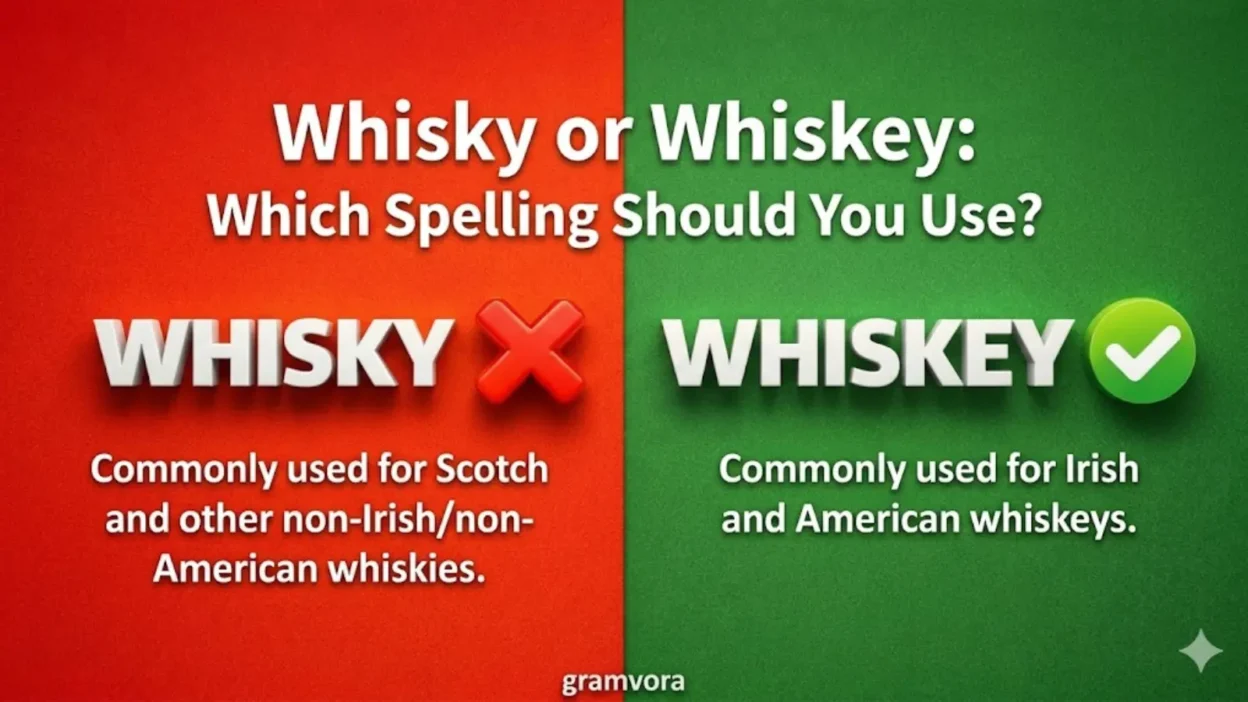
Both whisky and whiskey are correct spellings. The right choice depends mostly on origin, label style, and reader expectation.
For a US audience, whiskey is the normal spelling when you mean American or Irish grain spirits. Use whisky when you mean Scotch, Canadian, Japanese, or many other world styles that normally drop the “e.”
The spelling does not automatically tell you the flavor, quality, or price. It mainly points to naming tradition.
Quick Answer
Use whiskey for most American and Irish contexts.
Use whisky for Scotch, Canadian, Japanese, and many non-US, non-Irish contexts.
When you are writing about a specific bottle, brand, menu item, or product label, copy the spelling used on the label. That is the safest choice because some brands choose a spelling that does not follow the usual country pattern.
Why People Confuse Them
People confuse whisky and whiskey because they name the same general kind of drink: a distilled spirit made from grain.
The only visible difference is one letter. That makes it look like one form must be wrong, but it is not that simple.
The confusion gets stronger in the United States because American readers usually see whiskey, while many famous bottle labels say Scotch whisky, Canadian whisky, or Japanese whisky.
Both spellings are pronounced the same in everyday US English: WIS-kee. The extra “e” changes the spelling, not the usual sound.
Key Differences At A Glance
| Context | Best Choice | Why |
|---|---|---|
| General US writing about American spirits | whiskey | This is the expected US spelling. |
| Irish spirits | whiskey | Irish products usually use the “e.” |
| Scotch | whisky | Scotch is normally written without the “e.” |
| Canadian spirits | whisky | Canadian usage usually drops the “e.” |
| Japanese spirits | whisky | Japanese labels usually follow the no-“e” form. |
| A specific brand or bottle | Match the label | Brand spelling should be preserved. |
| A broad category in a menu | whiskey or whisky, depending on scope | Use the house style, or choose the spelling that fits the bottles listed. |
Compact comparison:
• Whiskey = usual US and Irish spelling.
• Whisky = usual spelling for Scotch, Canadian, Japanese, and many other world styles.
• Both words name the same broad type of grain spirit.
• The spelling alone does not prove taste or quality.
• For brand names, always follow the bottle.
Meaning and Usage Difference
Whiskey and whisky mean nearly the same thing at the core: a strong alcoholic drink distilled from grain.
The real difference is not basic meaning. It is usage tradition.
In American English, whiskey is the default spelling for the general category. A US writer might say, “She ordered a whiskey,” or “The bar has a strong whiskey list.”
But when the type is Scotch, Canadian, or Japanese, whisky is usually expected: “He bought a bottle of Scotch whisky,” “They tasted Canadian whisky,” or “Japanese whisky has become popular with collectors.”
That means the best choice depends on what you are naming. If you are talking about American bourbon, rye, Tennessee whiskey, or Irish whiskey, use whiskey unless the brand label says otherwise.
If you are talking about Scotch, Canadian whisky, or Japanese whisky, use whisky.
Tone, Context, and Formality
Neither spelling is more formal by itself. The tone comes from how accurately you match the context.
In a casual text, “I brought whiskey” sounds natural in the United States. In a restaurant menu, “Scotch whiskey” may look careless because Scotch is normally written Scotch whisky.
In polished writing, the spelling should fit the product. A drinks writer, bartender, editor, or brand page should be careful with the difference because readers who know the category may notice it.
For broad US writing, whiskey feels natural and familiar. For global drinks writing, whisky often appears because many major producing regions use that spelling.
Pronunciation is simple: both are commonly said WIS-kee. Do not pronounce the “e” in whiskey as a separate sound.
Which One Should You Use?
Use whiskey when your sentence is about:
American whiskey
Irish whiskey
bourbon whiskey
rye whiskey
Tennessee whiskey
a general US bar order
a US-centered drink list
Use whisky when your sentence is about:
Scotch whisky
Canadian whisky
Japanese whisky
many world whisky styles
a label that spells the word without the “e”
The most practical rule is this: write the word the way the producer, region, or label writes it.
If you are not naming a specific origin and you are writing for Americans, whiskey is usually the safer general choice.
When One Choice Sounds Wrong
Scotch whiskey can sound wrong to informed readers because the expected form is Scotch whisky.
Irish whisky can also sound off in modern general writing because Irish products usually use Irish whiskey.
Japanese whiskey may appear in casual writing, but Japanese whisky is the better expected form in careful writing.
American whisky is more complicated. Most American products use whiskey, but some labels and official type names may use whisky. That is why the bottle matters.
So the wrong choice is not always a grammar error. Often, it is a context error.
Common Mistakes (and Quick Fixes)
Mistake: “Scotch whiskey”
Fix: Write Scotch whisky.
Mistake: “Irish whisky”
Fix: Write Irish whiskey in normal modern use.
Mistake: “All American bottles must say whiskey.”
Fix: Most do, but some labels use whisky.
Mistake: “Whisky is better than whiskey.”
Fix: The spelling does not prove quality.
Mistake: “Whiskey and whisky are different drinks.”
Fix: They are different spellings for the same broad kind of grain spirit, with regional and label-based patterns.
Mistake: “The plural is always whiskeys.”
Fix: Whiskey commonly becomes whiskeys. Whisky commonly becomes whiskies.
Everyday Examples
I ordered a whiskey at the hotel bar.
She prefers Irish whiskey in her coffee cocktail.
The recipe calls for bourbon whiskey.
He brought a bottle of Scotch whisky to the tasting.
That shop has a strong selection of Japanese whisky.
Canadian whisky is often used in simple mixed drinks.
The label says whisky, so the menu should use whisky too.
Our bar list separates American whiskey from Scotch whisky.
The gift box includes two whiskies from Scotland.
The distillery released three new American whiskeys this year.
Dictionary-Style Word Details
Verb
• whisky: Not commonly used as a verb in standard US English.
• whiskey: Not commonly used as a verb in standard US English.
Both words are mainly nouns. You may see them used before another noun, as in whiskey barrel or whisky tasting, but that is not a true verb use.
Noun
• whisky: A noun for a grain-based distilled spirit, especially in spellings tied to Scotch, Canadian, Japanese, and many other non-US, non-Irish contexts. It can be countable or uncountable.
Example: “The store carries several rare Scotch whiskies.”
• whiskey: A noun for the same broad kind of grain-based distilled spirit, especially in US and Irish contexts. It can also mean one serving of the drink.
Example: “He ordered a whiskey with ice.”
In everyday US writing, whiskey is the general form. In specific product writing, match the region or label.
Synonyms
• whisky: Exact synonyms are limited because the spelling carries product and regional meaning. Closest plain alternatives: grain spirit, distilled spirit, brown spirit, liquor.
• whiskey: Exact synonyms are also limited. Closest plain alternatives: grain spirit, distilled spirit, brown spirit, liquor.
Clear antonyms do not really fit because these words name a specific drink category. Nonalcoholic drink is a contrast, not a true direct antonym.
Example Sentences
• whisky: “The tasting started with a smoky Scotch whisky.”
• whisky: “Japanese whisky is often written without the ‘e.’”
• whisky: “The menu lists Canadian whisky by the glass.”
• whiskey: “Kentucky bourbon is a type of American whiskey.”
• whiskey: “Irish whiskey is a common choice for an Irish coffee.”
• whiskey: “She bought a bottle of rye whiskey for the party.”
Word History
• whisky: The word is tied to older Irish and Scottish Gaelic phrases often explained as meaning “water of life.” The no-“e” spelling became strongly linked with Scotland and later with other whisky-producing countries.
• whiskey: This spelling is linked with Irish and American usage. The “e” became a familiar marker in Irish whiskey and then in much American usage.
The history is not a neat grammar rule. It is a mix of language, trade, regional habit, and label tradition.
Phrases Containing
• whisky: Scotch whisky, Canadian whisky, Japanese whisky, single malt whisky, blended whisky, malt whisky, whisky tasting, whisky barrel.
• whiskey: American whiskey, Irish whiskey, bourbon whiskey, rye whiskey, Tennessee whiskey, whiskey sour, whiskey neat, whiskey barrel.
These phrases show the main pattern: whiskey is common in American and Irish contexts, while whisky is common in Scotch, Canadian, Japanese, and many global contexts.
Conclusion
Whisky or whiskey is not a simple right-or-wrong choice. Both spellings are correct.
Use whiskey for most American and Irish writing. Use whisky for Scotch, Canadian, Japanese, and many other world styles. When a bottle, brand, or official product name uses one spelling, copy that spelling exactly.