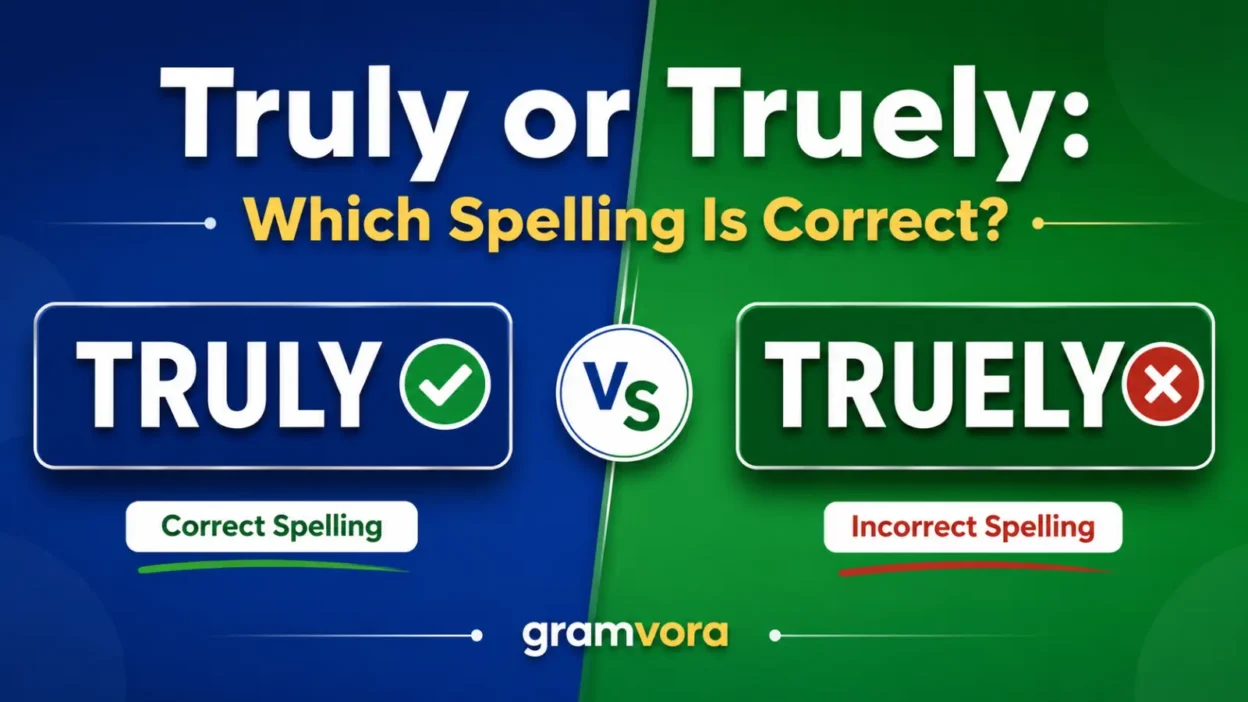
The correct spelling is truly. The spelling truely is a common mistake, not a standard spelling in modern US English.
This confusion makes sense because the base word is true. Many learners expect to keep the e and add -ly. However, this word drops the e, so the correct form is truly.
Quick Answer
Use truly when you mean “really,” “sincerely,” “in a truthful way,” or “genuinely.” Do not use truely in standard writing. Truely is not a US spelling, UK spelling, or formal variant. It is simply a misspelling of truly.
Correct: I am truly sorry.
Incorrect: I am truely sorry.
Why People Confuse Them
People confuse truly and truely because true ends in e. It feels natural to add -ly and write truely.
That pattern works in some words. For example, nice becomes nicely, and safe becomes safely. Still, true does not follow that pattern.
The standard spelling is:
true + ly = truly
So, the e disappears before -ly in this word.
Key Differences At A Glance
| Context | Best Choice | Why |
|---|---|---|
| School writing | truly | This is the standard spelling. |
| Business emails | truly | It looks polished and correct. |
| Formal letters | truly | Use it in phrases like “Yours truly.” |
| Social media captions | truly | Casual writing still needs the correct spelling. |
| Resume or cover letter | truly | “Truely” can look careless. |
| Any standard US English sentence | truly | “Truely” is a misspelling. |
Are They the Same Word?
Truly is the real word. It is an adverb.
Truely is not a separate word with a different meaning. It is an attempted spelling of truly.
Both spellings are meant to represent the same sound, but only truly is correct. The plain pronunciation is TROO-lee.
Use truly when you want to show sincerity, truth, or strong emphasis.
Examples:
I truly believe you can improve.
That was a truly beautiful speech.
She answered truly and calmly.
US vs UK Preference
There is no US vs UK difference here.
American English uses truly. British English also uses truly. The spelling truely is not a normal regional spelling in either variety.
This is different from pairs like color/colour or canceled/cancelled, where regional spelling can matter. With truly or truely, the answer is much simpler: truly is correct.
Which Spelling Should You Use?
Use truly every time.
Choose truly in emails, essays, articles, captions, letters, text messages, resumes, and school assignments. It is the safe spelling in both casual and formal writing.
Use it when you mean:
I am truly sorry.
This is truly helpful.
He truly wants to change.
Yours truly, Maya
Avoid truely unless you are showing a spelling mistake on purpose.
When One Spelling Looks Wrong
Truely looks wrong because it keeps the e from true. That extra e is the problem.
Truly may look strange at first because the base word true has an e, but the correct spelling drops it.
Compact comparison:
• Truly: correct standard spelling
• Truely: incorrect spelling
• Truly: accepted in US and UK English
• Truely: not a regional variant
• Truly: works in formal and casual writing
• Truely: should be corrected before publishing
Common Mistakes (and Quick Fixes)
Mistake: I am truely grateful.
Fix: I am truly grateful.
Mistake: She truely cares about her team.
Fix: She truly cares about her team.
Mistake: Yours truely, Jordan
Fix: Yours truly, Jordan
Mistake: That was truely amazing.
Fix: That was truly amazing.
A simple memory tip: true loses e before ly.
Think of it this way:
true → truly
Do not write:
true → truely
Everyday Examples
I truly appreciate your help.
That was a truly kind thing to say.
She truly wanted to make things right.
This is truly one of the best meals I have had all year.
He was truly honest about what happened.
We are truly excited about the new project.
The view from the cabin was truly peaceful.
I truly did not expect that answer.
Yours truly,
Daniel Brooks
This plan will only work if everyone truly commits to it.
Dictionary-Style Word Details
Verb
• truly: Not used as a verb in standard US English. It is normally an adverb.
• truely: Not used as a verb. It is a misspelling of truly.
Noun
• truly: Not normally used as a noun by itself. In the phrase yours truly, it can refer humorously or informally to the speaker or writer.
• truely: Not used as a noun in standard English.
Synonyms
• truly: Closest plain alternatives include really, sincerely, genuinely, honestly, actually, and indeed. The best choice depends on the sentence.
• truely: No separate synonyms. It is only an incorrect spelling of truly.
Useful antonyms for some uses of truly include falsely, dishonestly, and insincerely. These do not fit every sentence, so use them only when the opposite meaning is clear.
Example Sentences
• truly: I truly respect her patience.
• truly: The movie was truly moving.
• truly: He spoke truly about the problem.
• truly: We are truly sorry for the delay.
• truely: This spelling should be corrected to truly in standard writing.
Word History
• truly: The word comes from true plus the adverb ending -ly. In modern standard spelling, the final e in true is dropped before -ly.
• truely: This spelling appears because writers sometimes keep the e from true, but it is not the accepted modern spelling.
Phrases Containing
• truly: yours truly, truly sorry, truly grateful, truly amazing, truly believe, truly understand
• truely: No standard phrases use this spelling. Write truly instead.
FAQs
Is it truly or truely?
The correct spelling is truly. Truely is a common misspelling and should be avoided in standard English.
Is truely a real word?
No, truely is not a standard English word. It is usually a spelling mistake for truly.
Why is truly spelled without an e?
Truly drops the final e from true before adding -ly. The correct pattern is true + ly = truly.
Is truly correct in American English?
Yes. Truly is the correct spelling in American English.
Is truly correct in British English?
Yes. British English also uses truly. Truely is not a normal UK variant.
What does truly mean?
Truly means really, sincerely, genuinely, or in a truthful way. Example: “I truly appreciate your help.”
How do you use truly in a sentence?
Use truly before a verb, adjective, or phrase to add sincerity or emphasis. Example: “She truly cares about her students.”
Is yours truly spelled with truly or truely?
The correct phrase is yours truly. Do not write yours truely.
Is truly formal or informal?
Truly works in both formal and informal writing. You can use it in emails, essays, letters, captions, and everyday messages.
What is the difference between truly and truely?
Truly is the correct spelling. Truely is an incorrect spelling of the same word.
Can I use truely in casual writing?
You should still avoid truely in casual writing. Even in texts or captions, truly is the correct spelling.
What is an easy way to remember truly?
Remember this simple rule: true drops the e before ly. That gives you truly, not truely.
Conclusion
The correct choice is always truly.
Truely is a common spelling mistake, not a different meaning, grammar form, or regional spelling. Use truly in US English, UK English, formal writing, casual messages, and phrases like yours truly.
The easiest way to remember it is simple: true drops the e before ly.