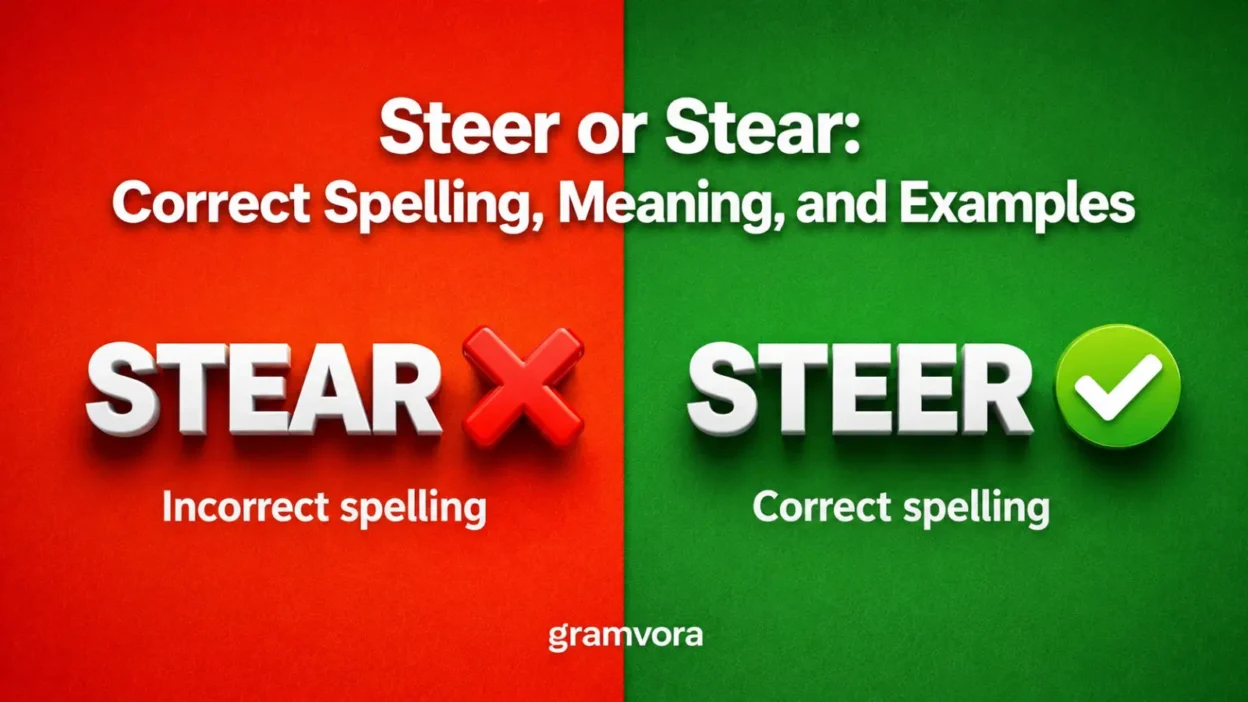
The correct spelling is steer. Use steer when you mean to guide a car, boat, conversation, plan, or person. Also use steer as a noun for a castrated male bovine.
Stear is not a standard modern spelling of steer in everyday US English. Most of the time, it is simply a spelling mistake. You may see stear- in scientific words related to stearic acid, but that is a different word part, not a spelling choice for steer.
Quick Answer
Use steer, not stear, in modern US English.
Correct: She had to steer the truck through heavy rain.
Incorrect: She had to stear the truck through heavy rain.
Stear is not an accepted modern alternative spelling of steer. It may appear as an obsolete form or as the prefix stear-, but those uses do not make it correct for normal writing.
Why People Confuse Them
People confuse steer and stear because the word sounds simple but does not follow the spelling pattern many learners expect.
The phrase steer clear also adds confusion. Since clear contains ear, some writers accidentally copy that pattern and write stear clear. That looks logical at first, but it is not the correct spelling.
The sound can also mislead writers. Steer is pronounced like “steer,” rhyming with near in standard US pronunciation. If someone only hears the word, they may guess the wrong vowel spelling.
Key Differences At A Glance
| Context | Best Choice | Why |
|---|---|---|
| Driving a car | steer | Standard verb for controlling direction |
| Guiding a conversation | steer | Standard figurative use |
| Giving advice or direction | steer | Standard verb for guiding someone |
| Cattle meaning | steer | Standard noun for a castrated male bovine |
| The phrase “steer clear” | steer | Correct spelling of the idiom |
| Everyday US writing | steer | Accepted modern spelling |
| Writing “stear” for “steer” | steer | “Stear” is usually a spelling error |
| Scientific word part | stear- | Separate combining form, not the word “steer” |
Are They the Same Word?
In current everyday English, steer and stear are not equal spelling choices.
Steer is the standard word. It works as a verb and as a noun. As a verb, it means to control direction or guide something. As a noun, it can mean a castrated male bovine.
Stear is not a normal modern spelling of that word. When people write stear instead of steer, they usually mean steer but have misspelled it.
A useful comparison:
• Steer: standard modern spelling; correct in normal writing.
• Stear: not a standard modern spelling of steer; usually an error. It may appear separately as stear- in scientific terms.
That small hyphen matters. Stear- is a word part, as in terms related to stearic acid. It is not the same as writing stear the car.
US vs UK Preference
There is no major US vs UK spelling split here. In both US and UK English, the standard everyday spelling is steer.
American English: Please steer the cart to the checkout line.
British English: Please steer the trolley to the checkout line.
The spelling stear is not a regular British alternative. It is also not an accepted American variant for modern writing.
So, this is not like color and colour, where region changes the spelling. For steer or stear, the answer is simpler: use steer.
Which Spelling Should You Use?
Use steer in all normal contexts.
Use it when writing about vehicles:
The driver tried to steer around the fallen branch.
Use it when writing about guidance:
The manager helped steer the team through the deadline.
Use it in the idiom steer clear:
I try to steer clear of gossip at work.
Use it as a noun:
The rancher bought a young steer at auction.
Do not use stear unless you are discussing an old spelling, a surname, an acronym, or the scientific combining form stear-. Those are special cases, not everyday spelling choices.
When One Spelling Looks Wrong
Stear looks wrong when it appears in ordinary sentences because readers expect steer.
Wrong: Can you stear the boat closer to the dock?
Right: Can you steer the boat closer to the dock?
Wrong: I want to stear clear of drama.
Right: I want to steer clear of drama.
Wrong: She helped stear the project in a better direction.
Right: She helped steer the project in a better direction.
The spelling stear may not always be meaningless. It can appear as a name, an acronym, or the prefix stear- in scientific terms. But those uses do not make stear correct when the intended word is steer.
Common Mistakes (and Quick Fixes)
Mistake 1: Writing stear clear
Quick fix: Write steer clear.
Mistake 2: Writing stear the car
Quick fix: Write steer the car.
Mistake 3: Thinking stear is the UK spelling
Quick fix: Use steer in both US and UK English.
Mistake 4: Confusing the verb with the scientific prefix
Quick fix: Steer means guide or control. Stear- is a separate word part used in scientific terms.
Mistake 5: Forgetting that steer can be a noun
Quick fix: Steer can mean a castrated male bovine, especially in farming or ranching contexts.
Everyday Examples
She learned how to steer before driving on the highway.
The captain had to steer the boat through rough water.
Try to steer the conversation back to the main issue.
The coach helped steer the team toward a stronger season.
I would steer clear of that shortcut after dark.
The ranch sold three steers at the livestock auction.
His advice helped me steer away from a bad decision.
The new policy may steer customers toward online billing.
Please steer the cart to the side of the aisle.
The committee tried to steer the discussion toward a fair answer.
Dictionary-Style Word Details
Verb
• Steer: A standard verb meaning to guide, direct, or control the course of something. It can describe physical direction, such as steering a car, or figurative direction, such as steering a meeting.
• Stear: Not commonly used as a modern verb in standard US English. If someone writes stear as a verb, they almost always mean steer.
Noun
• Steer: A standard noun that can mean a castrated male bovine. In some contexts, it can also mean guidance or a useful suggestion, though that sense is less common in everyday US writing.
• Stear: Not commonly used as a modern noun for this meaning. As stear-, it appears as a word part in scientific terms, but that is not the noun steer.
Synonyms
• Steer: Closest plain alternatives for the verb include guide, direct, lead, pilot, and control. For the noun meaning, bullock may be close in some contexts, but it is not always identical in US usage.
• Stear: No useful modern synonyms when it is used as a mistaken spelling of steer. Use the synonyms for steer only after correcting the spelling.
Helpful opposites for the verb include misguide and misdirect. There is no simple everyday opposite for the cattle noun steer.
Example Sentences
• Steer: Please steer the car into the right lane.
• Steer: The teacher helped steer the students toward stronger sources.
• Steer: We should steer clear of that broken sidewalk.
• Steer: The rancher checked the weight of each steer.
• Stear: Do not write, “Please stear the car.” Write, “Please steer the car.”
• Stear: Do not write, “Stear clear of that area.” Write, “Steer clear of that area.”
Word History
• Steer: The modern word has old roots in English and is established as the spelling for both the verb and the cattle noun.
• Stear: This spelling may appear as an obsolete form in some records, and stear- appears as a scientific combining form related to stearic acid. However, neither point makes stear an accepted modern spelling of steer in normal writing.
Phrases Containing
• Steer: Common phrases include steer clear, steer someone right, steer someone wrong, steer a course, and steering wheel.
• Stear: No standard modern phrases use stear as the correct spelling of steer. The common mistaken phrase is stear clear, but the correct form is steer clear.
FAQ
Is the full phrase grammatically correct?
Yes. It is grammatically correct. It works best when the meaning is “regardless of the answer.”
Is it redundant?
Sometimes. In “I don’t know whether she called,” the shorter form is enough. Adding or not would usually make the sentence wordier.
When should I use whether alone?
Use whether alone when you are asking about a choice, doubt, or unknown fact. Example: “Please check whether the room is available.”
When should I add or not?
Add it when the result stays the same in both cases. Example: “The rule applies whether or not you signed the form.”
Can I write whether to instead of whether or not to?
Yes. The shorter pattern is usually cleaner: “I’m deciding whether to apply.” Add or not only when you want extra emphasis.
Is rather or not correct?
No. Rather or not is incorrect for this meaning. Use whether, with or without or not depending on the sentence.
Conclusion
For modern US English, the correct choice is steer. Use it when you mean to guide a vehicle, direct a person, shape a discussion, manage a situation, or name a castrated male bovine.
Stear is not a standard spelling variant of steer today. It is usually a mistake, especially in phrases like stear clear. The clean rule is easy to remember: when you mean guide, direct, or control, write steer.