
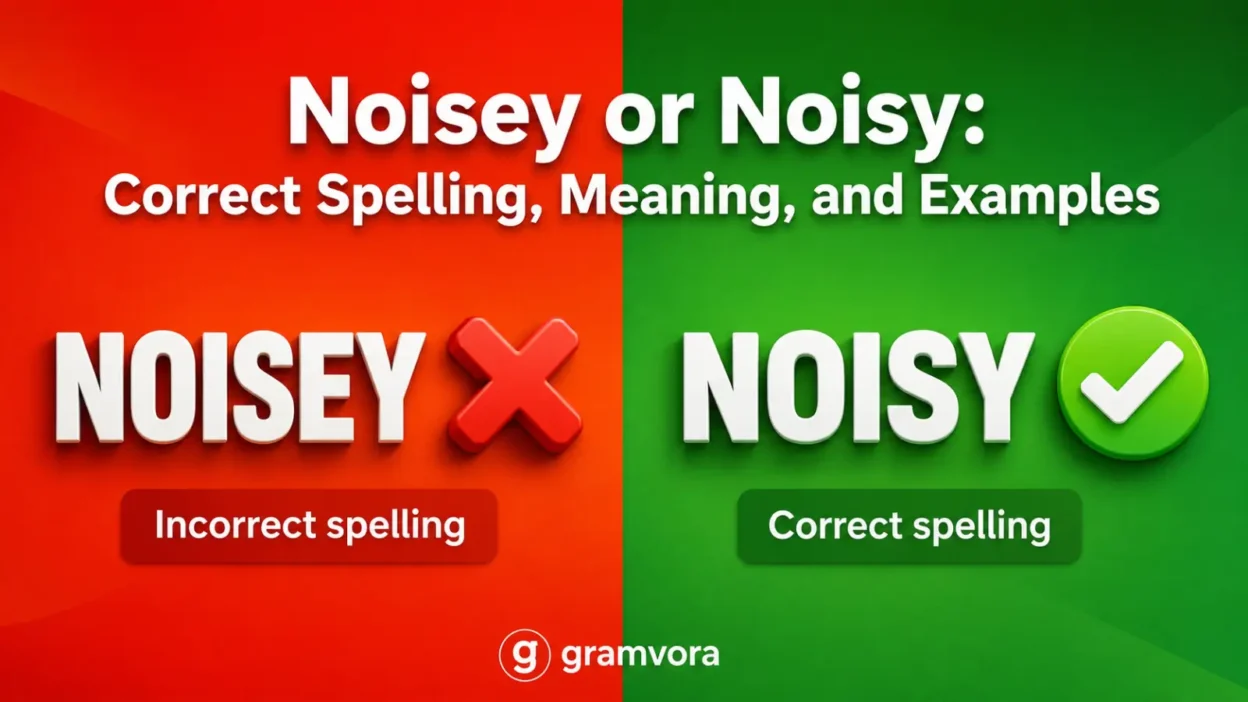
The correct spelling is noisy. The spelling noisey is not standard when you mean “loud,” “full of noise,” or “making a lot of noise.”
This is an easy mistake to make because the base word is noise. Still, when English adds -y to noise, the final e drops. That gives us noisy, not noisey.
Quick Answer
Use noisy in standard US English. Noisey is a misspelling when you mean loud or full of noise. Write a noisy room, a noisy street, noisy neighbors, or a noisy classroom. Do not write a noisey room in regular school, business, or everyday writing.
Why People Confuse Them
People confuse noisey and noisy because noise ends in e. It feels natural to keep that e and add y.
However, English often drops the final e before adding a vowel-starting ending or a y ending. That is why noise + y becomes noisy.
The same pattern appears in other familiar words:
• grease → greasy
• haze → hazy
• shine → shiny
So, the spelling may look surprising at first, but noisy follows a normal spelling pattern.
Key Differences At A Glance
| Context | Best Choice | Why |
|---|---|---|
| Standard US writing | noisy | This is the accepted spelling. |
| School assignments | noisy | Teachers expect the standard form. |
| Business emails | noisy | It looks polished and correct. |
| Describing sound | noisy | It means loud or full of noise. |
| A brand or creative name | Noisey | Only if that is the official name. |
| Regular adjective use | noisy | Noisey is not standard for this meaning. |
Are They the Same Word?
Noisy is the standard adjective. It means making a lot of noise or full of noise.
Noisey is usually an incorrect spelling of noisy. It is not a standard spelling variant in US English. It is also not a British spelling of the word.
There is one important exception: Noisey may appear as a proper name, title, or brand-style spelling. In that case, you should copy the official spelling. But when you are describing a loud place, person, object, or situation, use noisy.
Small comparison:
| Feature | Noisey | Noisy |
|---|---|---|
| Standard adjective | No | Yes |
| Correct in US English | Only as a name/title | Yes |
| Correct in UK English | Only as a name/title | Yes |
| Meaning in normal writing | Misspelling of noisy | Loud or full of noise |
| Example | Noisey may be a brand name. | The room was noisy. |
US vs UK Preference
There is no US vs UK split here. Noisy is the standard spelling in American English and British English.
Use noisy for both audiences:
Correct: The hotel room was too noisy.
Correct: The kids were noisy after recess.
Correct: The fan gets noisy at night.
Do not treat noisey like color/colour or traveled/travelled. It is not a regional spelling choice.
Which Spelling Should You Use?
Use noisy almost every time.
Choose noisy when you describe:
• a loud room
• busy traffic
• rowdy children
• an office full of chatter
• a machine that makes sound
• a crowded restaurant
• a street with constant honking
Examples:
Correct: Our apartment gets noisy after 10 p.m.
Correct: The office was too noisy for a phone call.
Correct: That old refrigerator is noisy at night.
Use Noisey only when it is part of an official name, title, account, publication, or creative spelling that must be copied exactly.
When One Spelling Looks Wrong
Noisey looks wrong in normal writing because it adds an extra e that standard spelling does not keep.
Incorrect: The cafeteria was noisey during lunch.
Correct: The cafeteria was noisy during lunch.
Incorrect: My upstairs neighbors are noisey.
Correct: My upstairs neighbors are noisy.
Incorrect: The engine sounded noisey this morning.
Correct: The engine sounded noisy this morning.
The word may sound like it could end in -ey, but spelling is based on the accepted written form. The correct written form is noisy.
Common Mistakes (and Quick Fixes)
Mistake 1: Keeping the final e from noise
Incorrect: The street was noisey.
Correct: The street was noisy.
Fix: Remember noise + y = noisy.
Mistake 2: Treating noisey as a casual variant
Incorrect: It is noisey, but people understand it.
Correct: It is noisy, and that is the standard spelling.
Fix: Casual writing still looks cleaner with noisy.
Mistake 3: Using noisey in professional writing
Incorrect: The meeting room was noisey.
Correct: The meeting room was noisy.
Fix: In emails, reports, posts, and schoolwork, always use noisy.
Mistake 4: Confusing a name with the adjective
Correct as a name: I read an article from Noisey.
Correct as an adjective: The concert was noisy.
Fix: Capitalized creative names can keep unusual spelling. The regular adjective should be noisy.
Everyday Examples
The restaurant was too noisy for a quiet dinner.
Our neighbors were noisy after midnight.
The classroom gets noisy before the bell rings.
Please close the window; the street is noisy.
That old air conditioner is noisy but still works.
The airport was crowded and noisy.
A noisy workplace can make it hard to focus.
The dog gets noisy when someone knocks.
We left the party because it was too noisy.
The engine sounds noisy when the car first starts.
Dictionary-Style Word Details
Verb
• noisey: Not commonly used as a verb in standard US English.
• noisy: Not commonly used as a verb in standard US English.
Use make noise, get loud, or sound noisy instead.
Example: The crowd started to make noise after the final play.
Noun
• noisey: Not a standard noun for the sound-related meaning.
• noisy: Usually not a noun. It is mainly an adjective.
The noun form is noise.
Example: The noise from the hallway kept us awake.
Another related noun is noisiness, which means the quality of being noisy.
Example: The noisiness of the room made studying difficult.
Synonyms
• noisey: No separate synonyms because it is not the standard spelling for the adjective.
• noisy: Closest plain alternatives include loud, rowdy, boisterous, clamorous, rackety, and full of noise.
Useful opposites include quiet, silent, peaceful, and calm.
Choose the synonym carefully. Loud often focuses on volume. Noisy can mean loud, distracting, messy, or full of many sounds.
Example Sentences
• noisey: Avoid this spelling in regular sentences.
Incorrect: The hallway was noisey after class.
• noisy: Use this spelling in standard English.
Correct: The hallway was noisy after class.
More examples:
Correct: A noisy fan can make it hard to sleep.
Correct: The kids were happy but noisy.
Correct: We moved to a less noisy street.
Correct: The coffee shop was too noisy for a video call.
Word History
• noisey: This spelling likely comes from keeping the final e in noise, but it is not the accepted adjective spelling.
• noisy: This spelling comes from noise plus the adjective ending -y. In the standard spelling, the final e drops before -y.
That is why the correct spelling is noisy, not noisey.
Phrases Containing
• noisey: No standard everyday phrases use noisey as the correct adjective spelling.
• noisy: Common phrases include noisy neighbors, noisy classroom, noisy street, noisy crowd, noisy restaurant, noisy office, noisy fan, and noisy engine.
Examples:
Correct: noisy neighbors
Correct: a noisy classroom
Correct: a noisy street
Correct: a noisy engine
Correct: a noisy restaurant
FAQs
Is it noisey or noisy?
The correct spelling is noisy. Use noisy when something is loud, full of sound, or making a lot of noise. Noisey is a common misspelling.
Is noisey a real word?
Noisey is not the standard spelling of the adjective. In regular writing, use noisy. You may only see Noisey as a proper name, title, or creative brand spelling.
Why is noisy spelled without an e?
Noisy comes from noise plus -y. When the ending is added, the final e in noise drops. That is why the correct spelling is noisy, not noisey.
Is noisy American or British spelling?
Noisy is standard in both American English and British English. This is not like color and colour. Noisey is not a regular UK spelling.
What does noisy mean?
Noisy means loud, full of noise, or making a lot of sound. For example, a noisy classroom, noisy street, or noisy neighbor creates a lot of sound.
How do you use noisy in a sentence?
You can write: The restaurant was too noisy for a quiet dinner. You can also write: My upstairs neighbors were noisy last night.
What is the noun form of noisy?
The main noun form is noise. For example: The noise from the street kept me awake. Another related noun is noisiness, which means the quality of being noisy.
What is the opposite of noisy?
Common opposites of noisy include quiet, silent, peaceful, and calm. The best choice depends on the sentence.
Conclusion
Use noisy, not noisey, when you mean loud, full of sound, or making a lot of noise. The spelling noisey is a common mistake, not a standard US or UK spelling.
The easiest rule is this: noise drops the final e before -y, so the correct adjective is noisy. Write a noisy room, noisy traffic, and noisy neighbors.


[…] not use either spelling when you mean healthy […]