
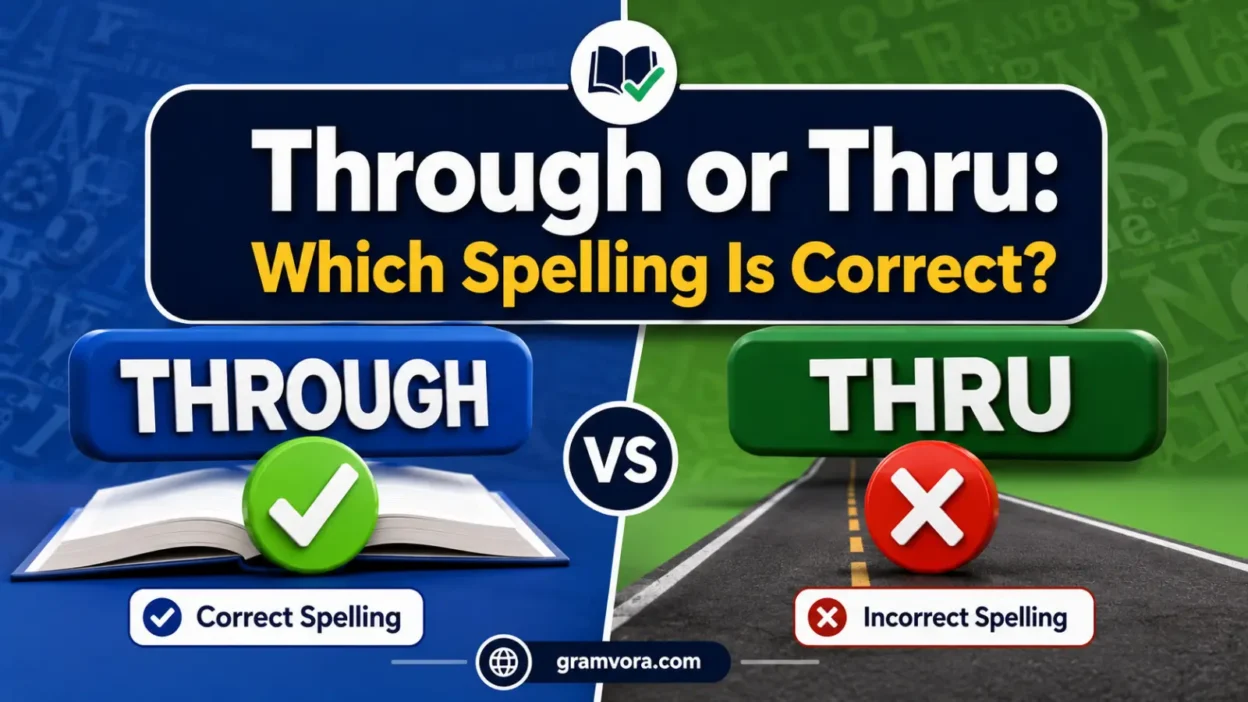
Both spellings appear in the United States, but they do not fit every setting equally. Through is the standard spelling for school, work, publishing, and ordinary sentences. Thru is a recognized informal variant found mainly in signs, advertising, casual messages, and compounds such as drive-thru.
The difference concerns spelling preference and formality, not meaning. Both forms are pronounced the same and can express movement, time, means, or completion.
Quick Answer
Use through in normal and formal writing. It is the safe choice in essays, emails, reports, applications, and articles.
Use thru only when an informal, shortened style is intentional. It is common on road signs, business signs, and in drive-thru. It may also appear in texts, but it can look careless in professional writing.
- Through: standard, widely accepted, and suitable everywhere
- Thru: informal, shortened, and limited to certain contexts
Why People Confuse Them
The spellings look different even though they sound alike: throo. The letters ough in through do not match the simple pronunciation, so thru feels more phonetic.
American signs also make the shorter form highly visible. Drivers see wording such as NO THRU TRAFFIC, while restaurants advertise a drive-thru. That public use can make thru seem suitable everywhere, although its acceptability remains limited.
Key Differences At A Glance
| Context | Best Choice | Why |
|---|---|---|
| School assignment | through | It is the standard spelling |
| Business email | through | It sounds polished and professional |
| Published article | through | Edited prose normally uses the full form |
| Legal document | through | The shortened form may appear too casual |
| Personal text | through or thru | Both are understood, but thru is informal |
| Restaurant service lane | drive-thru | This compound is widely established |
| Road or lane sign | thru | Space-saving sign language commonly uses it |
| Official name or quotation | Match the original | Preserve the wording actually used |
Are They the Same Word?
Yes. Thru is a spelling variant of through, and both forms share the same pronunciation and basic meanings. The shorter spelling does not create a separate definition.
The standard form can work as a preposition, adverb, or adjective:
- We walked through the gate.
- Please read the instructions through.
- The train is a through service.
In informal use, thru may appear in similar positions. Still, it does not look natural in every sentence. Register matters more than grammar here.
US vs UK Preference
This is not a balanced US-versus-UK pair like color and colour. Through is standard in both American and British English.
Thru is especially associated with North American signs, advertising, and informal writing. British readers may recognize it, particularly in drive-thru, but it is not usual in standard British prose.
US writers should not treat thru as the regular American form. American English still prefers through in general and formal writing.
Which Spelling Should You Use?
Choose through whenever you are unsure. It works in formal, neutral, and casual writing without drawing attention to itself.
Use thru when brevity or an established label matters, such as on a road sign, in a branded service lane, or in a deliberately casual message.
Ask whether the sentence belongs in a report, application, class paper, or professional email. If it does, write through.
When One Spelling Looks Wrong
Thru looks out of place in formal writing:
- Weak: Please submit the form thru the online portal.
- Better: Please submit the form through the online portal.
It also looks awkward in established expressions:
- Weak: She supported me thru thick and thin.
- Better: She supported me through thick and thin.
However, changing thru can be wrong when it belongs to an official sign, title, or business name. Preserve NO THRU TRAFFIC when quoting a sign.
Common Mistakes (and Quick Fixes)
A common mistake is using thru simply because it is shorter. Replace it with through unless the context clearly supports the informal form.
Another error is assuming thru is wrong in every case. It is a recognized variant with established uses in signs and compounds. The practical rule is “use thru selectively.”
Do not confuse either spelling with threw, the past tense of throw:
- She threw the receipt away.
- The ball went through the window.
Finally, keep the spelling consistent unless one instance is part of a sign, quotation, or official name.
Everyday Examples
Standard uses of through
- We drove through downtown before rush hour.
- The office is open Monday through Friday.
- I heard about the job through a former coworker.
- Please read the agreement all the way through.
- The support team helped us through the change.
Natural limited uses of thru
- The drive-thru closes at midnight.
- The sign said, “No Thru Traffic.”
- Text me when you’re thru with practice.
- Cars should stay in the thru lane.
The last two examples are informal or specialized. In polished prose, through remains stronger.
Dictionary-Style Word Details
Verb
- Through: Not commonly used as a standalone verb. In go through or follow through, it works with a verb rather than acting as the verb itself.
- Thru: The same limit applies. It may replace through informally, but it does not become a separate standard verb.
Noun
- Through: Not normally a standalone noun. It appears in compound nouns such as drive-through and walk-through.
- Thru: Common in the compound noun drive-thru. Other shortened compounds may appear in branding or specialized writing.
Synonyms
No single synonym fits every meaning. Closest plain alternatives include:
- Movement: across, past, or by way of
- Means: by, via, or because of
- Time: during or until the end of
- Completion: finished or done
These alternatives apply to the shared meanings of both spellings.
Example Sentences
- Through: We entered through the side door.
- Thru: The bank’s drive-thru was open.
- Through: She stayed calm through the interview.
- Thru: The sign directed thru traffic to the left.
- Through: Your payment went through this morning.
- Thru: I’m almost thru with the cleanup.
Word History
English has used many spellings of this word over time. Thru is not a recent invention, but through became the standard form as English spelling grew more consistent.
The shorter form later received support from spelling reformers and remained useful where space mattered. Today, thru is treated as an informal or less common variant rather than an equal replacement in every context.
Phrases Containing
Use the full spelling in most established phrases:
- through and through
- through thick and thin
- go through
- follow through
- see through
- through the roof
- Monday through Friday
The shorter spelling is most natural in limited forms such as:
- drive-thru
- no thru traffic
- thru lane
- thru-hike, when that spelling matches the chosen house style
FAQs
Is thru a correct spelling of through?
Thru is a recognized informal spelling of through. However, through is the standard form for schoolwork, professional emails, reports, articles, and most other writing.
Is thru the American spelling of through?
No. Through is the standard spelling in both American and British English. Thru appears more often in North American signs, advertising, casual messages, and compounds such as drive-thru.
Should I write drive-thru or drive-through?
Both forms are used. Drive-thru is especially common in restaurant names, signs, and everyday American English. Drive-through is also correct and may look more formal in general prose.
Should I use through or thru for dates?
Use through in standard writing: “The office is open Monday through Friday.” The spelling thru may appear on schedules or signs where space is limited, but it is less suitable in formal sentences.
Are through and thru pronounced differently?
No. Both are normally pronounced like throo. The difference is in spelling, formality, and context rather than pronunciation.
Can I use thru in a business email?
It is better to use through in business communication. For example, write “Please send the document through the client portal.” The shortened spelling may make a professional message look too casual.
Conclusion
For through or thru, through is the standard answer. It works at every level of writing and is preferred in both US and UK English.
Thru is a real variant, but it carries an informal, commercial, or space-saving tone. Keep it for signs, familiar compounds, official names, quotations, or casual messages. When the context is professional, choose through.
[…] developed from an older English form and has a long history in the language. The shortened spelling thru has also appeared as a spelling variant, including in discussions of simplified […]