
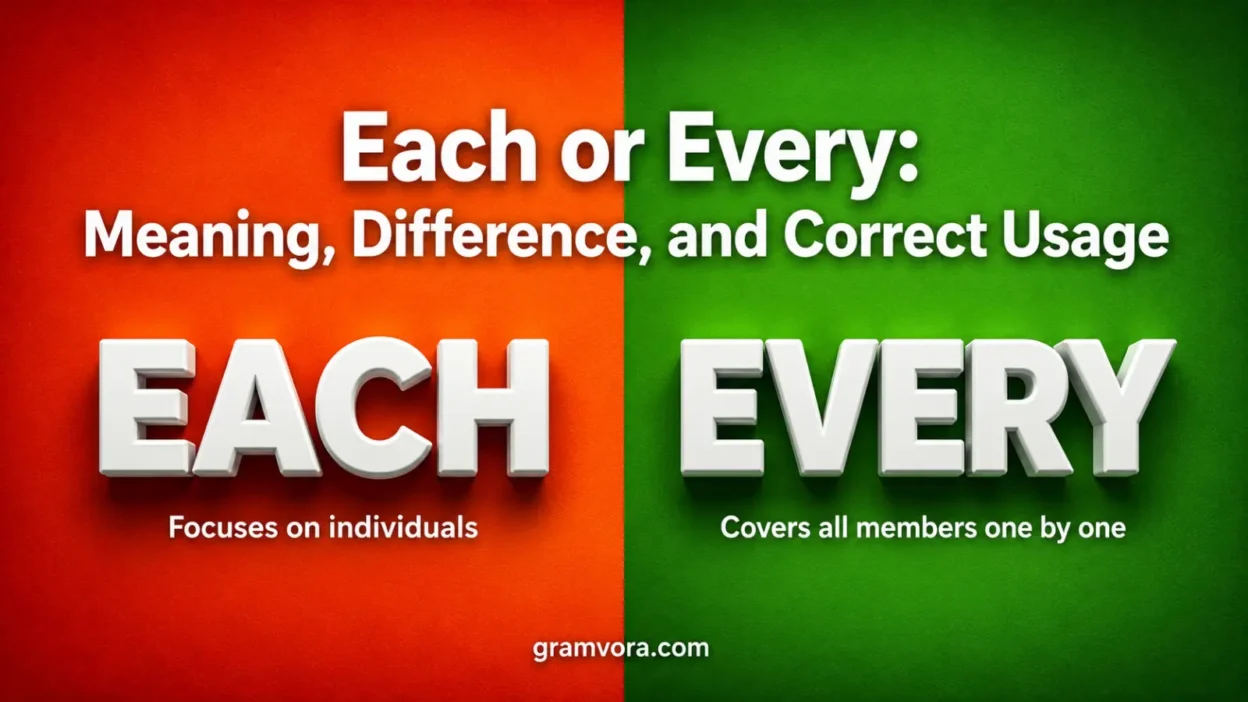
Each and every can both refer to all the members of a group, so the difference may seem small. However, they do not always work in the same way.
Use each when you want to think about members individually, one at a time. Use every when you want to include all members without exception and view them as a complete set or series.
The difference also affects sentence structure. Each is more flexible because it can stand alone and appear in patterns that every cannot.
Quick Answer
Both each and every are correct, but the best choice depends on meaning and grammar.
Each focuses on individual members separately and can refer to a group of two or more:
Each hand held a different card.
Every includes all members without exception and normally refers to a group of three or more:
Every employee received the updated schedule.
With a singular count noun, both normally take a singular verb:
Each student has a locker.
Every student has a locker.
The meaning may overlap, but the emphasis is different.
Why People Confuse Them
People confuse each and every because many sentences can use either word without a major change in the basic message.
Consider these examples:
Each room has a window.
Every room has a window.
Both sentences tell us that no room is missing a window. However, the first sentence encourages us to consider the rooms individually. The second emphasizes that the statement is true across the entire group.
That difference in viewpoint matters more in some contexts than others.
Key Differences At A Glance
| Feature | Each | Every |
|---|---|---|
| Main focus | Members considered individually | All members without exception |
| Group size | Two or more | Normally three or more |
| Before a singular count noun | Yes | Yes |
| Can stand alone | Yes | Normally no |
Can use of + plural group | Yes: each of the students | Not directly; use every one of the students |
| Common for repeated intervals | Less common | Yes: every day, every three weeks |
The simplest distinction is about perspective. Each moves attention from one member to another. Every makes a statement that applies throughout the whole group.
Still, grammar sometimes decides the choice even when the meanings are close.
Meaning and Usage Difference
Each refers to individual members of a group separately.
For example:
Each applicant received a different interview time.
The sentence encourages us to think about the applicants one by one. Their interview times may also differ.
Every means that something is true of all members without exception:
Every applicant must bring identification.
Here, the same requirement applies across the full group.
Grammatically, each is especially flexible. It can appear before a noun:
Each customer received a receipt.
It can stand alone:
Each received a receipt.
It can also follow a plural subject:
The customers each received a receipt.
In that last pattern, the verb remains plural because customers is the grammatical subject:
The customers each have a receipt.
Every normally appears before a noun:
Every customer has a receipt.
It does not normally stand alone in the same way. Instead of Every has a receipt, say:
Every customer has a receipt.
or:
Every one has a receipt.
Another useful difference involves group size. Each works naturally when only two members are involved:
She wore a bracelet on each wrist.
Because a person normally has two wrists, each is the natural choice.
Tone, Context, and Formality
Neither each nor every is inherently more formal. Both are normal in conversation, school writing, workplace communication, and formal prose.
The difference usually comes from emphasis rather than formality.
Choose each when individuality matters:
Each team submitted a different proposal.
Choose every when complete inclusion matters:
Every team must meet the deadline.
The phrase each and every adds strong emphasis:
We checked each and every application.
This wording stresses that nothing was skipped. In ordinary writing, however, either each or every is often enough.
Which One Should You Use?
Use the sentence meaning and structure to make the choice.
| Context | Best Choice | Why |
| Two members are being considered | Each | It works naturally with two or more |
| Members are viewed one by one | Each | It emphasizes individuality |
| All members must be included without exception | Every | It emphasizes complete coverage |
| The word must stand alone | Each | It can function independently |
You need of + plural group | Each | Each of the employees is standard |
| You are describing a repeated interval | Every | Use forms such as every day or every three months |
When either word is grammatically possible, ask what you want the reader to notice.
For separate individuals, choose each.
For complete coverage across the group, choose every.
When One Choice Sounds Wrong
Some structures do not allow a simple swap.
With a two-member group, each is normally the natural choice:
There was a lamp at each end of the couch.
Using every would suggest a larger set of ends rather than the ordinary two-end relationship.
Another major difference appears with of:
Correct: Each of the reports needs a signature.
Incorrect: Every of the reports needs a signature.
To use every, write:
Every one of the reports needs a signature.
Standalone use also differs:
Correct: Each received a badge.
Incorrect: Every received a badge.
Use every participant or every one instead.
Finally, every is the normal choice for recurring intervals:
We meet every three weeks.
Each three weeks is not the usual construction for that meaning.
Common Mistakes (and Quick Fixes)
A common mistake is placing an ordinary plural noun directly after each or every.
Incorrect: Each employees received a form.
Correct: Each employee received a form.
Incorrect: Every employees received a form.
Correct: Every employee received a form.
Both normally take a singular count noun when used directly before that noun.
Verb agreement causes another problem:
Incorrect: Every student have a laptop.
Correct: Every student has a laptop.
Likewise:
Each student has a laptop.
However, compare this structure:
The students each have a laptop.
Here, students is the plural subject, so have is correct.
Another mistake is writing every of:
Incorrect: Every of the candidates was interviewed.
Use either:
Each of the candidates was interviewed.
or:
Every one of the candidates was interviewed.
Do not assume that each and every can always replace one another just because their basic meanings overlap. Check both the intended emphasis and the sentence structure.
Everyday Examples
Here are natural examples showing the difference.
Each:
Each child chose a different flavor.
I checked each box before shipping the order.
The twins each have their own bedroom.
Each of the files has a separate password.
The tickets cost $25 each.
Every:
Every employee completed the training.
We order supplies every Friday.
Every seat in the theater was occupied.
She answered every question on the form.
The system backs up the files every six hours.
In many everyday situations, either word may be possible:
Each guest received a welcome bag.
Every guest received a welcome bag.
The first puts slightly more attention on the guests individually. The second stresses that no guest was left out.
Dictionary-Style Word Details
Verb
Each: Not used as a verb in standard US English.
Every: Not used as a verb in standard US English.
Both words modify or refer to distribution within a group rather than express an action.
Noun
Each: Not normally used as a noun. It can function as a pronoun when it stands in for individual members, as in Each was given a number.
Every: Not normally used as a noun and does not usually function as a standalone pronoun. Use a noun after it, as in every student, or use the separate expression every one when needed.
Synonyms
Each: Exact substitutes depend on the sentence. In an adverbial use, apiece can sometimes match the meaning:
The notebooks cost $4 each.
The notebooks cost $4 apiece.
For its individual-member meaning, a closest plain alternative is every one individually, though this changes the sentence structure.
Every: Closest plain alternatives include all … without exception or, in some contexts, each. However, these are not grammatically interchangeable in every sentence.
Neither word has one simple antonym that works across all of its uses.
Example Sentences
Each:
Each voter received a ballot.
We each brought something for lunch.
Each of the apartments has a balcony.
The notebooks cost five dollars each.
Every:
Every voter must show identification.
We visit our grandparents every summer.
Every desk in the office has been replaced.
The bus arrives every 20 minutes.
Word History
Each is an old English word with roots reaching back to Old English forms that expressed the idea of individual members within a total group.
Every developed from an older expression combining the ideas behind “ever” and “each.” Over time, the form became the modern word every.
Their histories help explain why the meanings still overlap closely today, even though modern English gives them different grammatical patterns and shades of emphasis.
Phrases Containing
Each:
- each one
- each of
- each other
- one each
- each way
- each and every
Examples:
Each of us received a copy.
The two neighbors helped each other.
Every:
- every day
- every time
- every one
- every other
- every now and then
- every so often
- each and every
Examples:
We walk every day.
She calls every so often.
Be careful with every day and everyday. In every day, every refers to each day in a recurring series.
FAQs
1. What is the main difference between each and every?
Each focuses on people or things individually, while every refers to all members of a group without exception. For example, Each student received a different topic emphasizes individuals, while Every student passed the test emphasizes the whole group.
2. Can each and every be used interchangeably?
Sometimes, but not always. In sentences like Each room has a window and Every room has a window, both are possible. However, their emphasis differs, and some grammatical structures allow only one choice.
3. Can each be used for two people or things?
Yes. Each can refer to two or more people or things. For example, She held a bag in each hand is correct because there are two hands.
4. Can every be used for only two things?
Normally, every is used when referring to three or more members. When there are only two, each is usually the natural choice.
5. Is “each of the students” correct?
Yes. Each of + plural noun or pronoun is standard English. For example, Each of the students has a locker. Do not say every of the students. Use every one of the students instead.
6. Should each and every take a singular or plural verb?
When each or every comes directly before a singular noun, use a singular verb: Each student has a book and Every student has a book. However, in The students each have a book, the plural subject students controls the verb.
Conclusion
Use each when you want to focus on members individually. It works with groups of two or more, can stand alone, and fits structures such as each of the students.
Use every when you want to say that something applies to all members without exception. It normally refers to three or more members and is especially common in repeated expressions such as every day and every three weeks.
A useful memory guide is simple: each looks at members one by one; every makes sure the whole group is covered. Then check the sentence structure, because some constructions allow only one of the two.



[…] does not mean every appearance of spicey is impossible. A dictionary may list it as a variant, and a business may use […]
[…] narrative from biblical instruction. The Bible records polygamous relationships, but that does not mean every such relationship is […]
[…] publishing an article. You may see miniscule in everyday writing, but seeing a form often does not mean every editor or dictionary accepts it […]