
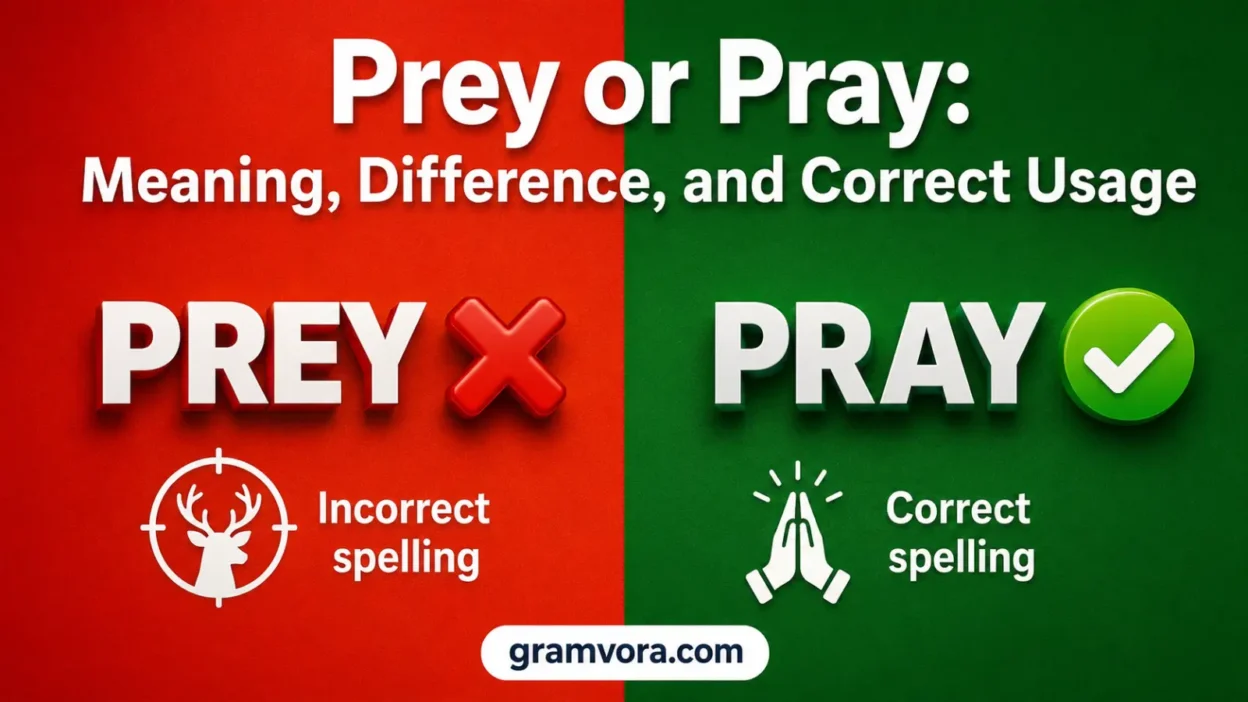
Prey and pray sound exactly alike, but they have very different meanings. That makes them easy to confuse when writing, even though the correct choice usually becomes clear once you look at the sentence.
Use prey for an animal or person being hunted, targeted, harmed, or exploited. Use pray when someone communicates through prayer, asks earnestly, or strongly hopes for something.
Quick Answer
Both prey and pray are correct English words, but they are not interchangeable.
Use prey when talking about something hunted or targeted. It can be a noun or a verb: The eagle spotted its prey or Scammers prey on vulnerable people.
Use pray as a verb for prayer, an earnest request, or strong hope: We pray for her recovery.
Both are pronounced like “pray”: /preɪ/.
Why People Confuse Them
The main problem is sound. Prey and pray are homophones, which means they have the same pronunciation but different spellings and meanings.
Their spelling is also very similar. Only one letter changes: e in prey and a in pray.
Because pronunciation gives no clue, you must choose the word by meaning. Ask whether the sentence is about hunting, targeting, or victimization, or whether it is about prayer, asking, or hoping.
Key Differences At A Glance
| Context | Best Choice | Why |
|---|---|---|
| An animal hunted for food | prey | It names the hunted animal |
| Hunting or exploiting someone | prey | The verb means to target, harm, or take advantage of |
| Speaking to God or a deity | pray | It refers to the act of prayer |
| Asking or hoping earnestly | pray | The verb can express a strong request or hope |
| A target or vulnerable victim | prey | It can function as a noun |
Compact comparison:
- Prey: noun or verb; connected with hunting, targets, victims, exploitation, or harmful effects.
- Pray: mainly a verb; connected with prayer, earnest requests, or strong hopes.
Meaning and Usage Difference
Prey commonly works as a noun. In its literal sense, it means an animal hunted by another animal for food.
The owl watched its prey from a tree branch.
It can also describe a vulnerable person or target.
Unprepared customers can become easy prey for dishonest sellers.
As a verb, prey usually appears with on or upon. It can mean to hunt or to exploit someone.
Fraudsters prey on people who are under pressure.
Pray is mainly a verb. It often means to speak to God or a deity in worship, thanks, confession, or a request.
They prayed for their family before going to sleep.
It can also express strong hope.
We’re praying the weather stays clear for Saturday’s game.
Tone, Context, and Formality
Both words are standard English, but their usual contexts differ sharply.
Prey is neutral in wildlife and biology contexts. When used about people, it often carries a negative meaning because it suggests exploitation, vulnerability, or deliberate harm.
Pray is common in religious contexts. It can also express deep hope or an earnest request.
Some nonreligious uses of pray, such as I pray you reconsider, can sound formal, literary, or old-fashioned in everyday American conversation. Expressions such as pray tell also have a deliberately formal, humorous, or old-fashioned tone.
Which One Should You Use?
Choose the word by asking one simple question: What is happening in the sentence?
Use prey when something is being hunted, targeted, exploited, or harmed.
Coyotes hunt small animals as prey.
The scheme preyed on people’s fears.
Use pray when someone is praying, asking earnestly, or hoping strongly.
We pray for peace.
She prayed that the interview would go well.
A useful memory clue is this: prey belongs with predator, while pray belongs with prayer.
When One Choice Sounds Wrong
Using the wrong spelling can completely change the meaning.
We prey for his recovery sounds as though hunting or victimization is involved. The intended sentence is:
We pray for his recovery.
Likewise, The scammers pray on older adults incorrectly suggests prayer. The correct expression is:
The scammers prey on older adults.
The same distinction applies to fixed expressions. Write bird of prey, easy prey, and fall prey to, but use pray for, pray to, and pray that when the meaning involves prayer or hope.
Common Mistakes (and Quick Fixes)
A common mistake is writing pray on when the intended meaning is to exploit someone.
Incorrect: Fake charities pray on people’s sympathy.
Correct: Fake charities prey on people’s sympathy.
Another error is using pray for a hunted animal.
Incorrect: The rabbit became the fox’s pray.
Correct: The rabbit became the fox’s prey.
Watch the verb forms too:
- pray → prayed → praying
- prey → preyed → preying
Therefore, write She prayed for help but The concern preyed on his mind.
Everyday Examples
Here are natural examples showing the difference:
- The hawk circled above its prey.
- Online scammers often prey on people who feel rushed.
- Small animals may become prey for larger predators.
- She prayed quietly before the surgery.
- We’re praying for good news this week.
- His family prayed that he would arrive safely.
- Fear continued to prey on her mind after the incident.
- Inexperienced buyers can be easy prey for dishonest sellers.
- They gathered to pray together before dinner.
- The owl waits silently before attacking its prey.
Dictionary-Style Word Details
Verb
Prey: Used as a verb to mean hunting or feeding on another creature, exploiting or victimizing someone, or having a harmful effect.
Predators prey on smaller animals.
The fraud targeted people by preying on their fears.
Its forms are preys, preyed, preying.
Pray: Used as a verb to mean communicating through prayer, making an earnest request, or strongly hoping for an outcome.
They pray every morning.
We prayed that everyone would get home safely.
Its forms are prays, prayed, praying.
Noun
Prey: Commonly used as a noun. It can mean an animal hunted for food or, figuratively, a person or group vulnerable to attack, deception, or exploitation.
The mouse became prey for the owl.
Pray: Not commonly used as a noun in standard modern American English. Prayer is the usual noun for the act, words, or practice of praying.
Synonyms
Prey: No single synonym fits every meaning.
For the noun meaning, sense-specific alternatives include quarry for something hunted and victim for someone harmed or exploited.
For the verb meaning, closest plain alternatives include hunt, feed on, exploit, and victimize, depending on context.
Pray: No single alternative covers every meaning. For earnest requests, close alternatives include implore, entreat, plead, and petition. In the strong-hope sense, hope may fit, though it does not carry every meaning of pray.
Example Sentences
Prey:
The falcon followed its prey across the open field.
Dishonest callers prey on people who are worried or confused.
She refused to fall prey to the misleading offer.
Pray:
They pray together every Sunday.
I pray that everything works out for you.
We’re praying for a safe trip home.
Word History
Prey: The word came into English through Middle English and Anglo-French forms connected to Latin praeda and related forms associated with plunder, seizing, or taking.
Pray: The word came through Middle English and Anglo-French from a Latin root associated with asking, requesting, or entreating.
Although the words now sound identical, they developed from different historical roots and have distinct meanings.
Phrases Containing
Prey:
- bird of prey — a bird that hunts other animals
- easy prey — someone or something easily attacked or exploited
- fall prey to — become a victim of something harmful
- prey on/upon — hunt, exploit, or harm
- prey on someone’s mind — continually worry or trouble someone
Pray:
- pray for — ask through prayer or strongly hope for
- pray to — direct prayer toward God or a deity
- pray that — express a prayer or strong hope about an outcome
- hope and pray — hope very strongly
- pray tell — an old-fashioned or sometimes humorous way to ask someone to explain or answer
Frequently Asked Questions
Is it prey or pray?
Both words are correct, but they have different meanings. Use prey for an animal or person that is hunted, targeted, or exploited. Use pray when referring to prayer, an earnest request, or a strong hope.
What is the difference between prey and pray?
Prey can be a noun or verb connected with hunting, victimization, or exploitation. Pray is mainly a verb meaning to communicate through prayer, ask earnestly, or strongly hope for something.
Are prey and pray homophones?
Yes. Prey and pray are homophones because they are pronounced the same but have different spellings and meanings. Both are pronounced like “pray.”
Is it prey on or pray on?
Use prey on when someone or something hunts, exploits, or takes advantage of another. For example, Scammers prey on vulnerable people. Pray on is incorrect when this meaning is intended.
Is it pray for or prey for?
Use pray for when asking through prayer or expressing strong hope. For example, We pray for her recovery. Prey for does not have this meaning.
Is it fall prey or fall pray?
The correct expression is fall prey to. It means to become a victim of something harmful, deceptive, or dangerous. For example, Many people fall prey to online scams.
Conclusion
The choice between prey and pray depends entirely on meaning.
Use prey for something hunted, targeted, exploited, or harmed. It can be both a noun and a verb. Use pray as a verb when talking about prayer, an earnest request, or a strong hope.
Because both words sound the same, pronunciation cannot help you choose. Remember the connection instead: predators have prey; people pray.


