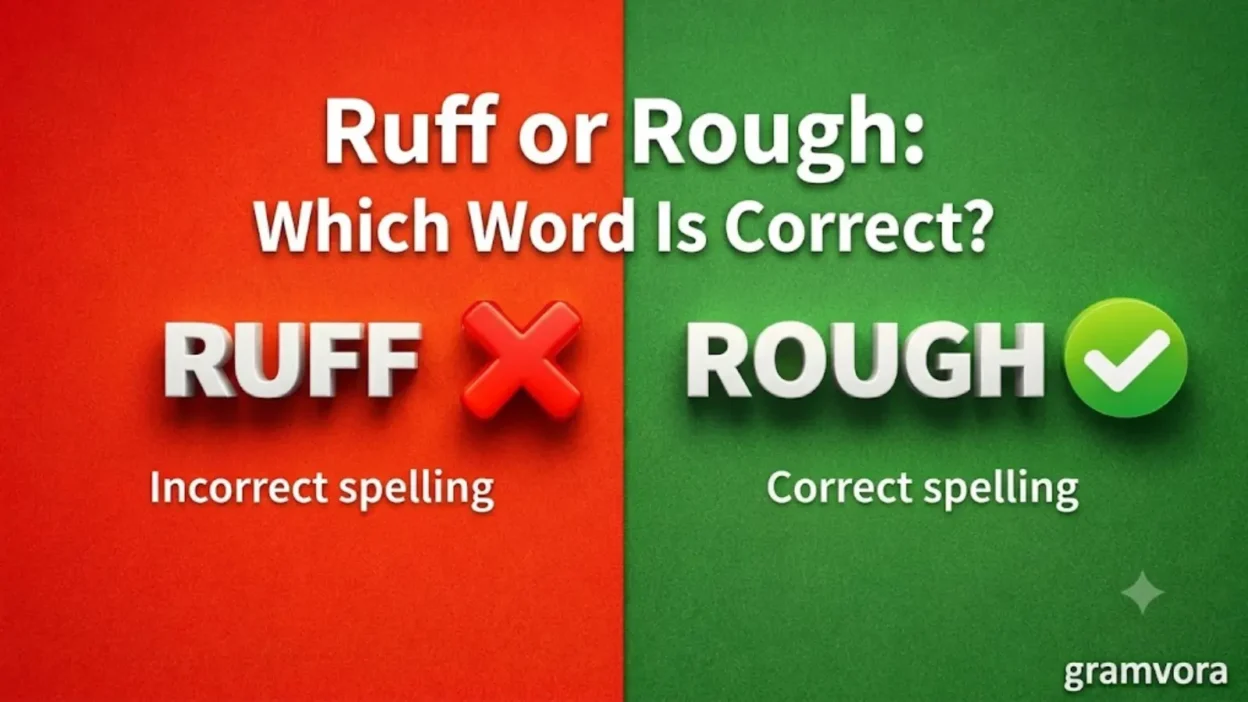
Ruff and rough sound the same, but they do not mean the same thing.
In most everyday writing, the word you want is rough. Use rough for something uneven, harsh, difficult, not exact, unfinished, or not smooth.
Use ruff only in special cases. A ruff can be a stiff old-fashioned collar, a ring of fur or feathers around an animal’s neck, a kind of bird, a dog-bark sound in playful writing, or a card-game term.
So, “I had a rough day” is correct. “I had a ruff day” is only a joke or a dog-themed pun.
Quick Answer
Use rough for almost all normal sentences.
Correct: I had a rough morning.
Correct: The road was rough after the storm.
Correct: This is only a rough draft.
Use ruff when you mean a collar, a neck frill, a bird, a bark sound, or a move in certain card games.
Correct: The costume had a white ruff around the neck.
Correct: The bird’s ruff looked bright during breeding season.
Correct: The puppy went, “ruff!”
The easiest rule is this: if the meaning is difficult, uneven, harsh, unfinished, or approximate, choose rough.
Why People Confuse Them
People confuse ruff and rough because they are homophones. That means they sound alike.
Both are usually pronounced like “ruf,” rhyming with stuff and tough. The spelling is the confusing part.
Rough looks unusual because the gh makes an f sound. English does this in some words, such as laugh, enough, and tough. Ruff looks more like it sounds, so some writers accidentally use it where rough belongs.
That mistake is easy to fix. Ask what the sentence means. If it describes a hard day, uneven surface, harsh treatment, or unfinished version, rough is the right word.
Key Differences At A Glance
- Ruff: a specific noun or card-game verb; also used as a playful dog-bark sound.
- Rough: a common adjective, noun, verb, and adverb with several everyday meanings.
- Ruff is narrow and uncommon in regular writing.
- Rough is common in daily, school, workplace, sports, and creative writing.
- They sound the same, so context decides the spelling.
Meaning and Usage Difference
Ruff is mainly a noun. It names something specific. A ruff can be a stiff folded collar worn in historical clothing. It can also mean a ring of fur or feathers around an animal’s neck. In bird writing, ruff can name a type of shorebird. In card games, ruff can mean playing a trump card when unable to follow suit.
Rough is much broader. As an adjective, it can describe texture, conditions, behavior, estimates, drafts, weather, water, neighborhoods, or experiences.
Examples:
The blanket feels rough.
We had a rough week at work.
She made a rough sketch before painting.
The boat struggled in rough water.
Rough can also be a noun, as in the rough on a golf course. It can be a verb in phrases like rough out a plan or rough it on a camping trip.
Tone, Context, and Formality
Rough is neutral and natural in modern US English. You can use it in casual, professional, academic, and creative writing.
Examples:
The first quarter was rough for the company.
Please send a rough estimate by Friday.
His tone sounded rough, but he apologized later.
Ruff is more limited. It sounds correct in historical clothing, animal description, birding, card games, or playful dog-related writing. Outside those contexts, it usually looks like a misspelling.
Example:
The dog’s winter coat formed a thick ruff around its neck.
Pronunciation matters here because readers may hear the same sound in their head. In writing, though, sound is not enough. Meaning decides the spelling.
Which One Should You Use?
| Context | Best Choice | Why |
|---|---|---|
| A difficult day | rough | It means hard, unpleasant, or challenging. |
| Uneven ground | rough | It describes a surface that is not smooth. |
| A first draft | rough | It means unfinished or not exact. |
| Harsh behavior | rough | It means forceful, careless, or severe. |
| A historical collar | ruff | It names a specific folded collar. |
| Fur or feathers around a neck | ruff | It names a ring or frill on an animal. |
| A dog bark in playful writing | ruff | It imitates a bark sound. |
| A card-game trump play | ruff | It is the specific card-game term. |
For normal writing, rough is usually the safe choice. Choose ruff only when the sentence clearly points to one of its special meanings.
When One Choice Sounds Wrong
Ruff sounds wrong when the sentence needs an adjective.
Wrong: I had a ruff day.
Correct: I had a rough day.
Wrong: The sandpaper felt ruff.
Correct: The sandpaper felt rough.
Wrong: We need a ruff estimate.
Correct: We need a rough estimate.
Rough sounds wrong when the sentence names the collar, animal frill, dog sound, or card move.
Wrong: The actor wore a lace rough.
Correct: The actor wore a lace ruff.
Wrong: The dog had a thick rough around its neck.
Correct: The dog had a thick ruff around its neck.
Common Mistakes (and Quick Fixes)
Mistake: Using ruff because it sounds like rough.
Fix: Use rough unless you mean a collar, neck frill, bark sound, bird, or card move.
Mistake: Writing “ruff draft.”
Fix: Write rough draft. It means an unfinished version.
Mistake: Writing “ruff around the edges.”
Fix: Write rough around the edges. It means not polished or not fully refined.
Mistake: Treating ruff as only a fake word.
Fix: Ruff is real, but it has narrow meanings.
Mistake: Using rough for a dog-bark sound.
Fix: In playful writing, ruff is the usual spelling for the sound.
Everyday Examples
The hike was rough, but the view was worth it.
My hands feel rough after working outside.
Can you give me a rough idea of the cost?
The team had a rough start but finished strong.
The designer sent a rough sketch before the final logo.
The actor wore a dramatic ruff in the school play.
The owl had a soft ruff of feathers around its face.
The puppy barked, “ruff, ruff,” at the delivery truck.
That old cabin is fun, but you really have to rough it.
His first speech was rough around the edges, but the message was strong.
Dictionary-Style Word Details
Verb
Ruff: Ruff can be a verb in certain card games. It means to play a trump card when you cannot follow the suit that was led. This use is specialized, not everyday English.
Example: She ruffed the trick and won the hand.
Rough: Rough can be a verb in phrases such as rough out, rough up, and rough it. Rough out means to make a basic first version. Rough up means to treat someone or something harshly. Rough it means to live without normal comfort.
Example: We roughed out the plan on a whiteboard.
Noun
Ruff: Ruff is commonly a noun in its standard uses. It can mean a stiff folded collar, a ring of fur or feathers around an animal’s neck, a bird, or a card-game play.
Example: The costume included a tall white ruff.
Rough: Rough can be a noun, but it is less common than the adjective. It can mean an uneven area, the longer grass beside a golf fairway, a first sketch, or an unfinished form.
Example: His ball landed in the rough.
Synonyms
Ruff: Exact synonyms are limited because ruff names specific things. Closest plain alternatives include collar, frill, neck frill, feather ring, and fur ring, depending on the context. There is no useful general antonym.
Rough: Synonyms depend on meaning. For texture, use uneven, coarse, bumpy, or jagged. For difficulty, use hard, difficult, tough, or challenging. For an early version, use draft, unfinished, approximate, or preliminary. Clear antonyms include smooth, even, polished, exact, gentle, and easy, depending on the sentence.
Example Sentences
Ruff: The museum display showed a lace ruff from an old costume.
Ruff: The bird raised its ruff during the display.
Ruff: The dog barked, “ruff,” when the doorbell rang.
Rough: The towel felt rough against my sunburn.
Rough: It was a rough week, but we got through it.
Rough: Send me a rough number before the meeting.
Word History
Ruff: The collar sense is often connected with ruffle, which makes sense because a ruff looks like a folded or frilled piece of fabric. The card-game sense has its own specialized history. For word choice, the exact history matters less than the modern meaning.
Rough: Rough comes from older English use connected with coarse, hairy, uneven, or not smooth qualities. Over time, it also became useful for difficult experiences, harsh behavior, unfinished work, and approximate ideas.
Do not rely on history to choose between them. Use the current meaning in the sentence.
Phrases Containing
Ruff: neck ruff, lace ruff, Elizabethan ruff, bird ruff, dog’s ruff, ruff and discard.
Rough: rough day, rough road, rough draft, rough estimate, rough patch, rough around the edges, rough it, rough out, rough up, in the rough.
These phrases show why rough appears far more often in everyday writing. Ruff belongs to specific settings. Rough works across many common situations.
Conclusion
Ruff and rough sound alike, but they belong in different sentences.
Use rough when you mean uneven, harsh, difficult, unfinished, approximate, or not smooth. This is the right choice in phrases like rough day, rough road, rough draft, rough estimate, and rough around the edges.
Use ruff only when you mean a folded collar, an animal’s neck frill, a type of bird, a playful dog-bark sound, or a card-game move.
When in doubt, choose rough for ordinary writing. Save ruff for its special meanings.