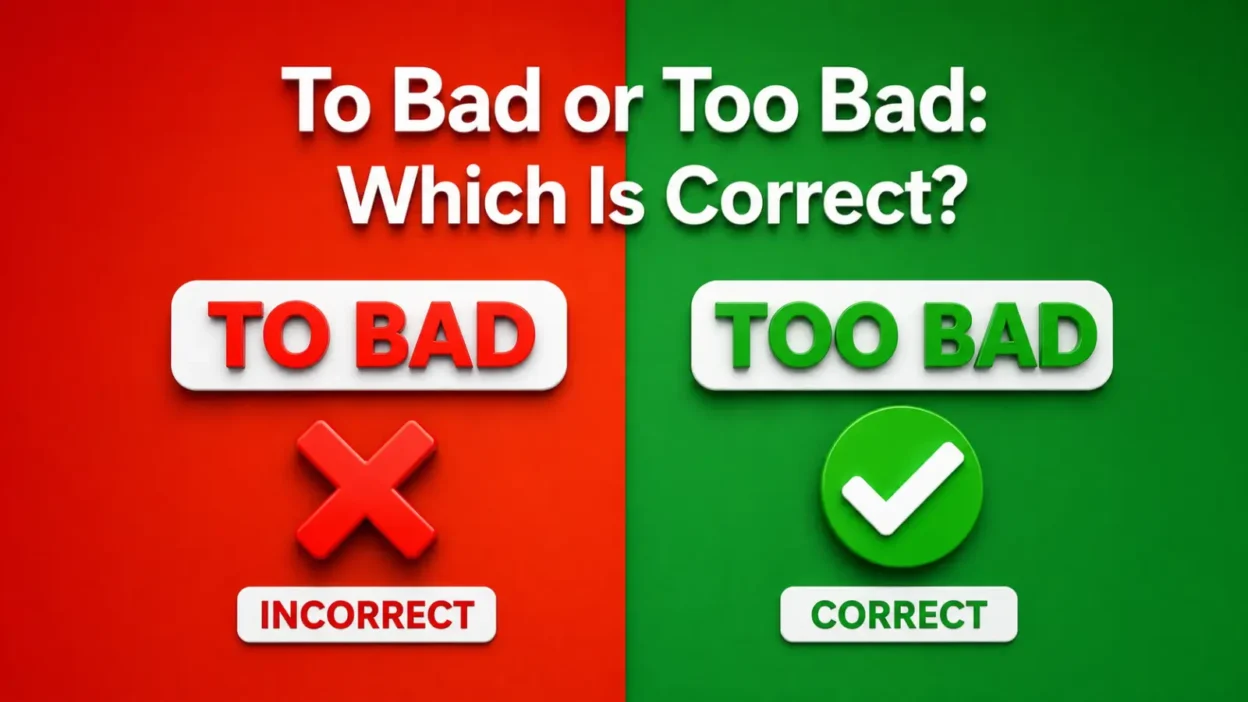
If you are wondering whether the correct phrase is “too bad” or “to bad,” the answer is simple: too bad.
Use too bad when you mean that something is unfortunate, disappointing, regrettable, or a shame.
- Correct: It’s too bad you missed the game.
- Incorrect: It’s to bad you missed the game.
The confusion happens because too and to sound the same in everyday speech. However, they have different grammatical roles. In the expression too bad, too modifies the adjective bad.
Quick Answer
Too bad is the correct choice when you mean “unfortunate,” “a shame,” or “regrettable.”
For example:
It’s too bad you couldn’t come to the party.
That’s too bad about your flight.
Too bad we missed the last train.
To bad is not correct when you are trying to express disappointment or sympathy.
Too Bad vs. To Bad at a Glance
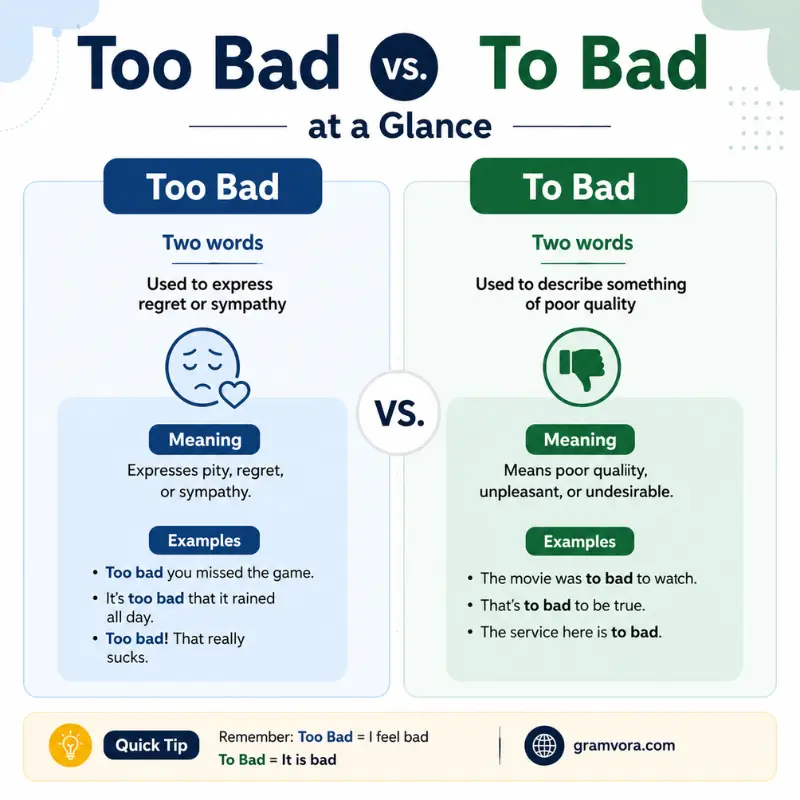
| Phrase | Correct? | Meaning |
|---|---|---|
| too bad | Yes | Unfortunate, disappointing, or excessively bad |
| to bad | Usually no | Not a standard expression meaning “unfortunate” |
| from good to bad | Yes | Shows a change from one condition to another |
The key is to look at how to or too functions in the sentence.
What Does “Too Bad” Mean?
The phrase too bad has several related uses in English.
1. To Say Something Is Unfortunate
This is the most common use.
It’s too bad you missed the concert.
Here, too bad means that it is unfortunate or regrettable that the person missed the concert.
You could replace it with:
- That’s unfortunate.
- That’s a shame.
- Unfortunately, that happened.
2. To Describe Something as Excessively Bad
Too bad can also literally mean “excessively bad” or “bad to an undesirable degree.”
The weather was too bad to go hiking.
The damage was too bad to repair quickly.
In these examples, too means “more than acceptable” or “to an excessive degree.”
3. To Give a Short Reaction
Sometimes too bad appears by itself:
“We sold the tickets already.”
“Too bad.”
The meaning depends heavily on tone and context. It can express genuine disappointment, but it can also sound dismissive or sarcastic.
Why Is “Too Bad” Correct?
The grammar is straightforward.
Too can modify an adjective when it means “more than is desirable,” “excessively,” or “to an undesirable degree.”
Since bad is an adjective, the combination too + bad is grammatically correct.
The pattern is:
too + adjective
For example:
- too loud
- too expensive
- too cold
- too late
- too difficult
- too bad
Consider these sentences:
The coffee is too hot.
The bag is too expensive.
The traffic is too bad.
In each sentence, too modifies the adjective that follows it.
Why Is “To Bad” Incorrect?
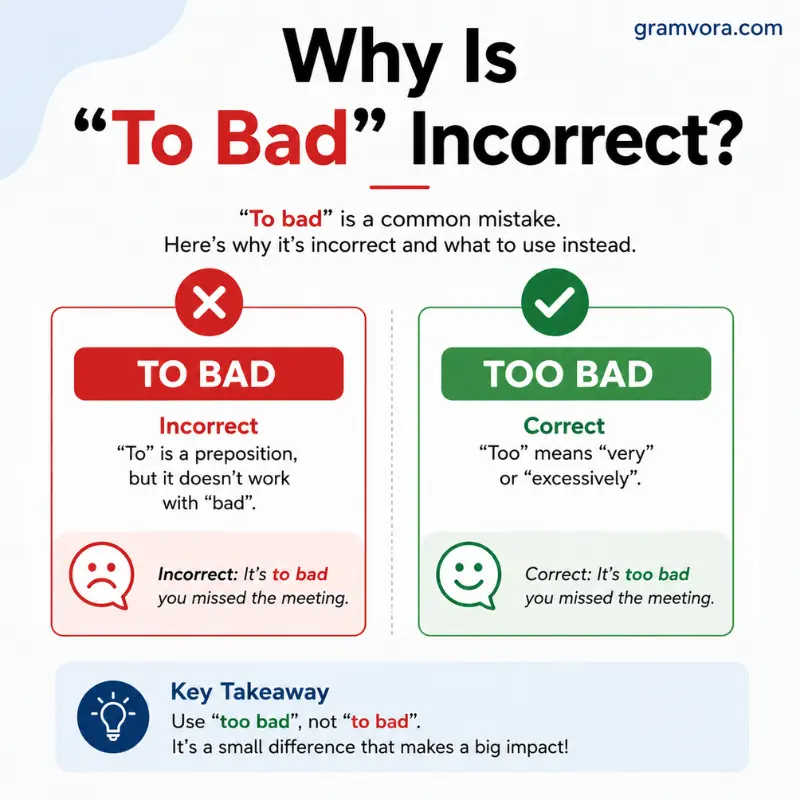
To does not normally function as an intensifier before an adjective.
It is commonly used as:
- a preposition: go to school
- part of an infinitive: to leave
- an indicator of direction or relationship: give it to her
- part of expressions showing movement or change: from good to bad
So when you want to say that something is unfortunate, to bad does not fit the grammatical structure.
Incorrect
It’s to bad that you missed the interview.
Correct
It’s too bad that you missed the interview.
The difference is only one letter in writing, but the grammatical roles are different.
When to Use “Too Bad”
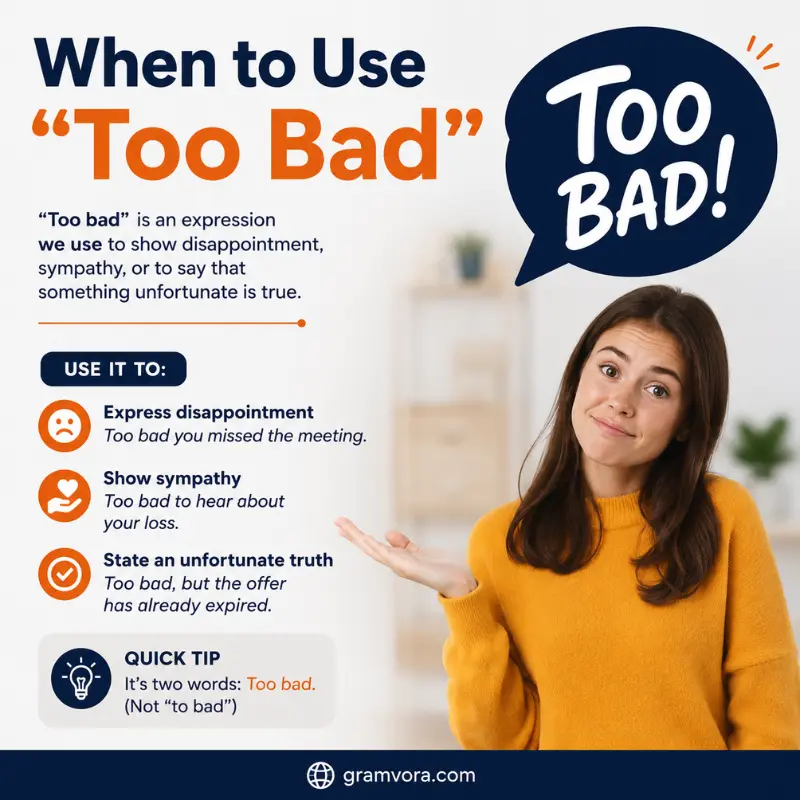
Use too bad when you are expressing disappointment, sympathy, regret, or an undesirable degree of something.
Expressing Disappointment
Too bad we missed the beginning of the movie.
It’s too bad the restaurant was closed.
Showing Sympathy
That’s too bad about your broken phone.
It’s too bad she couldn’t attend the ceremony.
Describing an Excessive Degree
The storm was too bad for the event to continue.
The traffic was too bad to drive safely.
Making a Mild Negative Judgment
The movie wasn’t too bad.
Here, wasn’t too bad means that the movie was actually fairly good or acceptable.
Can “To Bad” Ever Be Correct?
Yes, but only when to belongs to a different grammatical structure.
For example:
The situation went from good to bad.
His mood changed from happy to bad-tempered.
The conversation went from bad to worse.
In from good to bad, the word to shows a change from one state to another.
This is completely different from the expression too bad.
Compare:
Too bad:
It’s too bad we had to leave early.
Meaning: It is unfortunate that we had to leave.
To bad:
The situation went from good to bad.
Meaning: The situation changed from one condition to another.
So to bad can appear as part of a larger grammatical structure, but it is not a replacement for “too bad.”
Too Bad vs. Very Bad
These expressions are not always interchangeable.
Too Bad
Too bad can mean that something is unfortunate:
It’s too bad you missed the meeting.
This does not simply mean that the meeting itself was very bad. It means the situation is unfortunate.
Very Bad
Very bad emphasizes the severity or quality of something:
The weather was very bad yesterday.
This means the weather was extremely poor.
Compare:
It’s too bad you missed the flight.
Meaning: It is unfortunate that you missed it.
The flight was very bad.
Meaning: The flight experience itself was very poor.
The words may look similar, but their meanings can be quite different.
“That’s Too Bad” vs. “Too Bad”
Both are common, but the tone can change.
“That’s too bad.”
This usually sounds more sympathetic:
“My car broke down on the way to work.”
“That’s too bad. I hope you can get it fixed soon.”
“Too bad.”
This can sound more blunt:
“I forgot my ticket.”
“Too bad. The show has already started.”
Depending on the speaker’s tone and the situation, too bad can sound sympathetic, neutral, sarcastic, or dismissive.
The spelling and grammar remain the same; the context determines the tone.
Common Examples of “Too Bad”
Here are some natural examples:
- It’s too bad you couldn’t stay longer.
- That’s too bad about your canceled flight.
- Too bad we didn’t buy tickets earlier.
- The weather was too bad for us to go outside.
- The traffic was too bad to reach the airport on time.
- The movie wasn’t too bad.
- It’s too bad the store closed before we arrived.
- Too bad you missed the announcement.
Common Mistakes and How to Fix Them
Mistake 1: “To bad”
❌ To bad we missed the game.
✅ Too bad we missed the game.
Use too because it modifies bad.
Mistake 2: “That’s to bad”
❌ That’s to bad.
✅ That’s too bad.
This is one of the most common spelling mistakes because to and too sound alike.
Mistake 3: “It’s to bad that…”
❌ It’s to bad that she left early.
✅ It’s too bad that she left early.
Mistake 4: Confusing “too bad” with “very bad”
❌ I mean “very bad,” so I should always use too bad.
Not necessarily.
Use too bad when the meaning is appropriate. If you simply want to emphasize how poor something is, very bad may be better.
The service was very bad.
But:
It’s too bad you had to wait so long.
An Easy Trick to Remember “Too Bad”
Think of the common pattern:
too + adjective
For example:
- too big
- too small
- too expensive
- too difficult
- too late
- too bad
If you can use too before another adjective, you can recognize why too bad works.
You can also remember this:
Too = more than needed or desired.
To = direction, relationship, or part of an infinitive.
So:
too bad ✅
but:
go to school ✅
want to leave ✅
from good to bad ✅
Quick Test: Which One Should You Use?
Ask yourself what you are trying to say.
If you mean “unfortunate” or “a shame”:
Use too bad.
Too bad you couldn’t make it.
If you mean “excessively bad”:
Use too bad.
The weather was too bad to travel.
If you are showing movement or change:
To may be correct.
The situation went from good to bad.
If you are still unsure:
Try replacing the phrase with “unfortunate” or “a shame.”
Too bad you missed the event.
It’s unfortunate you missed the event.
If the meaning works, too bad is probably the right choice.
Too Bad or To Bad: The Simple Rule
The rule is easy:
Use “too bad” when you mean unfortunate, disappointing, a shame, or excessively bad.
Do not use “to bad” as a substitute for “too bad.”
The reason is grammatical: too can modify an adjective such as bad, while to normally has a different function.
FAQs
Is “too bad” or “to bad” correct?
Too bad is correct when you mean “unfortunate,” “a shame,” or “excessively bad.”
That’s too bad.
Why is “to bad” wrong?
In this expression, to cannot modify the adjective bad. The correct structure is too + adjective, giving us too bad.
Is “too bad” one word?
No. Too bad is written as two separate words.
Does “too bad” mean “very bad”?
Not always. Too bad can mean “very or excessively bad,” but it can also mean “unfortunate” or “a shame.”
For example:
It’s too bad you missed the train.
Here, it means the situation is unfortunate.
Can “too bad” be used by itself?
Yes.
“I forgot my umbrella.”
“Too bad.”
However, when used alone, it can sometimes sound blunt, sarcastic, or dismissive depending on the context.
Is “that’s too bad” polite?
Usually, yes. That’s too bad commonly expresses sympathy or disappointment.
That’s too bad. I hope everything works out.
However, tone and context can affect how it sounds.
Is “too bad” formal English?
Too bad is standard English, but it is more common in everyday conversation and informal writing. In highly formal writing, phrases such as “that is unfortunate” may sound more appropriate.
Is “to bad” ever grammatically correct?
Yes, when to has another grammatical function.
The situation changed from good to bad.
Here, to shows a change from one state to another. It is not the expression too bad.
What is the easiest way to remember the difference?
Remember:
Too + adjective
- too cold
- too expensive
- too late
- too bad
Use to for things such as direction, relationships, or infinitives:
- go to work
- give it to me
- to leave
Conclusion
When you mean “unfortunate,” “a shame,” “disappointing,” or “excessively bad,” the correct phrase is too bad.
It’s too bad you missed the game.
Not:
It’s to bad you missed the game.
The reason is simple: too can modify an adjective, while to serves different grammatical purposes.
Although to bad can appear in sentences such as “from good to bad,” it should not be used as a spelling or grammatical substitute for too bad.
When in doubt, remember the pattern too + adjective:
too loud, too cold, too expensive, too late, too bad.