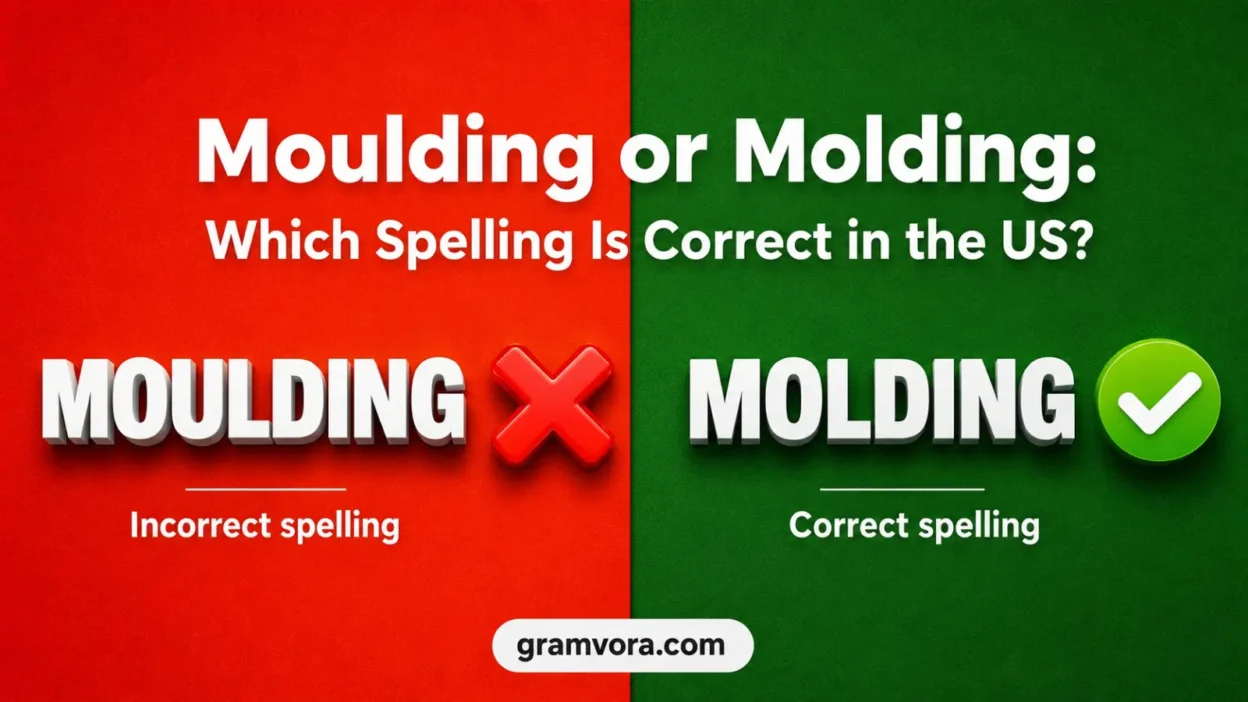
Both moulding and molding are correct spellings. They name the same word and carry the same meanings. The difference is regional: molding is standard in American English, while moulding is standard in British English.
For a US audience, choose molding. Use moulding when following British spelling or an established house style.
Quick Answer
Use molding in American English. Use moulding in British English.
The spelling difference does not create a different meaning. Both forms can refer to decorative trim, a shaping process, an object produced in a mold or mould, or the act of shaping something. Choose the regional form your readers expect, then use it consistently.
Why People Confuse Them
The words look nearly identical, and both appear in published English. US readers often meet moulding on British websites, imported product pages, international manufacturing documents, or design posts written outside the United States.
The word also has several uses. A contractor may discuss crown molding, a factory may use injection molding, and a teacher may describe experience molding a person’s character. British writers use moulding in those same settings. The added u marks a spelling convention, not a new definition.
Key Differences At A Glance
| Context | Best Choice | Why |
|---|---|---|
| American English | molding | This is the standard US spelling |
| British English | moulding | This is the standard UK spelling |
| US construction or interior design | molding | American readers expect terms such as crown molding |
| UK construction or interior design | moulding | British readers expect forms such as decorative moulding |
| US manufacturing | molding | Standard in phrases such as injection molding |
| UK manufacturing | moulding | Standard in phrases such as injection moulding |
| International organization | Follow house style | Consistency matters more than switching between forms |
Are They the Same Word?
Yes. Moulding and molding are regional spellings of the same lexical item. Their definitions, grammatical functions, and general uses match.
- Molding: the standard American spelling
- Moulding: the standard British spelling
- Meaning: the same in comparable contexts
- Pronunciation: the extra u is not separately pronounced
Accent may change the vowel slightly, but the spelling choice does not create a different pronunciation. In American English, molding sounds like “MOHL-ding.”
US vs UK Preference
In the United States, molding is the expected spelling. American retailers, contractors, manufacturers, and home-improvement publications normally use forms such as crown molding, base molding, and injection molding.
In British English, moulding is the conventional form. British writing commonly uses crown moulding, decorative moulding, and injection moulding.
Moulding also appears in many other countries that follow British conventions. Still, company and publication styles can vary. For a clearly American audience, molding is the safest choice.
Which Spelling Should You Use?
Choose the spelling that matches your audience and editorial standard.
For writing aimed at readers in the United States, use molding:
“The contractor replaced the damaged window molding.”
For writing aimed at readers in the United Kingdom, use moulding:
“The joiner restored the original ceiling moulding.”
For multinational writing, follow the organization’s regional style. A US catalog may use plastic molding, while its UK edition may use plastic moulding. Do not alternate without a reason; mixed spelling can look carelessly edited.
When One Spelling Looks Wrong
Moulding may look unusual in a US hardware guide, construction estimate, or manufacturing manual. It is not a misspelling, but it can feel out of place because American readers expect molding.
Likewise, molding may look inconsistent in a British publication that otherwise uses spellings such as colour, favour, and labour.
A title, company name, product label, or quotation may preserve its original spelling. In that case, moulding can appear appropriately inside otherwise American writing. Regional fit and consistency matter most.
Common Mistakes (and Quick Fixes)
Mistake: Treating the words as different materials or processes
Fix: They refer to the same process or object when used in matching contexts.
Mistake: Writing moulding for a US audience because it looks more formal
Fix: Use molding. The added u does not make the word more technical or refined.
Mistake: Using molding for trim but moulding for manufacturing in one US document
Fix: Keep the American spelling in both: crown molding and injection molding.
Mistake: Assuming the extra u changes pronunciation
Fix: Pronounce the word according to your accent. Do not give the u a separate sound.
Mistake: Changing a brand or official title to match your preferred spelling
Fix: Preserve official names and quoted wording exactly.
Everyday Examples
Here are natural American English examples using molding:
- We painted the crown molding before installing the new light fixture.
- The carpenter matched the window molding to the original trim.
- Injection molding allows the company to produce the same plastic part repeatedly.
- She spent years molding the team into a strong unit.
- The soft clay was molding easily under his hands.
- Moisture caused the bread to start molding in the sealed bag.
British English can use moulding in the same contexts:
- They repaired the decorative moulding above the doorway.
- The factory specializes in precision injection moulding.
- Her early experiences were moulding her view of the world.
Only the regional spelling changes.
Dictionary-Style Word Details
Verb
- Moulding: The -ing form of British mould. It can mean shaping a material, influencing development, fitting closely to a form, or becoming affected by mould.
- Molding: The -ing form of American mold. It has the same verbal uses in American English.
Example: “The designer is molding the clay into a shallow bowl.”
British spelling: “The designer is moulding the clay into a shallow bowl.”
Noun
- Moulding: A British noun for decorative trim, the process of shaping material, or something formed through that process.
- Molding: The American spelling used for those same noun senses.
The noun is countable for strips or formed pieces: “The room has ornate moldings.” It is usually uncountable for a process: “Injection molding requires careful temperature control.”
Synonyms
The best alternative depends on the sense.
- For the shaping process: forming, shaping, or sometimes casting
- For decorative molding or moulding: trim, edging, or ornamental strip
- For influencing a person or group: shaping, developing, or forming
These are closest plain alternatives, not perfect replacements in every sentence. There is no single useful antonym that fits all senses.
Example Sentences
- Moulding: The restored fireplace has detailed plaster moulding.
- Molding: The renovated kitchen has simple wood molding.
- Moulding: The company improved its rubber moulding process.
- Molding: The plant added a new plastic molding line.
- Moulding: Her mentor was moulding her into a confident leader.
- Molding: Practice was molding the players into a disciplined team.
Word History
The variation comes from the older pair mould and mold. American spelling reform helped establish the shorter mold form in the United States, while British English retained mould.
The shorter form was not created as a separate word. The regional pattern also appears in molded/moulded and moldy/mouldy.
Phrases Containing
- crown molding / crown moulding
- injection molding / injection moulding
- compression molding / compression moulding
- blow molding / blow moulding
- decorative molding / decorative moulding
- wall molding / wall moulding
- picture-frame molding / picture-frame moulding
- molding clay / moulding clay
For American readers, use the versions without u. For British readers, use the versions with u.
FAQs
Is molding or moulding correct?
Both spellings are correct. Molding is the standard spelling in American English, while moulding is the standard spelling in British English. They have the same meanings and grammatical uses. Choose the form that matches your audience and use it consistently.
Is it crown molding or crown moulding?
Use crown molding in American English and crown moulding in British English. Both terms describe decorative trim installed where a wall meets the ceiling. For a US home-improvement article, product listing, or construction estimate, crown molding is the expected form.
Do moulding and molding mean the same thing?
Yes. The words can refer to decorative trim, the process of shaping a material, an item produced in a mold or mould, or the act of influencing someone’s development. The added u does not create a different meaning.
Is it injection molding or injection moulding?
American manufacturers normally use injection molding. British companies and publications generally use injection moulding. Both phrases describe the same manufacturing process in which heated material is placed into a shaped cavity and allowed to form a part.
How do you pronounce moulding and molding?
The two spellings are pronounced the same way within a speaker’s accent. In American English, molding is commonly pronounced like “MOHL-ding.” The u in moulding does not have a separate sound. Regional accents may affect the vowel, but not because the spelling has changed.
Can molding be used as both a noun and a verb?
Yes. As a noun, molding can mean decorative trim or the process of shaping material. As a verb form, it describes shaping, forming, or influencing something.
For example:
- Noun: “The carpenter installed new molding around the doorway.”
- Verb: “The coach is molding the players into a stronger team.”
British English uses moulding in the same grammatical roles.
Conclusion
Both spellings are correct, but they belong to different regional conventions. Molding is the standard choice in American English, while moulding is the standard choice in British English.
They share the same meanings and grammatical uses. Whether the topic is decorative trim, manufacturing, clay, or personal development, match the spelling to your audience and keep it consistent throughout the document.