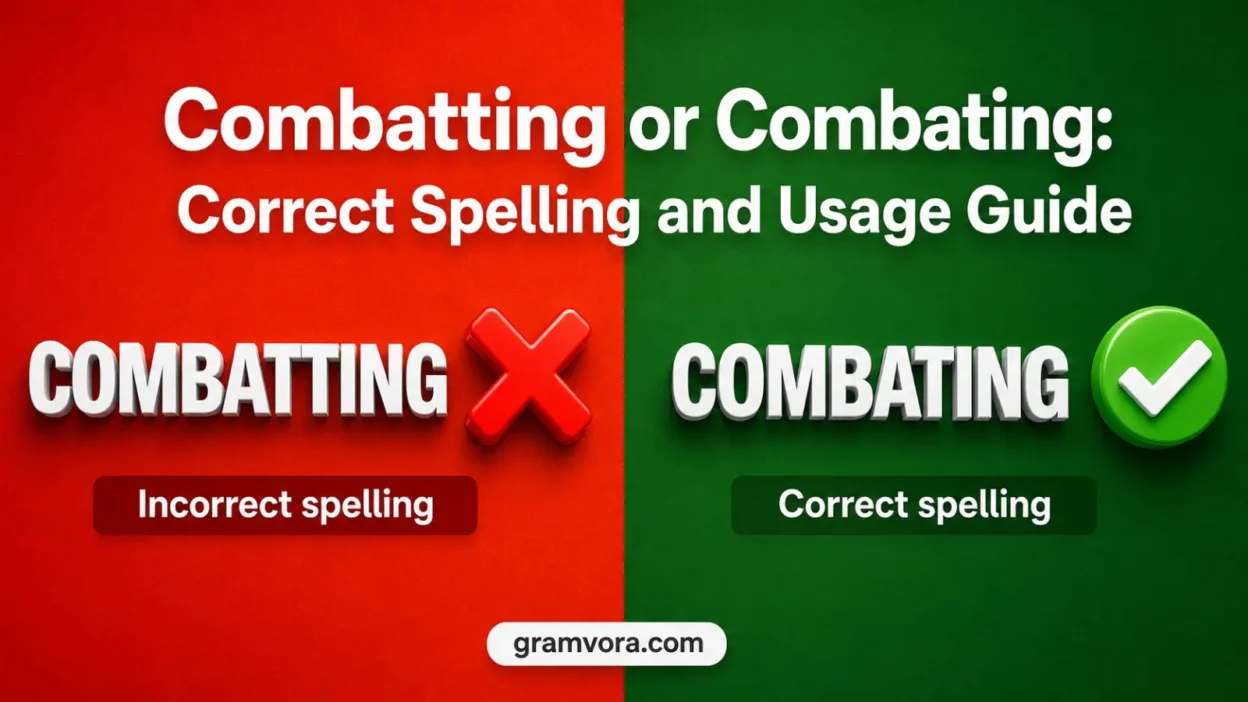
Both combatting and combating are accepted spellings of the same form of the verb combat. They carry the same meaning and normally sound the same when spoken.
For writing aimed at a US audience, combating is the safer and more common choice. The double-t spelling is recognized by major dictionaries, but it may look unusual to some American readers.
Quick Answer
Combating is the preferred spelling in modern US English. Combatting is an accepted variant, not a different word or a spelling with a separate meaning.
Use combating in American schoolwork, business writing, news copy, and general professional communication unless an organization’s house style specifically requires combatting.
Why People Confuse Them
The confusion comes from the final t in combat. Writers know that English often doubles a final consonant before adding -ing:
- Combatting: accepted spelling with a doubled t
- Combating: accepted spelling with a single t and the usual US preference
The word bat becomes batting, so combatting can look logical. However, spelling rules for longer words also consider syllable stress, established convention, and dictionary usage.
The verb combat can be pronounced with stress on either the first or second syllable. This variation helps explain why both inflected spellings have survived. The extra t does not create a different pronunciation.
Key Differences At A Glance
| Context | Best Choice | Why |
|---|---|---|
| General US English | combating | It is the expected and more familiar American spelling. |
| US academic writing | combating | It is the least distracting option for American readers. |
| US business communication | combating | It matches common professional usage. |
| British English | combating or combatting | Both are accepted; publication preferences may differ. |
| A document with an established house style | Follow that style | Consistency matters more than personal preference. |
| Quoting an original source | Preserve the original spelling | Changing it could make the quotation inaccurate. |
Are They the Same Word?
Yes. Combatting and combating are spelling variants of the same -ing form of the verb combat.
Both can describe physically fighting an opponent:
“Soldiers were combating enemy forces.”
They can also describe efforts to stop a harmful condition:
“The city is combating rising housing fraud.”
Changing the spelling to combatting does not change the action, tone, grammatical function, or pronunciation. The only meaningful difference is spelling preference.
US vs UK Preference
In current US English, combating is the strongest default. It appears natural in edited American writing and is unlikely to be questioned by teachers, editors, clients, or readers.
Combatting is still recorded as an acceptable American variant by major dictionaries. It is therefore too strong to call it incorrect. However, the doubled form is less expected in ordinary US copy.
British English allows more variation. Some British writers and publications use combatting, but British dictionaries also record combating. This pair does not follow a perfectly fixed national division like color and colour.
A British publication may choose either form as part of its house style. The writer should then follow that preference consistently.
Which Spelling Should You Use?
Choose combating when writing for readers in the United States. It is clear, standard, and suitable for nearly every subject.
Use it in sentences about public health, crime, discrimination, pollution, disease, cybersecurity, fraud, or military conflict:
“The hospital introduced new measures for combating infections.”
“The agency is combating online fraud.”
You may use combatting when a publisher, employer, instructor, or existing document requires the double-t form. It is also reasonable when preserving the spelling used in a quotation or official title.
When no style has been specified, combating is the more dependable choice.
When One Spelling Looks Wrong
A spell-checker set to US English may flag combatting, even though dictionaries accept it. That warning usually reflects the program’s preferred regional setting rather than a universal spelling rule.
In polished American copy, combatting can look like an accidental extra letter. Readers may pause even when they recognize the word.
The reverse problem is less common. Combating is accepted broadly enough that it normally looks natural in both American and British contexts.
A particular British publisher may nevertheless prefer combatting. In that setting, the single-t form could conflict with house style without being linguistically incorrect.
Common Mistakes (and Quick Fixes)
Mistake: Giving the spellings different meanings.
Both describe the same action. Choose according to regional or editorial preference, not meaning.
Mistake: Calling combatting universally wrong.
Major dictionaries record the doubled spelling. In US writing, describe it as an accepted but less common variant.
Mistake: Treating combatting as the past tense.
The past forms are combated and combatted. The forms combating and combatting end in -ing.
Mistake: Switching spellings within one document.
Do not write combating fraud in one paragraph and combatting fraud in the next without a reason. Pick one spelling and remain consistent.
Mistake: Assuming every British writer must use combatting.
British English accepts combating too. Check the publication’s preferred style instead of relying on an absolute national rule.
Everyday Examples
For modern US English, these sentences use the recommended spelling:
“The school is combating chronic absenteeism with a new family-support program.”
“Local firefighters are combating a fast-moving brush fire.”
“The company strengthened its security practices for combating payment fraud.”
“Regular handwashing helps with combating the spread of infection.”
“Community groups are combating food insecurity across the county.”
“The new policy focuses on combating workplace harassment.”
The accepted variant can appear in the same situations:
“The charity has spent years combatting hunger.”
“Researchers are combatting the problem through early intervention.”
Those final two sentences are not wrong. For a US publication, however, an editor would be more likely to change combatting to combating.
Dictionary-Style Word Details
Verb
Combatting: An accepted -ing form of the verb combat. It can appear in a continuous verb phrase, as in “The officers are combatting fraud.”
Combating: The preferred -ing form in modern US English. It works in the same grammatical structures, as in “The officers are combating fraud.”
Both mean fighting against someone or taking action to reduce, prevent, or eliminate something harmful.
Noun
Combatting: Not normally treated as a separate dictionary noun. It can begin an activity phrase that functions as the subject of a sentence: “Combatting corruption requires strong oversight.”
Combating: Also not a separate noun in this comparison. It can begin the same kind of subject phrase: “Combating corruption requires strong oversight.”
The spelling choice does not change the function of the phrase.
Synonyms
The closest plain alternatives for both spellings include fighting, opposing, resisting, countering, challenging, and tackling.
The best alternative depends on the object. A city may be combating crime, countering fraud, or tackling homelessness.
Possible opposites also depend on context. Supporting, encouraging, or promoting may work when the object is a behavior, practice, or policy. They are not exact opposites in every sentence.
Example Sentences
Combatting: “The organization is combatting illegal dumping along the river.”
Combating: “The organization is combating illegal dumping along the river.”
Combatting: “Doctors are combatting the infection with a new treatment plan.”
Combating: “Doctors are combating the infection with a new treatment plan.”
Each pair has the same meaning. In US writing, the combating versions are generally preferred.
Word History
The word combat entered English through French and is connected to older words referring to fighting.
The spelling variation appears when writers add -ing to the verb. English sometimes doubles a final consonant before a suffix, but stress patterns and established usage can produce competing forms.
Current dictionaries preserve both combatting and combating. Modern American usage generally favors the version with one t.
Phrases Containing
Common combinations with combatting include combatting crime, combatting poverty, combatting disease, and combatting discrimination.
Common combinations with combating include combating crime, combating poverty, combating disease, and combating discrimination.
These are common word combinations rather than fixed expressions. The spelling does not change their meaning.
FAQs
Is combatting or combating correct?
Both combatting and combating are accepted spellings of the -ing form of combat. They have the same meaning. However, combating is the more common and preferred spelling in modern American English.
Which spelling should I use in US English?
Use combating in US English. It is the safest choice for school assignments, professional writing, news articles, business communication, and general American content.
Is combatting a misspelling?
No, combatting is not a misspelling. Major dictionaries recognize it as an accepted variant. Still, it is less common than combating in American writing and may be flagged by some US spell-checkers.
Is combatting the British spelling?
Combatting is sometimes associated with British English, but the distinction is not absolute. British English accepts both combatting and combating, and the preferred form may depend on a publication’s house style.
Do combatting and combating have different meanings?
No. Both spellings mean fighting against, opposing, reducing, or trying to stop something harmful. The spelling does not change the meaning, pronunciation, tone, or grammatical function.
Why does combatting sometimes have two t’s?
The double-t form comes from the English practice of sometimes doubling a final consonant before adding -ing. Because pronunciation and stress patterns vary, both combatting and combating became accepted forms. Modern US usage generally favors the single-t spelling.
Conclusion
Both combatting and combating are correct forms of the verb combat. They mean the same thing, perform the same grammatical job, and are pronounced alike.
For American readers, choose combating. Use combatting only when it matches a required house style, an original quotation, or an established preference. Whichever form you select, keep the spelling consistent throughout your document.