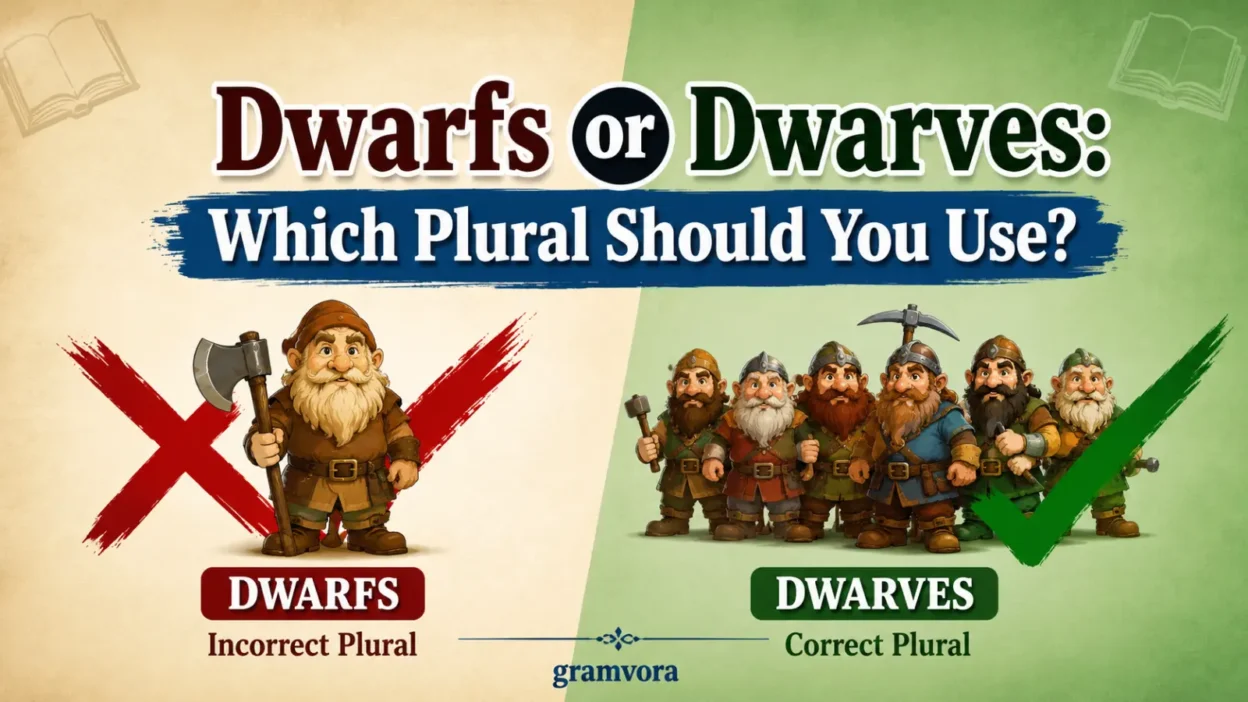
Dwarfs or dwarves is a grammar question about the plural of dwarf. The short answer is that both can be correct as plural nouns, but they are not always the best choice in the same context.
In general US English, dwarfs is the safer plural for real-world use, science, and general writing. Dwarves is most natural when you are writing about fantasy creatures, especially in stories, games, and myth-inspired settings.
Quick Answer
Both dwarfs and dwarves can be correct plural nouns. Use dwarfs for general writing, science, astronomy, plants, animals, and most real-world contexts. Use dwarves when you mean fantasy or folklore characters. As a verb, use dwarfs, not dwarves.
What Is Correct?
Dwarfs is correct. Dwarves is also correct when it is used as a plural noun.
The choice depends on context. In everyday writing, dwarfs usually looks more standard. For example, you would write white dwarfs, brown dwarfs, dwarf planets, or dwarf trees. These are not fantasy beings, so dwarfs is the clearer choice.
In fantasy writing, dwarves often sounds more natural. A novel, game, or movie may use dwarves for a race of underground or magical beings. That use is common and accepted.
However, dwarves should not be used as the verb form. Write The new tower dwarfs the old houses, not dwarves the old houses.
The Core Grammar Rule
The word dwarf has two accepted plural noun forms: dwarfs and dwarves.
That happens because some English nouns ending in f form the plural with -s, while others change f to ves. For example, roof becomes roofs, but wolf becomes wolves. Some words allow both patterns.
Dwarf is one of those flexible nouns. Still, context matters. Dwarfs works best as the default plural. Dwarves works best when the subject is a fantasy people or storybook group.
When Each Form Is Correct
Use dwarfs when the meaning is general, scientific, medical, botanical, astronomical, or non-fantasy. It is the best choice in phrases like red dwarfs, white dwarfs, brown dwarfs, dwarf shrubs, and dwarf animals.
Use dwarves when the meaning is fictional, mythic, or fantasy-based. It fits sentences about kingdoms, clans, mines, quests, games, and fantasy races.
| Form or Pattern | Best Use | Why |
|---|---|---|
| dwarfs | General plural noun | Safest default in standard US writing |
| dwarves | Fantasy or folklore plural noun | Common for fictional beings or fantasy races |
| dwarfs | Verb form | Correct third-person singular verb form |
| dwarves | Verb form | Not standard as a verb |
When It Is Incorrect or Less Natural
Dwarves is less natural in science and real-world technical writing. For example, white dwarves may be understood, but white dwarfs is the standard form in astronomy.
Dwarfs is not wrong in fantasy, but it may sound less familiar to readers who expect dwarves in that setting. A fantasy writer can choose either form, but the choice should stay consistent.
The truly incorrect form is dwarves as a verb. You should not write The skyscraper dwarves the nearby homes. The correct sentence is The skyscraper dwarfs the nearby homes.
Meaning, Structure, or Emphasis Differences
The meaning does not change completely. Both plural nouns mean more than one dwarf.
The difference is mainly context and tone. Dwarfs feels plain, general, and standard. Dwarves feels more literary, fantasy-based, or story-driven.
There is also a structure difference. Dwarfs can be a plural noun or a verb. Dwarves is only a plural noun in standard modern use.
So, dwarfs can mean “more than one dwarf” or “makes something look small.” Dwarves only means “more than one dwarf,” usually in a fictional or legendary setting.
Real-World Examples
Dwarfs as a general plural noun:
The astronomy class studied red dwarfs and white dwarfs.
Dwarfs for plants or animals:
The nursery sells several dwarf trees, but only two are true dwarfs.
Dwarfs as a verb:
The new office tower dwarfs the buildings around it.
Dwarves in fantasy:
The dwarves guarded the mountain gate.
Dwarves in a game setting:
Players can choose elves, humans, or dwarves.
Dwarfs in a fairy-tale title or general story reference:
Many people know the phrase the Seven Dwarfs.
Common Mistakes (and Quick Fixes)
A common mistake is treating dwarves as the only correct plural because it looks like wolves or leaves. That rule does not apply to every word ending in f. For dwarf, both plural noun forms exist.
Another mistake is using dwarves for the verb. The fix is simple: if the word means “makes something look small,” use dwarfs.
Incorrect: The huge screen dwarves the small room.
Correct: The huge screen dwarfs the small room.
A third mistake is switching forms in the same piece of writing. If a fantasy story uses dwarves, keep using dwarves. If a science article uses dwarfs, keep using dwarfs.
Grammar Rule Details
Rule
Use dwarfs or dwarves as the plural noun of dwarf. Use dwarfs as the verb form for he, she, it, or a singular noun subject.
Correct Usage
Dwarfs is correct in general writing:
The exhibit includes models of several white dwarfs.
Dwarves is correct in fantasy writing:
The dwarves built a city under the mountain.
Dwarfs is correct as a verb:
The stadium dwarfs the houses nearby.
Incorrect or Less Natural Usage
Dwarves is incorrect as a verb:
Incorrect: The mountain dwarves the cabin.
Correct: The mountain dwarfs the cabin.
Dwarves is less natural in scientific terms:
Less natural: The telescope found two white dwarves.
Better: The telescope found two white dwarfs.
Examples
The children drew seven dwarfs from the fairy tale.
The fantasy series follows a clan of dwarves.
The huge statue dwarfs everyone standing beside it.
Astronomers study red dwarfs because they are common stars.
Common Mistakes
Writers often choose dwarves because it matches familiar plurals like wolves and shelves. However, English plural forms do not always follow one pattern.
Writers also sometimes forget that dwarfs has two jobs. It can be a noun plural, and it can be a verb.
Exceptions
There is no major grammar exception that makes one plural always correct and the other always wrong.
The useful exception is context-based: in fantasy, dwarves is often preferred; in science and general writing, dwarfs is usually preferred.
Quick Test
Use this fast check:
• If it means “makes something look small,” choose dwarfs.
• If it means real, scientific, plant, animal, or astronomy contexts, choose dwarfs.
• If it means fantasy people in a story or game, dwarves is usually natural.
• If you need the safest default plural, choose dwarfs.
Usage Notes
When writing about real people, be careful. The grammar question is about plural form, but the word itself can be sensitive. In many modern contexts, people with dwarfism, little people, or people of short stature may be more respectful, depending on the person and context.
For fantasy, dwarves is widely understood. For schoolwork, formal writing, science, and general US English, dwarfs is usually the cleaner choice.
FAQ
Is dwarves wrong?
No. Dwarves is not wrong when it is used as a plural noun. It is especially common in fantasy and folklore contexts.
Is dwarfs wrong?
No. Dwarfs is correct as a plural noun and as a verb. It is the safest default in general US English.
Should I write dwarfs or dwarves in fantasy?
Use dwarves if you want the familiar fantasy style. Use dwarfs only if that choice matches your story’s style or house preference.
What is the plural of dwarf in science?
Use dwarfs in scientific terms. Write white dwarfs, red dwarfs, and brown dwarfs.
Can dwarves be a verb?
No. In standard use, dwarves is not the verb form. Write dwarfs when the meaning is “makes something seem smaller.”
Which form should students use?
Students should usually use dwarfs unless the sentence clearly refers to fantasy characters. It is the safer answer in most school and formal writing contexts.
Conclusion
Use dwarfs as your safest default plural. It works in general writing, science, astronomy, plants, animals, and verb use. Choose dwarves when you are writing about fantasy or folklore beings.
The key rule is simple: dwarfs is broader and more standard, while dwarves is more story-like. For the verb, always use dwarfs.