
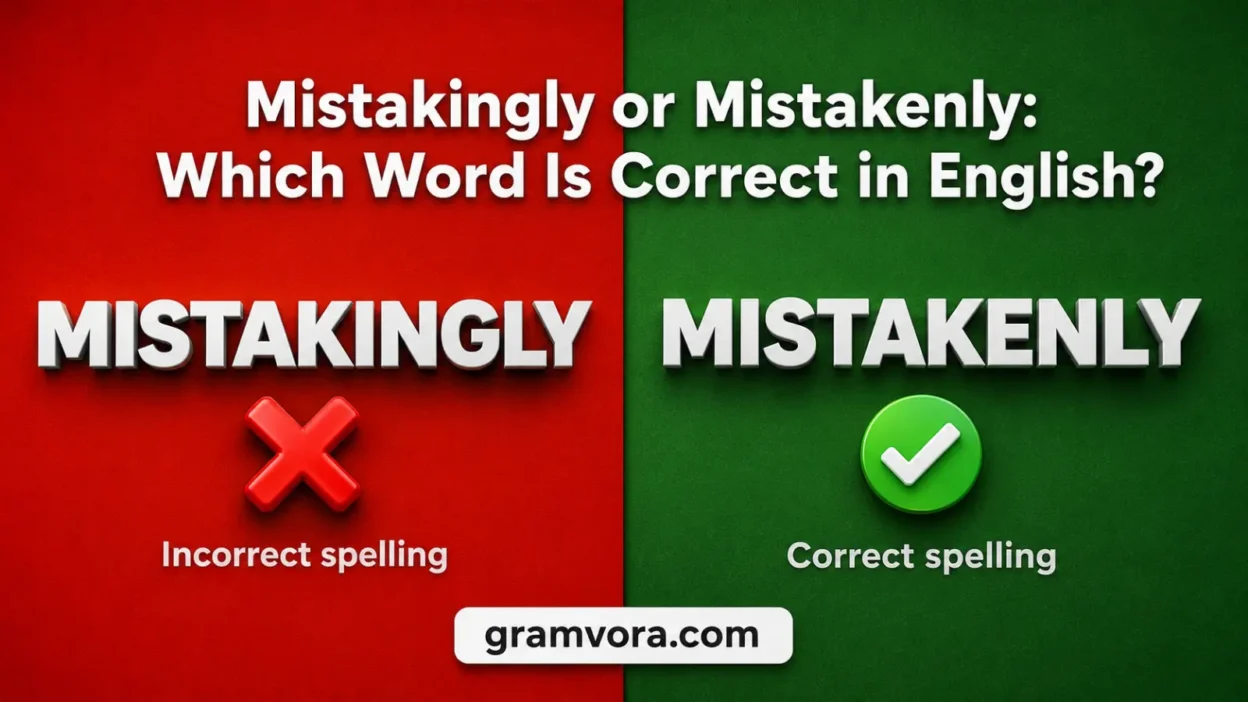
Should you write mistakingly or mistakenly? In most situations, the answer is simple: use mistakenly.
Mistakenly is the normal modern adverb for something done in error, based on a wrong belief, or done by mistake. You can use it naturally in everyday conversation, schoolwork, professional emails, news writing, and formal documents.
However, there is an important detail. Mistakingly does exist as an attested word. Therefore, calling it completely imaginary or claiming that it has never been a word goes too far.
The practical difference is usage. Mistakenly is the established choice that readers expect today. Mistakingly is rare and will often look unusual even when a dictionary records it.
Quick Answer
Use mistakenly in normal modern US English.
It means wrongly, incorrectly, or by mistake.
For example:
“She mistakenly sent the invoice to the wrong customer.”
Mistakingly is an attested adverb, but it is rare in modern writing. Most writers should avoid it because readers may assume it is an error for mistakenly.
The safest rule is simple: when you mean “by mistake” or “incorrectly,” choose mistakenly.
Why People Confuse Them
The confusion makes sense because both forms come from the same word family and look grammatically possible.
Writers know forms such as mistaken and mistaking. Adding -ly can naturally lead someone to wonder whether both mistakenly and mistakingly work as adverbs.
There is also a second source of confusion: mistakingly really has appeared in English. That means the issue is more complicated than a simple keyboard typo.
Still, dictionary existence does not mean two forms are equally natural.
Modern speakers overwhelmingly expect mistakenly when someone means that an action, belief, identification, or decision was wrong.
Do not treat the pair as different tenses. Neither adverb has a past or present tense of its own.
Key Differences At A Glance
| Context | Best Choice | Why |
|---|---|---|
| Something happened by mistake | Mistakenly | Normal modern wording |
| Someone held an incorrect belief | Mistakenly | Natural with verbs such as believe, assume, or think |
| Professional or academic writing | Mistakenly | Clear and widely recognized |
| Emails and workplace communication | Mistakenly | Sounds natural and polished |
| Historical or unusual lexical context | Mistakingly may appear | It is an attested but rare form |
| Unsure which form to choose | Mistakenly | Safest choice in modern US English |
Compact comparison
- Mistakenly: standard, familiar, and appropriate in everyday or formal writing.
- Mistakingly: attested but rare; often sounds awkward or looks like an error to modern readers.
- Main practical rule: choose mistakenly for ordinary communication.
Meaning and Usage Difference
Mistakenly is an adverb meaning that something happens wrongly, incorrectly, or by mistake.
You might mistakenly delete a file, mistakenly believe a rumor, or mistakenly identify the wrong person.
It works with both actions and beliefs:
“I mistakenly grabbed your coffee instead of mine.”
“She mistakenly assumed the office would be open.”
“The package was mistakenly delivered next door.”
Mistakingly is also recorded as an adverb. Its traditional formation relates to doing something in a mistaking manner.
In actual practical writing, however, there is no useful everyday distinction that requires most writers to choose mistakingly instead of mistakenly.
Avoid inventing a rule that mistakingly means a mistake happening now while mistakenly means a past mistake. That distinction does not work because these adverbs do not express tense.
Tone, Context, and Formality
Mistakenly works across almost every level of formality.
You can use it in a casual text:
“I mistakenly took your charger.”
You can also use it professionally:
“The customer was mistakenly charged twice.”
It fits formal explanations as well:
“The document was mistakenly classified under the wrong category.”
Mistakingly, by contrast, may distract readers. Because it is uncommon, many people will read it as a spelling error even when the writer can point to historical or dictionary evidence for the form.
That makes mistakenly the stronger choice whenever clarity matters.
There is no useful US-versus-UK rule to memorize here. For ordinary current writing, mistakenly remains the practical choice.
Which One Should You Use?
Choose mistakenly whenever you mean:
- by mistake
- incorrectly
- wrongly
- based on an incorrect belief or assumption
For example:
“I mistakenly scheduled two appointments for the same time.”
“The bank mistakenly applied the fee twice.”
“We mistakenly assumed parking was free.”
“She was mistakenly identified as another customer.”
These sentences sound natural with mistakenly.
Using mistakingly instead would add no necessary meaning. In fact, it could make readers pause and wonder whether you made a spelling mistake.
Therefore, unless you are discussing the rare word itself, quoting older material, or examining historical usage, mistakenly is usually the better choice.
When One Choice Sounds Wrong
Mistakingly often sounds wrong when it simply replaces mistakenly in an ordinary sentence.
Less natural:
“I mistakingly sent the email to everyone.”
Better:
“I mistakenly sent the email to everyone.”
Less natural:
“They mistakingly believed the deadline was Friday.”
Better:
“They mistakenly believed the deadline was Friday.”
This does not require claiming that mistakingly has never existed. The problem is modern expectation.
Readers are familiar with constructions such as mistakenly believed, mistakenly identified, mistakenly sent, and mistakenly charged. Replacing the familiar adverb with the rare form can make otherwise clear writing feel awkward.
Common Mistakes (and Quick Fixes)
A common mistake is assuming that only one of the two strings can possibly exist as an English word.
Quick fix: Separate dictionary existence from recommended modern usage. Mistakingly is attested, but mistakenly is the normal choice.
Another mistake is creating a tense rule.
Incorrect idea:
“Mistakingly is present tense, while mistakenly is past tense.”
Quick fix: Remember that these are adverbs. They do not become present- or past-tense forms.
Writers may also build mistakingly directly from mistaking because the pattern looks logical.
Quick fix: When you mean “by mistake” or “incorrectly,” connect the adverb with mistaken: mistaken + ly = mistakenly.
Finally, do not use rarity as proof that a word has never existed.
A better explanation is precise: mistakingly is recorded, but mistakenly is the form modern readers normally expect.
Everyday Examples
Here are natural examples using mistakenly:
- I mistakenly left my wallet in the car.
- Mia mistakenly sent the text to her manager.
- The cashier mistakenly scanned the item twice.
- We mistakenly drove to the old office.
- He mistakenly thought the event started at eight.
- The package was mistakenly delivered across the street.
- Jordan mistakenly deleted the shared document.
- The customer was mistakenly charged a late fee.
- I mistakenly assumed the meeting was online.
- The teacher mistakenly marked the correct answer wrong.
In each case, mistakenly clearly communicates an error, wrong belief, or unintended action.
Using mistakingly would usually make these sentences less natural without giving the reader an important new shade of meaning.
Dictionary-Style Word Details
Verb
Mistakingly: Not commonly used as a verb. It functions as an adverb.
Mistakenly: Not used as a verb. It functions as an adverb.
The related verb is mistake, but neither compared form itself functions as the standard verb.
Noun
Mistakingly: Not used as a standard noun.
Mistakenly: Not used as a noun.
Both compared terms function as adverbs rather than names for a person, thing, place, or idea.
Synonyms
Mistakingly: Because this form is rare, the clearest plain alternatives are mistakenly, wrongly, and erroneously, depending on context.
Mistakenly: Common meaning-matched alternatives include:
- incorrectly
- erroneously
- wrongly
- by mistake
- in error
The best alternative depends on whether the sentence describes an accidental action or an incorrect belief.
Example Sentences
Mistakingly:
“Older texts occasionally use mistakingly where modern writers would normally choose mistakenly.”
Because the form is rare, writers should not force it into ordinary sentences merely to create a contrast.
Mistakenly:
“I mistakenly attached the wrong document.”
“They mistakenly believed the store closed at nine.”
“The payment was mistakenly processed twice.”
“She was mistakenly listed as absent.”
Word History
Mistakingly: This adverb has historical evidence going back centuries. Its structure comes from mistaking plus the adverb-forming ending -ly. Although it is attested, it became far less familiar than mistakenly in ordinary modern use.
Mistakenly: This form developed from mistaken plus -ly and also has a long history in English. It became the familiar adverb used for actions, beliefs, assumptions, and judgments made in error.
The key historical point is that mistakingly should not be dismissed as a newly invented typo. Still, historical existence does not make it equally useful in present-day writing.
Phrases Containing
Mistakingly: No common fixed modern phrases strongly require this form.
Mistakenly: Common combinations include:
- mistakenly believe
- mistakenly assume
- mistakenly think
- mistakenly identify
- mistakenly send
- mistakenly charge
- mistakenly delete
- mistakenly report
- mistakenly classify
These combinations help explain why mistakenly feels so natural in everyday English.
FAQs
Is mistakingly a real word?
Yes. Mistakingly appears in some dictionaries and has historical use. However, it is rare in modern English, and most writers should use mistakenly instead.
Is mistakenly the correct word?
Yes. Mistakenly is the standard and natural choice when you mean “by mistake,” “wrongly,” or “incorrectly.”
What is the difference between mistakingly and mistakenly?
Mistakenly is the common modern adverb used for actions or beliefs that are wrong. Mistakingly is an attested but uncommon form that usually sounds unusual today.
Can I use mistakingly in a sentence?
You can, but it is rarely the best choice in modern writing. In most sentences, mistakenly sounds clearer and more natural.
Is mistakingly the present tense of mistakenly?
No. Neither word is a tense form because both function as adverbs. Use mistakenly regardless of whether the sentence refers to the past, present, or future.
What is an example of mistakenly in a sentence?
A natural example is: “I mistakenly sent the email to the wrong person.” Here, mistakenly means that the action happened by mistake.
Conclusion
When choosing between mistakingly or mistakenly, use mistakenly for normal modern US English.
Mistakenly is the familiar adverb meaning by mistake, wrongly, or incorrectly. It works naturally in casual conversations, school assignments, professional communication, and formal writing.
Mistakingly has historical and dictionary support, so describing it as completely nonexistent is inaccurate. However, it is rare enough that many modern readers may see it as an error.
The most useful rule is straightforward: use mistakenly whenever you want to describe an action, belief, assumption, or decision made in error.


