
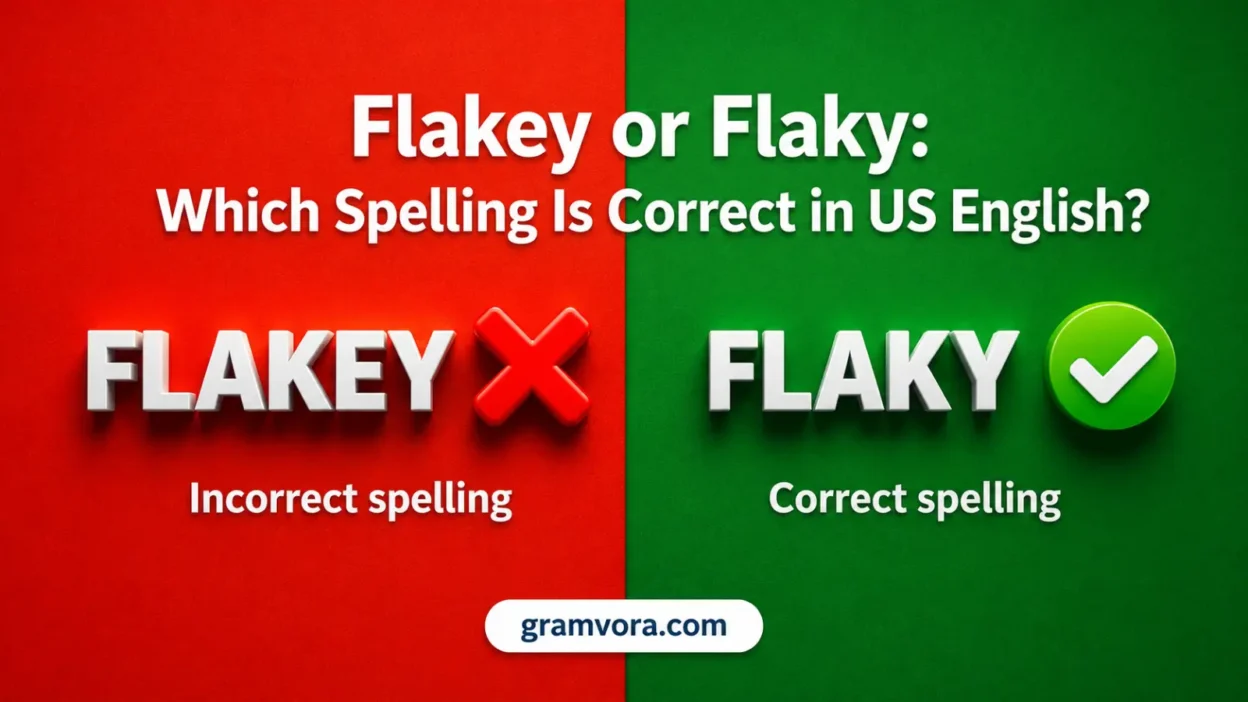
When choosing between flakey or flaky, the best spelling for modern US English is flaky.
However, the answer needs one important detail: flakey is not simply an invented misspelling. Major dictionaries recognize it as a variant of flaky. Still, flaky is the main, more common, and safer spelling for everyday American writing.
Both forms refer to the same word. The difference is mainly spelling preference, not meaning or grammar.
Quick Answer
Flaky is the preferred spelling in US English. Flakey is an accepted but less-common variant.
Use flaky in schoolwork, articles, emails, professional documents, recipes, and general American writing.
Examples:
Correct and preferred: The croissant was light and flaky.
Accepted but less common: The croissant was light and flakey.
The two spellings do not need different meanings. Choosing flaky simply follows the stronger modern convention.
Why People Confuse Them
The confusion makes sense because the base word flake ends in e. A writer may naturally expect that e to remain when adding -y, producing flakey.
However, flaky became the dominant spelling.
Another source of confusion is that both forms still appear in real writing. Someone may see flakey in a recipe, article, social post, or older text and assume that it represents a separate rule.
It does not.
The spelling difference also does not reliably separate meanings. You do not need flakey for pastry and flaky for an unreliable person. The preferred spelling flaky works across the word’s normal senses.
Key Differences At A Glance
| Context | Best Choice | Why |
|---|---|---|
| US English | Flaky | Main and preferred spelling |
| Formal writing | Flaky | Safest conventional choice |
| School or professional writing | Flaky | Most widely recognized form |
| Food and texture descriptions | Flaky | Standard choice for layered or delicate textures |
| Describing unreliable behavior | Flaky | Normal informal spelling |
| Quoted or intentionally preserved wording | Flakey | Appropriate when the original wording uses it |
| General modern writing | Flaky | Avoids unnecessary spelling doubt |
The practical rule is simple: choose flaky unless you have a specific reason to preserve flakey.
Are They the Same Word?
Yes. Flakey and flaky are spelling variants of the same adjective.
They do not form a pair like two different words with separate grammatical jobs. Their meanings overlap.
Both can describe something that forms, breaks, or comes away in thin pieces or layers. The word can also describe unreliable or inconsistent behavior in informal contexts.
A useful comparison:
- Flaky: primary and preferred spelling
- Flakey: recognized alternate spelling, but less common
- Meaning: essentially the same
- Part of speech: adjective
- Pronunciation: the same in normal use
Therefore, spelling preference is the real issue.
US vs UK Preference
There is no strong, simple regional rule saying Americans must write flaky while British writers should write flakey.
That distinction would be misleading.
Major British-oriented dictionaries also use flaky as the main headword while recognizing flakey as an alternate form. As a result, flaky is a safe choice on both sides of the Atlantic.
For a US audience, the recommendation is especially straightforward: use flaky as your default.
Unlike pairs such as color/colour, this comparison does not create a neat American-versus-British spelling divide.
Which Spelling Should You Use?
Use flaky in almost all ordinary modern writing.
Choose it when describing food:
The biscuits came out buttery and flaky.
Choose it for skin or surfaces:
The old paint became dry and flaky.
Use it in informal descriptions of unreliable behavior:
He can be flaky about weekend plans.
The spelling flakey may still be acceptable when intentionally following a source, quotation, brand wording, title, or established personal style.
However, writers usually gain nothing by choosing the less-common form when flaky is available.
For consistency and familiarity, flaky is the better default.
When One Spelling Looks Wrong
Although flakey is recognized as a variant, it may look like a spelling mistake to many readers because they encounter flaky much more often.
That matters in polished writing.
A sentence such as The pie had a flakey crust is understandable, but many editors and readers would expect flaky crust instead.
The same applies to figurative use:
Less natural default: She has been flakey about confirming the meeting.
Preferred: She has been flaky about confirming the meeting.
Do not create an artificial meaning distinction between the spellings. Changing the meaning does not require changing the spelling.
Common Mistakes (and Quick Fixes)
Mistake: Treating flakey as a completely different word.
Quick fix: Treat it as a less-common spelling variant of flaky.
Mistake: Assuming flakey is automatically the British spelling.
Quick fix: Use flaky confidently in both US and UK contexts unless a specific style requires otherwise.
Mistake: Using flakey for food and flaky for people.
Quick fix: Use flaky for both meanings.
Flaky pastry is standard.
A flaky friend is also standard.
Mistake: Switching between spellings in one document.
Quick fix: Choose flaky and stay consistent.
Mistake: Calling every appearance of flakey an obvious error.
Quick fix: Recognize that dictionaries record the form, but understand that it is less commonly preferred.
Everyday Examples
Here are natural examples using the recommended spelling:
The bakery sells flaky croissants every morning.
Cold butter helps create a flaky pie crust.
The paint around the old window had become flaky.
My skin gets dry and flaky during the winter.
The fish was tender and flaky after baking.
Jason is friendly, but he can be flaky about making plans.
We need a dependable schedule because the current arrangement feels flaky.
She apologized for being flaky and canceling at the last minute.
You may occasionally see flakey in similar sentences:
The pastry looked golden and flakey.
The meaning remains clear. Still, flaky is the stronger default for modern US writing.
Dictionary-Style Word Details
Verb
Flakey: Not commonly used as a verb in standard English.
Flaky: Not commonly used as a verb either.
Both compared forms function primarily as adjective spellings. The related base word flake can function as a verb, but that does not make flakey or flaky verb forms.
Noun
Flakey: Not commonly used as a standard noun.
Flaky: Not commonly used as a standard noun.
In this comparison, both forms are adjectives rather than nouns.
Synonyms
Because the word has more than one sense, alternatives depend on context.
For a physical texture, closest plain alternatives may include:
- crumbly
- crisp
- delicate
- layered
- brittle
For unreliable behavior, useful alternatives include:
- unreliable
- undependable
- inconsistent
- erratic
These alternatives describe meanings of the shared word. They do not represent separate meanings for flakey and flaky.
Example Sentences
Flakey: The recipe promised a light, flakey crust.
This spelling is understandable and recognized, but less commonly preferred.
Flaky: The recipe promised a light, flaky crust.
This is the recommended modern spelling.
Flakey: He has been flakey about confirming plans.
Flaky: He has been flaky about confirming plans.
Again, the spelling changes, but the intended meaning does not.
Word History
Both spellings are connected to the word flake.
The form flaky follows the established spelling in which the final e of flake does not remain before the adjective ending -y.
The alternate form flakey preserves that e, which helps explain why it can look natural to writers.
Modern dictionaries generally center flaky while recording flakey as an alternate or less-common form. No separate historical meaning is needed to explain the spelling choice.
Phrases Containing
Common phrases normally use flaky:
- flaky pastry
- flaky crust
- flaky biscuits
- flaky skin
- flaky paint
- flaky scalp
- flaky friend
- flaky behavior
Forms such as flakey pastry or flakey skin can occur because flakey is a recognized variant. However, flaky is the more conventional spelling for these phrases.
FAQs
Is flakey or flaky the correct spelling?
Flaky is the preferred and more common spelling in modern US English. Flakey is an accepted but less-common variant.
Is flakey a real word?
Yes. Major dictionaries recognize flakey as a spelling variant of flaky. However, most writers and editors prefer flaky.
Is it flaky or flakey pastry?
Flaky pastry is the standard and more natural spelling. Example: The bakery makes light, flaky pastries every morning.
Is flaky American or British spelling?
Flaky is widely used in both American and British English. There is no clear rule that assigns flaky to the US and flakey to the UK.
Do flakey and flaky have different meanings?
No. Flakey and flaky share the same meanings. The difference is mainly spelling preference, with flaky being the more common form.
How do you spell flaky when describing an unreliable person?
Use flaky. For example: He can be flaky about keeping plans. The spelling flakey may occur, but flaky is the preferred choice.
Conclusion
For flakey or flaky, choose flaky in modern US English.
Flaky is the main and preferred spelling for descriptions of pastry, skin, paint, layered textures, unreliable people, and similar uses.
Flakey is a real recorded variant, so it should not automatically be treated as a meaningless spelling error. However, it is less common and usually offers no advantage in ordinary writing.
The easiest rule to remember is: write flaky by default, and use flakey only when you have a specific reason to preserve that variant.
[…] calling practises simply “wrong” would be inaccurate. It is a standard British English spelling, but it is not the normal spelling for American English […]