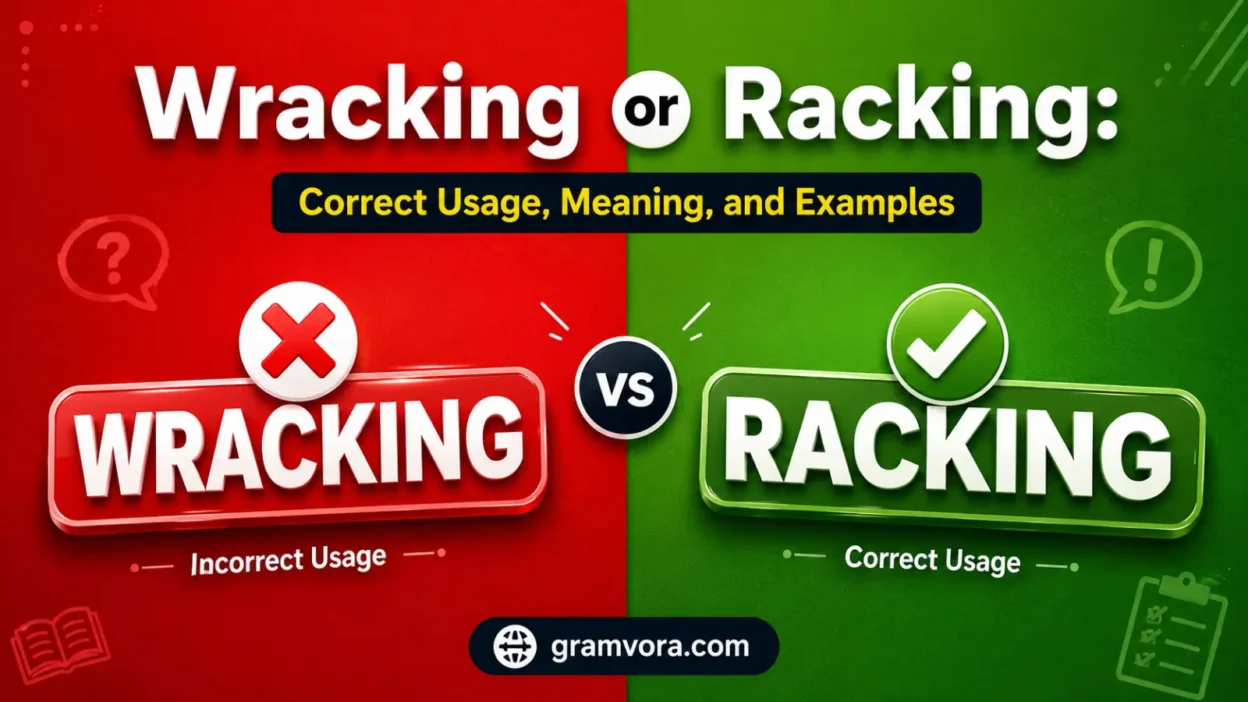
Wracking and racking are both real words, but they are not always interchangeable. Racking is the safer choice for common expressions about strain, pain, intense thought, or nervous tension. Wracking usually relates more directly to ruin or destruction.
Dictionaries accept both nerve-racking and nerve-wracking. Both racking your brain and wracking your brain also appear in edited writing. Even so, racking remains the more traditional and broadly preferred form in those expressions.
Quick Answer
Use racking in familiar American English expressions:
- racking your brain
- a nerve-racking interview
- racked with pain
- racking up points
Use wracking when the meaning is ruining or severely damaging something:
- waves wracking the coast
- a storm-wracked community
Wracking is also an accepted variant in nerve-wracking and wracking your brain. For polished writing, racking is usually the safest choice in those phrases.
Why People Confuse Them
Wracking and racking sound exactly alike: “RAK-ing.” Their meanings also overlap around suffering and damage. Rack can mean to strain or torment, while wrack can mean to ruin or destroy.
Because mental strain can feel destructive, both spellings seem logical in phrases about nerves and hard thinking. Long-standing mixed usage has made the overlap even stronger.
Key Differences At A Glance
| Context | Best Choice | Why |
|---|---|---|
| Thinking very hard | racking | The established phrase is racking your brain |
| Causing intense anxiety | racking | Nerve-racking is the traditional, generally preferred form |
| Causing pain or distress | racking | Rack commonly means to strain or torment |
| Ruining or devastating something | wracking | Wrack directly suggests destruction |
| Accumulating points, bills, or wins | racking | The fixed phrasal verb is rack up |
| Accepted variant in familiar phrases | wracking | Some dictionaries recognize nerve-wracking and wracking your brain |
Meaning and Usage Difference
The practical distinction is simple:
- Racking: straining, tormenting, arranging on a rack, or accumulating through rack up.
- Wracking: ruining or causing destructive damage; also an accepted variant in a few strain-related expressions.
Racking has a wider everyday range. You can rack billiard balls, rack up expenses, rack your brain, or feel racked with guilt. Those meanings do not transfer freely to wracking.
Wracking fits best when destruction is central: “The storm was wracking the coastal town.” The past-participle form wracked commonly appears in descriptions such as “a storm-wracked region.”
In nerve-racking and nerve-wracking, the meaning is the same: extremely stressful. The difference is preference, not definition.
Tone, Context, and Formality
Neither form is automatically formal or informal. Context matters more than tone.
Racking looks more conventional in business, academic, news, and professional writing when the phrase concerns mental effort or nervous tension. “The final interview was nerve-racking” is unlikely to distract careful readers.
Wracking can also be correct, but some readers may view it as disputed in nerve-wracking or wracking my brain. That makes racking the lower-risk choice when broad acceptance matters.
For literal destruction, wracking can sound vivid and serious. Wrecking may sometimes be clearer for a general audience.
Which One Should You Use?
Use racking for straining, tormenting, thinking intensely, arranging items on a rack, or accumulating something.
Use wracking for ruining or devastating. You may also use it in accepted variants such as nerve-wracking, especially when following a publication’s preferred style.
When no house preference is available, choose nerve-racking and racking your brain. These forms are traditional and widely accepted in American English.
When One Choice Sounds Wrong
Wracking is wrong in expressions that belong specifically to rack:
- “wracking up wins” should be “racking up wins.”
- “wracking the pool balls” should be “racking the pool balls.”
- “wracking the dishes” should be “racking the dishes,” though “placing them on the rack” sounds more natural.
Racking can be unclear when the intended meaning is direct destruction:
- “The hurricane was racking the coastline” may suggest torment.
- “The coastline was wracked by the hurricane” clearly emphasizes damage.
Nerve-wracking is accepted, but nerve-racking remains the safer default.
Common Mistakes (and Quick Fixes)
Mistake: Treating wracking as a misspelling.
Quick fix: Wracking is a real form that can mean ruining or destroying.
Mistake: Using wracking in rack up.
Quick fix: Write racking up points, costs, miles, wins, or debt.
Mistake: Writing nerve-wrecking.
Quick fix: Use nerve-racking or the accepted variant nerve-wracking.
Mistake: Assuming the words are interchangeable everywhere.
Quick fix: They overlap in a few expressions, not in every meaning.
Everyday Examples
- I have been racking my brain trying to remember the password.
- Waiting for the test results was nerve-racking.
- The company is racking up late fees.
- She racked the pool balls before the game.
- He was racked with guilt after missing the deadline.
- Powerful waves were wracking the coast.
- Volunteers entered the storm-wracked area.
- The final seconds were nerve-wracking.
- She spent the morning wracking her brain for a better headline.
The final two sentences show accepted variant use, although many editors would still prefer racking.
Dictionary-Style Word Details
Verb
- racking: The -ing form of rack. It can mean straining, tormenting, placing something on a rack, or accumulating through rack up.
- wracking: The -ing form of wrack. It can mean ruining or severely damaging. It also appears as a variant of racking in several familiar expressions.
Noun
- racking: It can act as a gerund, as in “the racking of the billiard balls.” It also has specialized noun uses outside this comparison.
- wracking: It can act as a gerund for an act of ruin or damage, but this use is uncommon in everyday American English.
Synonyms
- racking: Closest plain alternatives include straining, tormenting, distressing, agonizing, and taxing.
- wracking: Closest plain alternatives include ruining, wrecking, devastating, and destroying.
For nerve-racking or nerve-wracking, useful alternatives include stressful, tense, unsettling, and anxiety-inducing. Opposites include calming, reassuring, and relaxing.
Example Sentences
- racking: “We were racking our brains for a solution.”
- racking: “The rookie is racking up impressive numbers.”
- wracking: “Powerful waves were wracking the shoreline.”
- wracking: “The delay created a nerve-wracking hour.”
Word History
Rack and wrack entered English through different historical paths. Rack became associated with a frame used for stretching and later with strain, torment, and pain. Wrack developed meanings tied to wreckage, ruin, and destruction.
Those ideas eventually overlapped in expressions about nerves, pain, and intense thought. That overlap explains why both spellings now appear in several established phrases.
Phrases Containing
- racking: racking your brain, nerve-racking, racking up points, racking sobs, racked with pain
- wracking: wracking your brain, nerve-wracking, storm-wracked, wracked with grief
Racking is generally safer in brain- and nerve-related expressions. Wracking is especially natural when ruin or devastation is the main idea.
FAQs
Is it racking my brain or wracking my brain?
Racking my brain is the more traditional and widely preferred expression. It means thinking very hard to remember or solve something. Wracking my brain is also accepted by several dictionaries, but racking is the safer choice in formal American English.
Is it nerve-racking or nerve-wracking?
Both nerve-racking and nerve-wracking are accepted. They describe something extremely stressful, tense, or frightening. However, nerve-racking is the traditional form and is often preferred in edited and professional writing.
Is wracking a real word?
Yes. Wracking is a real word. It comes from the verb wrack, which can mean to ruin, damage, or destroy severely. For example, you might describe a community as storm-wracked after a powerful hurricane.
What does racking mean?
Racking can mean causing pain, strain, or distress. It can also mean placing something on a rack or accumulating something through the phrase rack up. Examples include racking pain, racking the pool balls, and racking up expenses.
Can racking and wracking be used interchangeably?
Not in every sentence. They overlap in expressions such as nerve-racking or nerve-wracking and racking or wracking your brain. However, only racking works naturally in phrases such as racking up points or racking the billiard balls.
Is nerve-wrecking correct?
Nerve-wrecking is usually considered a spelling mistake. Use nerve-racking or nerve-wracking instead. The word wrecking refers to destroying or severely damaging something and is not the standard form of this expression.
Should I write racked with pain or wracked with pain?
Racked with pain is the traditional and generally preferred form because rack can mean to torture or cause severe suffering. Wracked with pain also appears in modern writing, but some editors may prefer racked.
What is the easiest way to remember the difference?
Connect racking with strain and wracking with wreckage. Use racking for mental effort, pain, nervous tension, arranging objects, or accumulating totals. Use wracking when the main idea is serious damage, ruin, or destruction.
Conclusion
Both wracking and racking are valid, but they are not freely interchangeable. Racking is the best default for mental strain, nervous tension, severe pain, arranging items, and accumulating totals. Wracking is most precise for ruin or destructive damage.
For the least disputed choice, write racking your brain and nerve-racking. The forms wracking your brain and nerve-wracking are accepted variants, but they may draw more attention from careful readers.