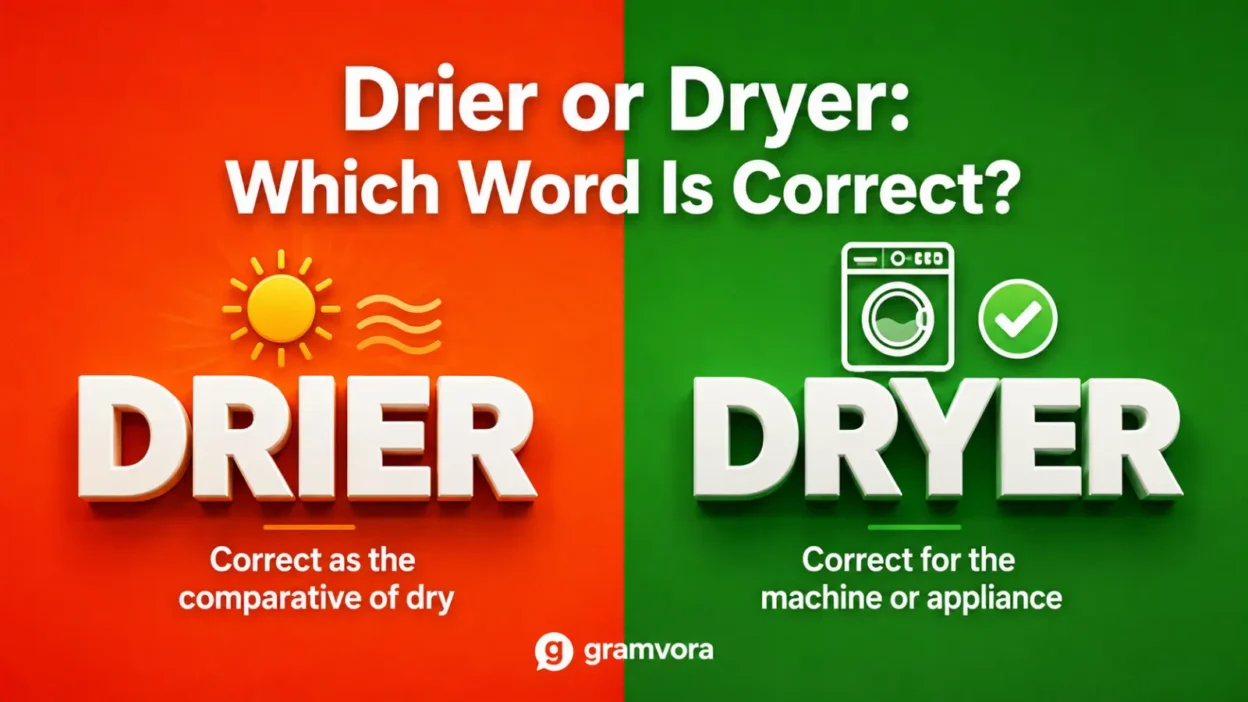
Both drier and dryer are real words. The correct choice depends on what you mean.
Use drier when you mean “more dry” or “less wet.”
Use dryer when you mean a machine or device that dries something.
That is the main difference. The confusing part is that some dictionaries still list drier as a noun variant for a drying device. In everyday US writing, though, dryer is the normal choice for appliances, and drier is the normal choice for comparisons.
Quick Answer
Choose drier when you are comparing dryness.
Correct: The air is drier in the winter.
Correct: This towel is drier than that one.
Choose dryer when you mean a machine or device.
Correct: I put the sheets in the dryer.
Correct: She packed a travel hair dryer.
A simple test helps: if you can replace the word with more dry, use drier. If you mean a thing that dries, use dryer.
Why People Confuse Them
People confuse drier and dryer because they look almost the same and sound the same in normal US speech.
They also come from the same base word, dry. One form developed as a comparison word. The other is used for a person, machine, or thing that dries.
The spelling is tricky because English often changes y to i before adding -er in comparisons. That gives us dry → drier, just like happy → happier.
But when -er creates a noun for a thing that performs an action, the spelling usually stays closer to the base word. That gives us dry → dryer, as in clothes dryer or hair dryer.
Key Differences At A Glance
| Context | Best Choice | Why |
|---|---|---|
| Comparing two towels | drier | It means more dry. |
| Talking about laundry equipment | dryer | It means a drying machine. |
| Describing winter air | drier | It compares the level of dryness. |
| Naming a bathroom hand device | dryer | It is a device that dries hands. |
| Describing wine with less sweetness | drier | It compares taste style. |
| Talking about a hair tool | dryer | It means a device used to dry hair. |
Meaning and Usage Difference
Drier is usually an adjective. More exactly, it is the comparative form of dry. It describes something as having less moisture than something else, or less moisture than before.
Examples:
The trail is drier after three days of sun.
My skin feels drier in January.
This chicken is drier than the one we made last week.
Dryer is usually a noun. It names something that dries. In US English, it most often means an appliance or device.
Examples:
The dryer stopped halfway through the cycle.
Use the hand dryer by the sink.
My hotel room had a hair dryer.
Pronunciation is not a useful way to tell them apart. In everyday US speech, drier and dryer are pronounced alike: “DRY-er.” The difference is in meaning and grammar, not sound.
Tone, Context, and Formality
Neither word is more formal by itself. The right choice depends on the sentence.
Drier fits descriptions, comparisons, weather reports, food comments, skin care, wine descriptions, and any sentence about the degree of dryness.
Dryer fits home, laundry, appliance, bathroom, salon, and equipment contexts.
In careful US writing, use dryer for the machine even though drier can appear in dictionaries as a noun variant. Readers expect dryer in phrases like clothes dryer, hair dryer, and hand dryer.
Using drier for the appliance is usually understandable, but it may look old-fashioned, technical, or simply mistaken to many US readers.
Which One Should You Use?
Use drier when the sentence answers “how dry?”
Examples:
The basement is drier now.
Denver is usually drier than Miami.
These crackers are drier than I expected.
Use dryer when the sentence answers “what object?”
Examples:
The dryer needs a new lint screen.
The gym installed a faster hand dryer.
Do not leave the hair dryer plugged in.
Here is the quick memory aid:
• Drier = more dry
• Dryer = drying device
That rule will work for almost every everyday US sentence.
When One Choice Sounds Wrong
Dryer sounds wrong when the sentence is comparing dryness.
Awkward: The air is dryer today.
Better: The air is drier today.
Awkward: This paint is dryer than the first coat.
Better: This paint is drier than the first coat.
Drier sounds wrong when the sentence names a common appliance.
Awkward: Clean the lint trap in the drier.
Better: Clean the lint trap in the dryer.
Awkward: I forgot my hair drier.
Better: I forgot my hair dryer.
The first pair needs an adjective. The second pair needs a noun.
Common Mistakes (and Quick Fixes)
Mistake: I put the towels in the drier.
Fix: I put the towels in the dryer.
Mistake: The towels are dryer now.
Fix: The towels are drier now.
Mistake: Arizona is dryer than Florida.
Fix: Arizona is drier than Florida.
Mistake: The hotel has no hair drier.
Fix: The hotel has no hair dryer.
Mistake: My hands are dryer after using the towel.
Fix: My hands are drier after using the towel.
A good fix is to ask: Am I describing a condition, or naming a device? Condition takes drier. Device takes dryer.
Everyday Examples
I moved the laundry from the washer to the dryer.
The porch is drier than the grass.
This apartment feels drier when the heat is running.
The public restroom has a loud hand dryer.
My lips get drier during cold weather.
The repair tech said the dryer belt was broken.
I prefer a drier white wine with seafood.
The second batch of brownies came out drier.
She used a hair dryer before work.
The desert air felt much drier than the air back home.
Dictionary-Style Word Details
Verb
• drier: Not commonly used as a verb in standard US English. It is mainly the comparative adjective form of dry. For the verb, use dry, dries, dried, or drying.
• dryer: Not commonly used as a verb in standard US English. It is mainly a noun. Say “dry the clothes,” not “dryer the clothes.”
Noun
• drier: Can be listed as a noun meaning something that dries, but this is not the usual everyday US spelling for common appliances. For normal home and personal-care devices, dryer is clearer.
• dryer: A noun meaning a thing, machine, or device that dries something. Common examples include clothes dryer, hair dryer, and hand dryer.
Synonyms
• drier: Closest plain alternatives include more dry, less wet, less humid, and more arid. These are not always exact matches in every sentence.
• dryer: Closest plain alternatives include drying machine, drying device, and drying appliance. For specific items, use clothes dryer, hair dryer, or hand dryer.
Clear antonyms depend on context. For drier, useful opposites include wetter or more humid. For dryer, there is no clean everyday opposite because it names a device, not a quality.
Example Sentences
• drier: The towels were drier after ten more minutes outside.
• drier: My skin gets drier when the furnace runs all day.
• drier: This trail is drier than the one by the creek.
• dryer: The dryer buzzed when the cycle ended.
• dryer: Please clean the lint trap before starting the dryer.
• dryer: The locker room has one working hand dryer.
Word History
• drier: Comes from dry plus the comparative ending -er. The spelling changes y to i, which is common in words like drier and driest.
• dryer: Comes from dry plus -er as a noun-forming ending. It names a thing or person that performs the action of drying. The exact history of how usage separated in every context is not something to overstate; modern US usage keeps the common roles clear.
Phrases Containing
• drier: drier than, drier air, drier climate, drier skin, drier wine, much drier, getting drier
• dryer: clothes dryer, hair dryer, hand dryer, dryer vent, dryer sheet, dryer cycle, washer and dryer
Conclusion
The choice between drier and dryer is simple once you look at the job the word is doing.
Use drier when you mean more dry or less wet.
Use dryer when you mean a machine or device that dries something.