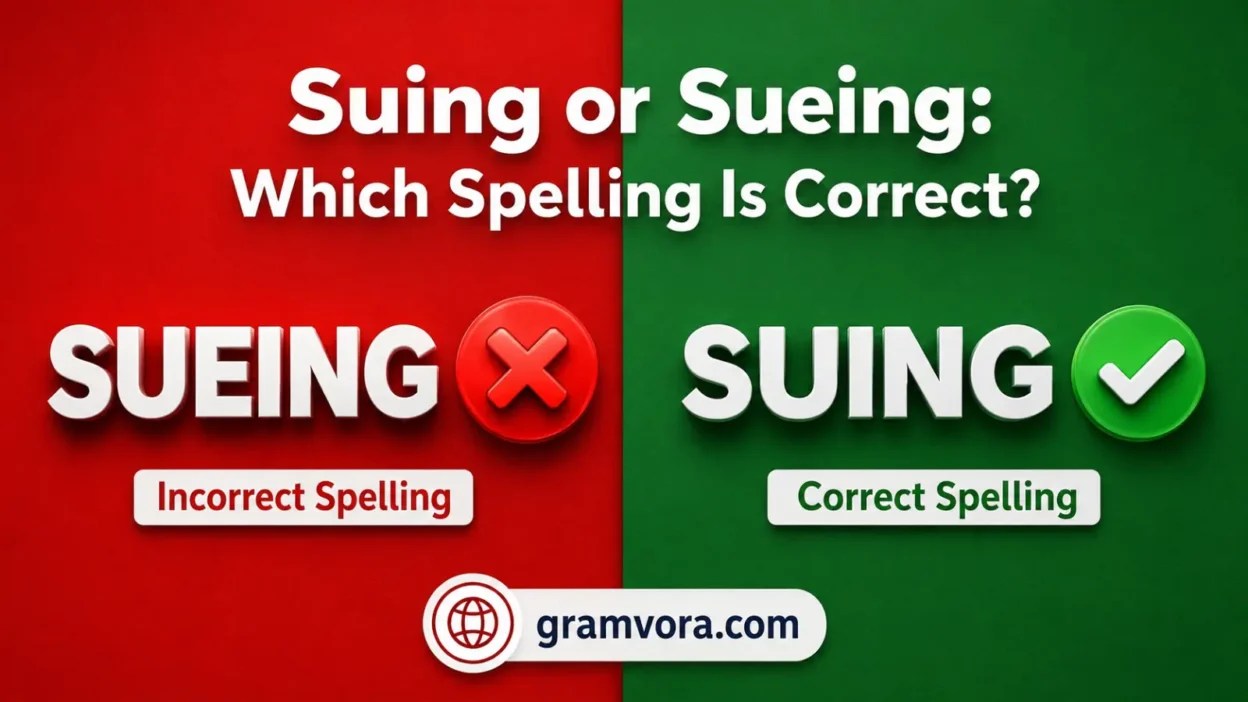
Choosing between suing and sueing may seem difficult because the base verb is spelled sue. Many writers assume they should keep the final e when adding -ing.
Standard English follows a different pattern. The accepted form is suing, with the final e removed. Sueing points to the same intended action, but it is a nonstandard spelling that should not appear in ordinary edited writing.
Quick Answer
Suing is the correct spelling in American and British English. It is the present participle and gerund form of the verb sue.
Sueing is a documented nonstandard form, not an accepted regional alternative.
Correct: The customer is suing the company.
Incorrect: The customer is sueing the company.
Why People Confuse Them
The confusion begins with the spelling of the base verb sue. Writers may simply attach -ing and produce sueing:
sue + ing = sueing
However, the standard form removes the final e before the ending is added:
sue − e + ing = suing
The three-vowel sequence in suing can also look unusual. Some writers compare it with seeing, which keeps both e letters. That comparison does not determine the spelling of suing, however. Each base word follows its established form.
Key Differences At A Glance
| Feature | Suing | Sueing |
|---|---|---|
| Status | Standard spelling | Nonstandard spelling |
| Base word | Sue | Sue |
| Meaning intended | Taking legal action or formally seeking something | The same intended meaning |
| US usage | Correct | Avoid |
| UK usage | Correct | Avoid |
| Recommended in edited writing | Yes | No |
The difference is spelling acceptability, not meaning, tense, pronunciation, or regional vocabulary.
Are They the Same Word?
Both forms are intended to represent the -ing form of sue. Therefore, this is not a comparison between two separate words with different meanings.
The important distinction is standardness. Suing is the established form found in dictionaries, legal reporting, court-related writing, and ordinary communication. Sueing occurs as a nonstandard formation, usually because a writer keeps the final e from sue.
The standard pronunciation is SOO-ing, with two syllables. Removing the e does not change the long “oo” sound heard in the base verb.
US vs UK Preference
There is no meaningful US-versus-UK split in this comparison. Both major varieties use suing.
| Context | Best Choice | Why |
| American English | Suing | It is the standard American form |
| British English | Suing | British dictionaries list the same form |
| Legal documents | Suing | It is the accepted professional spelling |
| School assignments | Suing | It follows standard written English |
| Emails and messages | Suing | Informal context does not change the spelling |
| News reports | Suing | Edited publications use the standard form |
Do not choose sueing to make a sentence look more British. It is not a standard British variant.
Which Spelling Should You Use?
Use suing whenever you need the -ing form of sue.
You may use it in a continuous verb phrase:
The tenant is suing the property owner.
You may also use it after another verb:
They discussed suing for damages.
The same spelling works whether the action is happening now, being considered, or described as an activity.
A useful memory pattern is:
Sue loses its final e before -ing.
Sue → suing
When One Spelling Looks Wrong
Sueing looks wrong in standard prose because it keeps a letter that does not appear in the accepted -ing form.
It is especially noticeable in formal contexts:
Incorrect: Our client is sueing for compensation.
Correct: Our client is suing for compensation.
The incorrect form may also distract readers in business emails, school papers, news copy, and public statements. Although readers will probably understand the intended meaning, they may view it as a careless spelling error.
Common Mistakes (and Quick Fixes)
A common mistake is attaching -ing directly to sue. Remove the final e instead.
Incorrect: She plans on sueing the contractor.
Correct: She plans on suing the contractor.
Another error comes from copying the spelling pattern in seeing. The verb see becomes seeing, but sue becomes suing.
Some writers also believe sueing is British. Both American and British usage favor suing.
Finally, do not confuse suing with sewing. They sound similar in some speech, but sewing refers to joining or repairing material with a needle and thread.
Everyday Examples
The following sentences use the standard spelling naturally:
- Maya is suing her former employer for unpaid wages.
- The customer considered suing after the defective product caused damage.
- Several residents are suing over the construction project.
- The business denied that it was suing its former partner.
- Before suing, the couple tried to resolve the dispute privately.
- He spoke with an attorney about suing for compensation.
- The newspaper reported that the actor was suing for defamation.
- Suing may take more time and money than reaching a settlement.
In each sentence, replacing suing with sueing would create a nonstandard spelling.
Dictionary-Style Word Details
Verb
Suing: The standard present participle of sue. It appears in continuous verb phrases such as “is suing,” “was suing,” and “has been suing.”
Sueing: A nonstandard spelling of the same verb form. Avoid it in edited American and British English.
Noun
Suing: Not normally treated as a separate common noun. However, it can function as a gerund, which is a verb form used in a noun-like position.
Example: Suing was their last option.
Sueing: Not the standard spelling when the form has a noun-like gerund function.
Synonyms
For the common legal meaning, the closest plain alternatives to suing include:
- Taking legal action
- Filing a lawsuit
- Bringing a claim
- Going to court
- Litigating
- Bringing an action
These alternatives apply to the intended meaning behind both spellings. However, sueing remains nonstandard.
There is no single exact antonym. Depending on the situation, practical opposites may include settling, withdrawing the claim, or dropping the case.
Example Sentences
Suing:
- The driver is suing for medical expenses.
- They are suing the manufacturer over the faulty part.
- She decided against suing after the parties reached an agreement.
- The organization denied suing anyone involved in the dispute.
Sueing:
- “The driver is sueing for medical expenses” is nonstandard.
- Change sueing to suing in formal and informal writing.
Word History
The verb sue entered English through French and originally carried the broader idea of following, pursuing, petitioning, or seeking something. Its best-known modern meaning is to bring or pursue legal action.
Modern dictionaries consistently record its principal forms as sue, sues, sued, and suing. The nonstandard spelling sueing appears because some writers keep the visible form of the base word when adding -ing.
Phrases Containing
Standard phrases with suing include:
- Suing for damages
- Suing for compensation
- Suing for negligence
- Suing for breach of contract
- Suing the company
- Suing a former employer
- Suing over an injury
- Considering suing
- Threatening to sue
- Suing for peace
Versions such as sueing for damages or sueing the company should be corrected to suing.
FAQs
Is suing or sueing correct?
Suing is the correct spelling. It is the standard -ing form of the verb sue. Avoid sueing in formal and informal writing.
Why does sue become suing?
The verb sue drops its final e before adding -ing. Therefore, the correct formation is sue + ing = suing.
Is sueing accepted in American English?
No. Standard American English uses suing. Dictionaries may record sueing as a nonstandard form, but careful writers should not use it.
Is sueing correct in British English?
No. British English also uses suing. This comparison does not involve a US-versus-UK spelling difference.
How do you use suing in a sentence?
You can write, “The customer is suing the company for damages.” You can also write, “They considered suing after the contract dispute.”
Is suing a verb or a noun?
Suing mainly functions as the present participle of sue, as in “She is suing.” It can also work as a gerund, as in “Suing was their final option.”
How do you pronounce suing?
Pronounce suing as SOO-ing. It has two syllables and keeps the long “oo” sound from the verb sue.
What is an easy way to remember the spelling?
Remember this simple pattern: sue loses the final e before -ing. Write sue, sued, and suing.
Conclusion
Use suing, not sueing, when writing the -ing form of sue. The accepted formation removes the final e before adding the ending: sue → suing.
This spelling is standard in both American and British English. Sueing represents the same intended verb form, but dictionaries label it nonstandard rather than an equal regional variant.