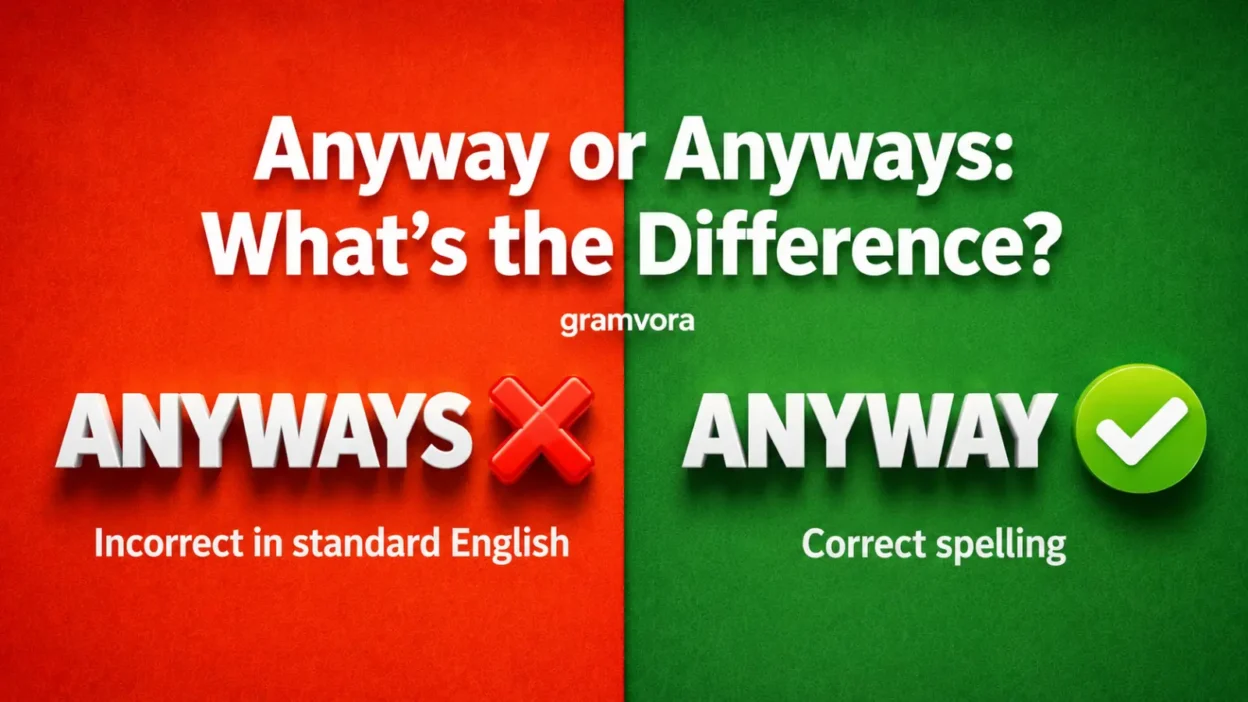
Many English learners and native speakers wonder whether “anyway” or “anyways” is correct. The short answer is simple: both words exist, but they are not used the same way.
In modern American English, “anyway” is the standard choice. It works in formal writing, professional communication, school assignments, emails, and everyday speech.
“Anyways” is considered informal. Many people use it in casual conversation, but some readers and listeners still see it as slangy or nonstandard.
That difference is what causes the confusion.
This guide explains exactly when to use each word, when one sounds wrong, and which choice is safer in different situations.
Quick Answer
If you are unsure which word to use, choose “anyway.”
It is the standard form in American English and works in almost every situation.
“Anyways” is mainly used in casual speech and informal conversation. It is common in everyday American English, but it can sound unprofessional in formal settings.
Here is the easiest rule:
| Context | Best Choice | Why |
|---|---|---|
| School writing | anyway | Standard and widely accepted |
| Business emails | anyway | Professional tone |
| Casual conversation | anyway or anyways | Both are common |
| Academic work | anyway | Preferred in formal English |
| Text messages | anyway or anyways | Informal tone is acceptable |
| Job applications | anyway | Safer and more polished |
Why People Confuse Them
People confuse these words because they usually mean the same thing.
Both can mean:
- “regardless”
- “in any case”
- “despite that”
For example:
- “I was tired, but I went anyway.”
- “I was tired, but I went anyways.”
Both sentences communicate the same basic idea.
The confusion becomes stronger because many Americans regularly say “anyways” in conversation. You may hear it:
- in podcasts
- on social media
- in movies
- during casual conversations
- in regional speech
So people naturally wonder:
“If everyone says it, why do teachers and editors still prefer ‘anyway’?”
The answer is tone and formality.
“Anyway” is the standard written form.
“Anyways” is more conversational and informal.
Key Differences At A Glance
| Feature | anyway | anyways |
|---|---|---|
| Standard in formal US English | Yes | Usually no |
| Common in casual speech | Yes | Yes |
| Used in academic writing | Yes | Rarely |
| Sounds conversational | Sometimes | Strongly |
| Accepted in dictionaries | Yes | Yes |
| May sound slangy to some readers | No | Sometimes |
| Best all-purpose choice | Yes | No |
One important point matters here:
“Anyways” is a real word. It appears in major dictionaries.
However, dictionary acceptance does not automatically mean equal formality.
That is the key difference.
Meaning and Usage Difference
In most modern American English, “anyway” and “anyways” have the same meaning.
They are both adverbs.
They often introduce:
- a return to the main topic
- a conclusion
- a contrast
- a dismissal of an objection
Examples:
- “Anyway, let’s continue.”
- “Anyways, where were we?”
- “She didn’t agree, but we went anyway.”
- “I’m going anyways.”
The meaning usually stays the same.
The real difference is usage style.
“Anyway” in Standard English
“Anyway” works everywhere:
- formal writing
- essays
- journalism
- presentations
- professional emails
- normal conversation
Examples:
- “Anyway, the meeting starts at 9.”
- “He apologized anyway.”
- “Anyway, I appreciate your help.”
It sounds natural without sounding too casual.
“Anyways” in Informal English
“Anyways” is more conversational.
It often appears:
- in relaxed speech
- in texting
- in storytelling
- in friendly conversation
Examples:
- “Anyways, I ended up leaving early.”
- “I wasn’t feeling great, but I went anyways.”
Many Americans use it naturally in speech, especially when changing topics or continuing a story.
Still, some people strongly dislike hearing or seeing it in formal writing.
Pronunciation
Pronunciation differences are small but noticeable.
- “Anyway” sounds like: EN-ee-way
- “Anyways” sounds like: EN-ee-wayz
The extra “z” sound in “anyways” gives it a more casual and conversational rhythm.
That is one reason it often feels more informal.
Tone, Context, and Formality
This is where the real distinction matters.
“Anyway” Sounds:
- neutral
- polished
- standard
- professional
- widely accepted
“Anyways” Sounds:
- casual
- conversational
- relaxed
- regional to some listeners
- slightly slangy to some readers
In spoken American English, many people barely notice the difference.
In writing, the difference becomes more important.
Formal Contexts
Use “anyway” in:
- resumes
- cover letters
- college essays
- research papers
- reports
- professional communication
Example:
- “Anyway, the data shows a clear increase.”
Using “anyways” here may make the writing seem less polished.
Casual Contexts
“Anyways” is more acceptable in:
- texting
- social media posts
- casual dialogue
- friendly emails
- storytelling
Example:
- “Anyways, that’s what happened.”
In these settings, it often sounds natural.
Regional and Personal Preference
Some Americans use “anyways” constantly.
Others never use it at all.
For some listeners, it sounds completely normal.
For others, it sounds grammatically wrong even though dictionaries include it.
That emotional reaction is part of why debates about this word continue.
Which One Should You Use?
If you want one safe answer, use “anyway.”
It works in nearly every situation and avoids criticism.
Use “anyways” only when:
- the tone is intentionally casual
- you are writing dialogue
- you want relaxed conversational speech
- the audience will not mind informal wording
Here is a practical guide:
Use “Anyway” When:
- writing professionally
- speaking formally
- communicating with clients or teachers
- creating polished content
- you want the safest option
Use “Anyways” When:
- texting friends
- telling stories casually
- writing realistic dialogue
- matching informal speech patterns
Even many people who say “anyways” in conversation still write “anyway” in professional settings.
That tells you a lot about the difference in tone.
When One Choice Sounds Wrong
Sometimes one option sounds unnatural depending on the situation.
Formal Example
Correct:
- “Anyway, thank you for your time.”
Less natural:
- “Anyways, thank you for your time.”
The second version sounds too casual for professional communication.
Academic Example
Correct:
- “The experiment failed anyway.”
Less natural:
- “The experiment failed anyways.”
In academic writing, “anyways” can distract readers.
Casual Dialogue Example
Natural:
- “Anyways, I called him back later.”
Also natural:
- “Anyway, I called him back later.”
Both work casually, though “anyways” sounds more conversational.
Overuse Problem
Some speakers repeatedly say:
- “Anyways… anyways… anyways…”
That repetition can sound filler-heavy or sloppy in speech.
Using either form too often weakens writing and conversation.
Common Mistakes (and Quick Fixes)
Mistake 1: Thinking “Anyways” Is Not a Real Word
Wrong idea:
- “Anyways isn’t a word.”
Reality:
- It is a real word found in major dictionaries.
- It is simply more informal.
Quick fix:
- Understand the difference between “real” and “formal.”
Mistake 2: Using “Anyways” in Formal Writing
Less polished:
- “Anyways, attached is the report.”
Better:
- “Anyway, attached is the report.”
Quick fix:
- Use “anyway” for professional writing.
Mistake 3: Confusing “Anyway” With “Any Way”
These are different.
“Anyway” is an adverb:
- “I’m going anyway.”
“Any way” refers to a method or manner:
- “You can solve it any way you want.”
Quick fix:
- If you mean “regardless,” use “anyway.”
Mistake 4: Adding “S” Because Other Words End That Way
Some people assume “anyways” must be more correct because words like:
- always
- sideways
- anyways
look similar.
But English does not always follow predictable patterns.
Quick fix:
- Remember that “anyway” is still the standard formal form.
Everyday Examples
Here are realistic American English examples showing how people actually use these words.
Everyday Speech
- “Anyways, I finally finished the project.”
- “Anyway, what are you doing tonight?”
- “I didn’t really want to go, but I went anyway.”
- “She was already late anyways.”
Professional Situations
- “Anyway, we should review the budget again.”
- “Anyway, thank you for meeting with us.”
Most professionals avoid “anyways” here.
Text Messages
- “Anyways lol, I’ll call you later.”
- “Anyway, see you tomorrow.”
Both feel natural in texting.
Storytelling
- “Anyways, that’s when everything got weird.”
- “Anyway, we made it home safely.”
“Anyways” often sounds more relaxed and spoken.
Dictionary-Style Word Details
Verb
anyway:
Not commonly used as a verb in standard US English.
anyways:
Not commonly used as a verb in standard US English.
Noun
anyway:
Not commonly used as a noun in standard US English.
anyways:
Not commonly used as a noun in standard US English.
Both words are mainly used as adverbs.
Synonyms
anyway:
Closest plain alternatives:
- anyhow
- regardless
- in any case
- at any rate
anyways:
Closest plain alternatives:
- anyway
- anyhow
- regardless
There are no strong direct antonyms because these words mainly function as discourse markers or adverbs.
Example Sentences
anyway:
- “I knew it was risky, but I did it anyway.”
- “Anyway, let’s move on.”
- “She didn’t need help anyway.”
anyways:
- “Anyways, that’s the full story.”
- “I was going anyways.”
- “Anyways, thanks for listening.”
Word History
anyway:
The standard form has existed in English for centuries and became the preferred formal written version in modern usage.
anyways:
This word has also existed for hundreds of years. Historical evidence shows that it is not new slang. However, modern American English still treats it as more informal and conversational.
Some speakers strongly dislike it, while others use it naturally every day.
Phrases Containing
anyway:
- anyway you want
- anyway possible
- anyway, moving on
- anyway, as I was saying
anyways:
- anyways then
- anyways, back to the point
- anyways, what happened next?
These conversational phrases appear mostly in informal speech.
Conclusion
The difference between “anyway” and “anyways” is mostly about tone and formality, not meaning.
“Anyway” is the standard choice in American English. It works in formal writing, professional communication, academic work, and casual conversation.
“Anyways” is informal and conversational. Many Americans say it naturally in speech, but some readers still view it as too casual for polished writing.