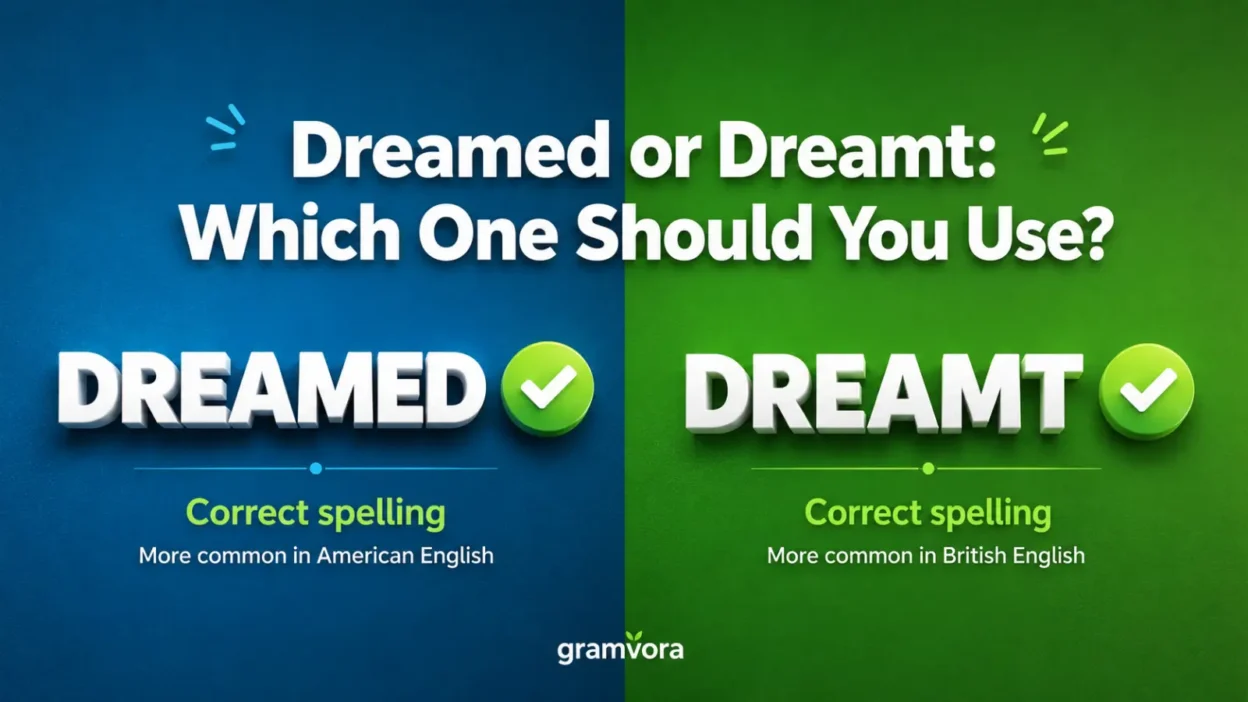
Dreamed and dreamt are both correct. They are two past-tense and past-participle forms of the verb dream.
For most American writing, dreamed is the better default. It sounds natural in school papers, emails, articles, stories, and everyday speech.
Dreamt is also a real word. It is not a mistake. In the US, though, it can sound a little more literary, old-fashioned, or British.
Quick Answer
Use dreamed if you want the safest choice in American English.
Use dreamt if you want a slightly shorter, more traditional sound, or if you are writing in a British style.
Both forms mean the same thing:
- I dreamed about the beach last night.
- I dreamt about the beach last night.
Neither sentence is wrong. The difference is mostly usage, audience, and tone.
Why People Confuse Them
People confuse dreamed and dreamt because English has two ways to form some past-tense verbs.
Dreamed follows the regular pattern: add -ed.
Dreamt follows an irregular pattern: the ending changes to -t.
That same kind of variation appears in pairs such as learned/learnt and burned/burnt. In American English, the -ed form is usually more common.
Key Differences At A Glance
| Context | Best Choice | Why |
|---|---|---|
| Everyday American writing | dreamed | It is the most natural US default. |
| School or business writing | dreamed | It sounds clear, standard, and neutral. |
| Casual speech in the US | dreamed | Most Americans expect this form. |
| British-style writing | dreamt | It is more common in British use. |
| Literary or reflective tone | dreamt | It can sound softer or more old-fashioned. |
| Past participle after “has” or “had” | dreamed or dreamt | Both are grammatically possible. |
| When unsure | dreamed | It is the safer choice for US readers. |
Meaning and Usage Difference
There is no real meaning difference between dreamed and dreamt.
Both can mean that you had images, thoughts, or feelings while sleeping:
- I dreamed about missing my flight.
- I dreamt about missing my flight.
Both can also mean that you imagined, hoped for, or pictured something:
- She dreamed of opening her own bakery.
- She dreamt of opening her own bakery.
The main difference is not meaning. It is the form readers expect.
Dreamed is the regular form. It feels more common and more neutral in American English.
Dreamt is the irregular form. It is still correct, but US readers may notice it more.
Tone, Context, and Formality
Dreamed works in almost every US context. It is plain, modern, and easy to read.
Use it in:
- emails
- essays
- work messages
- news-style writing
- casual stories
- instructions or explanations
Dreamt can work well when the sentence has a softer or more reflective tone.
For example:
- She dreamt of a quieter life by the water.
That sentence sounds a little more story-like than:
- She dreamed of a quieter life by the water.
Still, this is a tone choice, not a rule. You do not need dreamt to sound thoughtful. Dreamed can also be warm, serious, or poetic depending on the sentence.
Pronunciation only matters a little here. Dreamed is often said like “dreemd.” Dreamt is said like “dremt.” The spelling difference is more important than the sound difference for most writers.
Which One Should You Use?
For a US audience, choose dreamed most of the time.
It is the best choice when your goal is to sound natural, clear, and current.
Choose dreamt when you have a reason to prefer it. Maybe your piece has a British voice. Maybe the rhythm of the sentence sounds better with one syllable and a crisp ending.
Compact comparison:
- Dreamed: regular form, common in the US, neutral tone.
- Dreamt: irregular form, accepted, often more British or literary in feel.
- Both: past tense and past participle of dream.
- Best US default: dreamed.
When One Choice Sounds Wrong
Neither word is grammatically wrong by itself. What can sound wrong is the fit.
In a plain American work email, dreamt may sound too stylized:
- Less natural: I dreamt we could finish the report by Friday.
- More natural: I dreamed we could finish the report by Friday.
In a personal essay or story, dreamt may fit nicely:
- I dreamt of that house for years.
Mixing both forms without a reason can also sound uneven:
- Awkward: I dreamed about the trip, and later I dreamt about missing the plane.
- Better: I dreamed about the trip, and later I dreamed about missing the plane.
Pick one form and stay consistent unless you are quoting someone or making a clear style shift.
Common Mistakes (and Quick Fixes)
Mistake: Thinking dreamt is not a real word.
Fix: Dreamt is correct, but dreamed is usually better for US writing.
Mistake: Thinking the words have different meanings.
Fix: They mean the same thing as past forms of dream.
Mistake: Using dreamt only for sleep and dreamed only for goals.
Fix: Both can be used for sleep dreams and hopes.
Mistake: Switching forms in the same paragraph.
Fix: Use one form consistently.
Mistake: Writing dreampt.
Fix: The correct spelling is dreamt, not dreampt.
Everyday Examples
I dreamed about my old neighborhood last night.
She dreamed of getting into a good nursing program.
We dreamed up a new name for the podcast.
He said he had dreamed about that moment since high school.
I dreamt I was walking through an empty airport.
They dreamt of a small cabin in the mountains.
She had dreamt about performing on that stage for years.
No one dreamed the little shop would become so popular.
Dictionary-Style Word Details
Verb
dreamed: A past-tense and past-participle form of the verb dream. It can describe sleeping dreams or hopes.
Example: I dreamed that my phone kept ringing.
dreamt: Also a past-tense and past-participle form of dream. It has the same meaning, but it is less common in everyday American use.
Example: I dreamt that my phone kept ringing.
Noun
dreamed: Not commonly used as a noun in standard US English. It is a verb form.
dreamt: Not commonly used as a noun in standard US English. It is a verb form.
The noun form is dream:
- That was a strange dream.
- Her dream is to own a home.
Synonyms
For dreamed and dreamt, exact synonyms depend on the meaning.
Closest plain alternatives for sleep meaning:
- imagined while asleep
- saw in a dream
Closest plain alternatives for hope or ambition meaning:
- hoped
- imagined
- pictured
- envisioned
Clear antonyms do not always fit because dreamed and dreamt are past forms of an action. In some contexts, possible opposites include woke, faced reality, or stopped imagining, but these are not exact one-word antonyms.
Example Sentences
dreamed: I dreamed about snow, even though it was July.
dreamt: I dreamt about snow, even though it was July.
dreamed: Marcus always dreamed of coaching his son’s team.
dreamt: Marcus always dreamt of coaching his son’s team.
dreamed: We never dreamed the video would get that much attention.
dreamt: We never dreamt the video would get that much attention.
Word History
Dreamed shows the regular English past-tense pattern: verb + -ed.
Dreamt shows an irregular past-tense pattern with a -t ending.
The base word dream is old, and both past forms became established over time. For this comparison, the practical point is simple: both forms survived in modern English, but dreamed is the more natural default for American readers.
Phrases Containing
dreamed:
- dreamed about
- dreamed of
- dreamed that
- dreamed up
- had dreamed
- always dreamed
dreamt:
- dreamt about
- dreamt of
- dreamt that
- dreamt up
- had dreamt
- always dreamt
In US writing, dreamed about, dreamed of, and dreamed up usually sound more natural.
Conclusion
Dreamed and dreamt are both correct. They have the same meaning and the same basic grammar role.
For American English, dreamed is the best default. It is clear, common, and neutral.