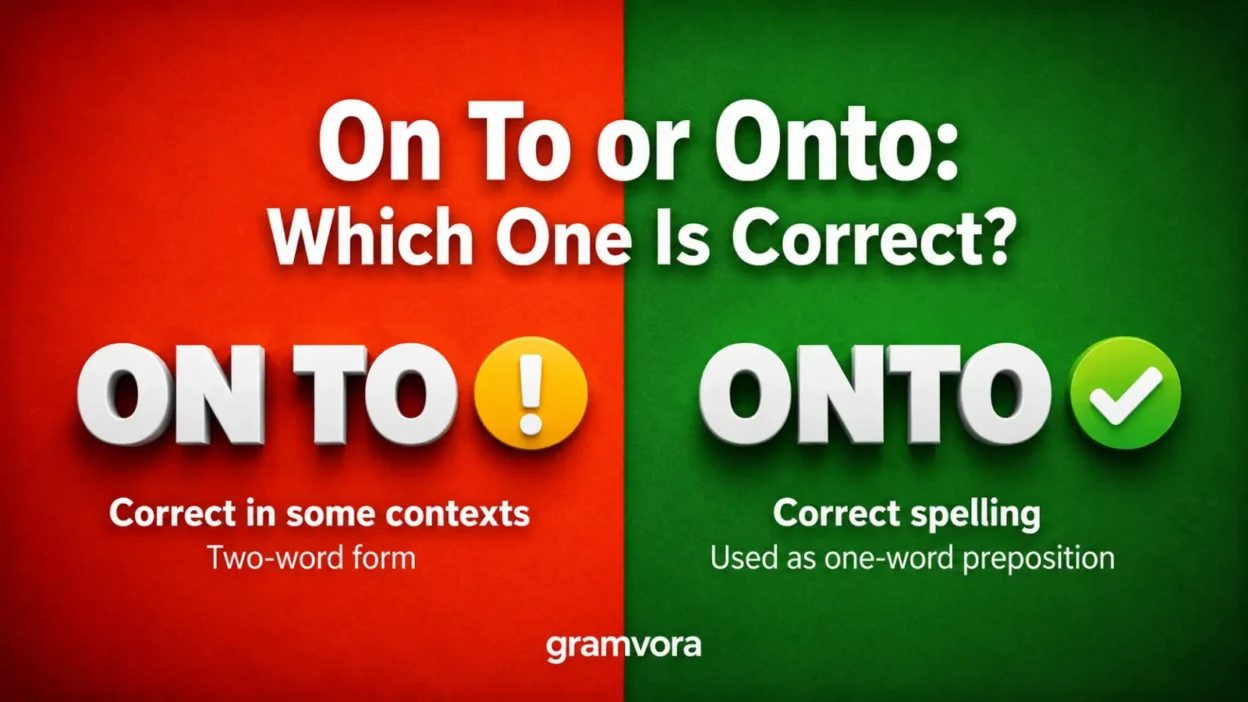
On to and onto are both correct, but they do not always mean the same thing. The space matters.
Use onto when something moves to a place, surface, position, or state: “She stepped onto the porch.”
Use on to when on belongs to a verb phrase and to starts the next part of the sentence: “Let’s move on to the next question.”
That is the core difference. The tricky part is that both forms can look natural in real sentences, especially with verbs like move, go, turn, log, and hold.
Quick Answer
Choose onto when the idea is “to a position on” something.
Example:
“The dog jumped onto the couch.”
Choose on to when the sentence uses a verb phrase such as move on, go on, pass on, log on, or hold on.
Example:
“We moved on to the next topic.”
A quick test helps: ask whether on belongs with the verb before it. If it does, use on to.
Why People Confuse Them
People confuse on to and onto because they sound almost the same. They also appear after the same kinds of action verbs.
Compare these:
“She moved onto the stage.”
“She moved on to the next topic.”
The first sentence describes physical movement to a stage. The second sentence describes progress from one topic to another. The words look similar, but the grammar is different.
Another reason is that some expressions allow both forms in common use. For example, many people write log onto your account, while careful grammar explanations often treat log on to your account as clearer because log on is the verb phrase.
Key Differences At A Glance
| Context | Best Choice | Why |
|---|---|---|
| Physical movement to a surface | onto | “She climbed onto the roof.” |
| Moving to the next step or topic | on to | “Let’s move on to the budget.” |
| Awareness or suspicion | onto | “The teacher is onto the prank.” |
| A phrasal verb ending in “on” | on to | “He passed the note on to Mia.” |
| Turning toward a road or route | onto | “Turn right onto Main Street.” |
| Keeping or retaining something | on to | “Hold on to your receipt.” |
Meaning and Usage Difference
Onto is one word. It is usually a preposition. It shows movement toward a place, surface, position, or target.
Examples:
“Please place the boxes onto the shelf.”
“The runner stepped onto the track.”
“The truck turned onto the highway.”
It can also show awareness:
“I think she’s onto the surprise.”
“The detective is onto the suspect.”
On to is two separate words. The word on often belongs to the verb before it. Then to begins the next phrase.
Examples:
“Let’s move on to the next item.”
“She went on to become a doctor.”
“Please pass this on to your manager.”
In these sentences, the real verb phrases are move on, went on, and pass on.
Compact comparison:
• Onto = movement to a place, surface, target, or awareness.
• On to = a verb phrase ending in on plus to before the next idea.
• Onto the stage means moving to the stage.
• On to the next stage means continuing to the next step.
Tone, Context, and Formality
There is no major formality difference between on to and onto in standard US English. The better choice depends on meaning, not tone.
Onto sounds natural in physical directions, sports writing, instructions, and everyday speech:
“The kids ran onto the field.”
On to sounds natural in presentations, emails, reports, school writing, and step-by-step directions:
“Now we’ll move on to the results.”
Be careful with business and school writing. A sentence like “Let’s move onto the next section” may be understood, but move on to is usually clearer when you mean “continue to.”
Pronunciation does not need much attention here. In normal speech, on to and onto can sound very close, so the choice is mainly a writing issue.
Which One Should You Use?
Use onto when the sentence answers “Where did it move?”
“The cat jumped onto the counter.”
“The file uploaded onto the server.”
“She walked onto the balcony.”
Use on to when the sentence answers “What happened next?”
“We moved on to chapter three.”
“He went on to win the award.”
“Send the message on to the team.”
Use onto with awareness:
“My parents are onto us.”
“She is onto the scam.”
Use on to when on belongs to the verb:
“Keep on to the end of the road” is awkward in most cases.
“Keep on going to the end of the road” is clearer.
When One Choice Sounds Wrong
Onto sounds wrong when it breaks a verb phrase.
Wrong: “Let’s move onto the next question.”
Better: “Let’s move on to the next question.”
The sentence is not about climbing on top of a question. It means continuing.
On to sounds wrong when the meaning is one smooth movement to a place or surface.
Wrong: “She jumped on to the bed.”
Better: “She jumped onto the bed.”
The sentence is about movement to the bed, so the one-word preposition works best.
Sometimes both may appear in a sentence:
“She walked onto the stage, then moved on to her closing remarks.”
The first part is physical movement. The second part is progress in a talk.
Common Mistakes (and Quick Fixes)
Wrong: “We are moving onto the next agenda item.”
Right: “We are moving on to the next agenda item.”
Wrong: “He went onto become a coach.”
Right: “He went on to become a coach.”
Wrong: “The toddler climbed on to the chair.”
Right: “The toddler climbed onto the chair.”
Wrong: “Please pass the form onto HR.”
Better: “Please pass the form on to HR.”
Wrong: “I’m on to your plan” when you mean “aware of it.”
Usually better: “I’m onto your plan.”
That last one can feel tricky because “on to” is possible in other structures. But for the meaning “aware of” or “suspicious of,” onto is the common choice.
Everyday Examples
“After lunch, we moved on to the budget discussion.”
“The puppy jumped onto the couch before I could stop him.”
“Turn left onto Elm Street after the gas station.”
“She went on to finish law school.”
“I think the manager is onto the scheduling issue.”
“Please forward this on to the payroll team.”
“He stepped onto the train just before the doors closed.”
“Once you finish the form, go on to the next page.”
“The app saved the photos onto my phone.”
“Hold on to your ticket until the event is over.”
Dictionary-Style Word Details
Verb
• on to: Not commonly used as a verb by itself in standard US English. It is usually two words that appear after a verb, as in move on to, go on to, or pass on to.
• onto: Not commonly used as a verb in standard US English. It is usually a preposition, as in “jump onto the dock.”
Noun
• on to: Not used as a noun in standard US English.
• onto: Not used as a common noun in everyday US English. In math, onto can describe a type of function, but that use is separate from everyday word choice.
Synonyms
• on to: There is no exact synonym because it is usually a structure, not one word. Closest plain alternatives include continue to, proceed to, move forward to, or pass along to, depending on the sentence.
• onto: Closest plain alternatives include upon, to a position on, on top of, or toward, depending on the sentence. For awareness, closest alternatives include aware of, suspicious of, or wise to.
Clear antonyms do not fit neatly for either term because the right opposite depends on the full sentence.
Example Sentences
• on to: “Let’s move on to the final question.”
• on to: “She went on to lead the whole department.”
• on to: “Please pass this on to Jordan.”
• onto: “The player ran onto the field.”
• onto: “Water spilled onto the floor.”
• onto: “I think he’s onto the joke.”
Word History
• on to: This is not usually treated as one separate word with its own history. It comes from the normal use of on and to side by side in a sentence.
• onto: The word developed from on plus to and is now standard as a single preposition. Exact historical details vary by dictionary, so the safest practical point is this: modern English treats onto as a real word, not a mistake.
Phrases Containing
• on to: move on to, go on to, pass on to, read on to, send on to, hold on to, log on to.
• onto: climb onto, jump onto, step onto, turn onto, latch onto, lock onto, get onto, be onto something.
Conclusion
Use onto when something moves to a place, surface, position, target, or state of awareness.
Use on to when on belongs to the verb and to begins the next part of the sentence.
The easiest way to choose is to look backward. If on completes the verb before it, keep the words separate: “move on to,” “go on to,” “pass on to.” If the whole idea is movement to a position, use one word: “jump onto,” “step onto,” “turn onto.”