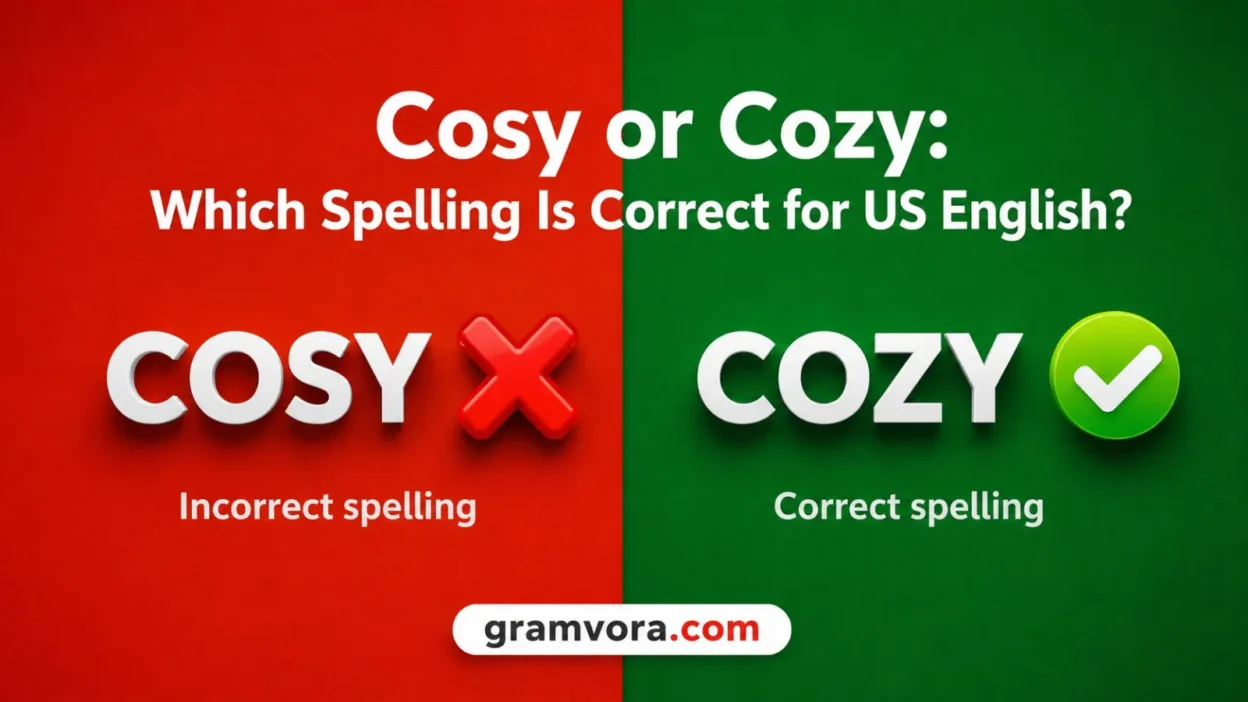
Both cosy and cozy are recognized spellings of the same word. They describe something warm, comfortable, pleasant, or pleasantly intimate. The difference is regional rather than grammatical.
For an American audience, cozy is the expected spelling. British writers usually choose cosy. Neither form has a separate meaning, and the letter change does not create a different pronunciation.
The spelling you need therefore depends mainly on your audience and the variety of English you are following.
Quick Answer
Use cozy in American English and cosy in British English.
Both spellings are correct, but they belong to different regional conventions. They have the same meanings and can perform the same grammatical roles. For a US website, school paper, business document, or general American publication, cozy is the safer and more natural choice.
Why People Confuse Them
The confusion occurs because both forms appear in published English. An American reader may encounter cosy in a British novel, while a British reader may see cozy in an American movie title, product description, or online article.
The difference also carries into related forms. American writers use cozier, coziest, cozily, and coziness. British writers generally use cosier, cosiest, cosily, and cosiness.
Because the two versions sound alike, hearing the word does not tell you whether it should contain an s or a z.
Key Differences At A Glance
| Context | Best Choice | Why |
|---|---|---|
| American English | cozy | This is the standard US spelling |
| British English | cosy | This is the expected British spelling |
| US school or workplace writing | cozy | It matches American convention |
| UK publication or audience | cosy | It follows British convention |
| Direct quotation or official title | Preserve the original | Source wording should normally remain unchanged |
| International house style | Follow the chosen style | Consistency matters more than switching between forms |
Are They the Same Word?
Yes. Cosy and cozy are regional spellings of the same lexical item. They do not differ in basic meaning, formality, tone, or grammatical function.
- Meaning: Both can describe warmth, comfort, friendliness, intimacy, or an overly close arrangement.
- Pronunciation: Both are pronounced like “KOH-zee,” adjusted naturally for the speaker’s accent.
- Grammar: Each spelling can function as an adjective, noun, or verb.
- Main distinction: Cozy is American; cosy is British.
The figurative meaning also remains the same. A “cozy relationship” and a “cosy relationship” can both suggest that two people or organizations are too close, especially when the arrangement seems unfair or improper.
US vs UK Preference
American dictionaries and publications normally use cozy as the main spelling. In ordinary US writing, cosy may look noticeably British, even though it is not an error in British English.
British publications generally prefer cosy. That preference extends to forms such as cosier, cosiest, cosily, and cosiness.
This distinction is a regional convention, not a universal rule about correctness. A British writer is not misspelling the word by using cosy, and an American writer is not changing its meaning by using cozy.
Consistency is still important. A document that begins with cozy should not randomly switch to cosy unless the second form appears in a quotation, title, name, or other wording that must be preserved.
Which Spelling Should You Use?
Choose cozy when writing for readers in the United States. It is the natural form in American emails, articles, advertisements, school assignments, product descriptions, and everyday messages.
Use cosy when following British spelling. It is also suitable when reproducing the official name of a British business, book, event, or creative work that uses that form.
For international writing, follow the selected house style. A company that publishes in American English should use cozy consistently. An organization that follows British English should normally select cosy.
The simplest memory aid is this: US writing takes the z in cozy.
When One Spelling Looks Wrong
In American prose, cosy can look out of place because most US readers expect cozy. A sentence such as “We booked a cosy cabin in Vermont” is understandable, but its spelling does not match normal American style.
The reverse applies in British writing. A UK publication may treat cozy as an American form and change it to cosy during editing.
However, do not automatically alter an official name or direct quotation. A British store called “The Cosy Corner” should retain its name in an American article. Likewise, quoted material should generally preserve the source’s original spelling.
A spelling may therefore be regionally unexpected without being universally incorrect.
Common Mistakes (and Quick Fixes)
Mistake: Treating one form as wrong everywhere
Both spellings are standard within their usual regions.
Quick fix: Use cozy for American readers and cosy for British readers.
Mistake: Mixing regional forms
A writer might use cozy in one paragraph and cosiness in another.
Quick fix: Keep the full spelling family consistent:
- American: cozy, cozier, coziest, cozily, coziness
- British: cosy, cosier, cosiest, cosily, cosiness
Mistake: Assuming the s changes the sound
The s in cosy does not make the word sound like “KOH-see.”
Quick fix: Pronounce both forms with the same final “zee” sound.
Mistake: Forgetting the figurative meaning
The word does not always describe a warm room. It can describe a relationship that seems unusually or improperly close.
Quick fix: Use context to determine whether the tone is pleasant or critical.
Mistake: Changing official wording
Regional spelling should not erase the established spelling of a title, name, or quotation.
Quick fix: Preserve official and quoted forms when accuracy requires it.
Everyday Examples
These American examples use cozy:
- The rental cabin felt cozy after we lit the fireplace.
- Maya found a cozy table near the back of the coffee shop.
- Our dog stayed cozy beneath the new blanket.
- Reporters questioned the company’s cozy relationship with the contractor.
- Several candidates were accused of cozying up to wealthy donors.
These British-style examples use cosy:
- The cottage had a cosy kitchen with a small wood stove.
- We spent a cosy evening reading by the window.
- Put the tea cosy over the pot before breakfast.
- Critics described the agreement as far too cosy.
- The representative appeared to be cosying up to influential officials.
The spelling changes, but the underlying meanings and sentence patterns remain the same.
Dictionary-Style Word Details
Verb
- Cosy: The British spelling used in forms such as cosy up, cosies, cosied, and cosying. It usually means moving closer for comfort or becoming friendly with someone.
- Cozy: The American spelling used in forms such as cozy up, cozies, cozied, and cozying. The phrase cozy up to often suggests seeking friendship or favor for personal advantage.
Noun
- Cosy: In British English, a padded covering that helps keep a teapot, egg, or similar item warm.
- Cozy: The corresponding American spelling of the same noun, although this use is less common in everyday US conversation than the adjective.
The noun does not represent a separate object or meaning in each region. Only the preferred spelling changes.
Synonyms
Both spellings share the same meaning-matched alternatives.
For warmth and comfort:
- comfortable
- snug
- warm
- inviting
- homey
- restful
For friendly intimacy:
- close
- intimate
- private
- familiar
Context-based antonyms:
- uncomfortable
- cold
- uninviting
- distant
- exposed
Not every alternative fits every sentence. For example, snug works well for a small room, while intimate better suits a private conversation.
Example Sentences
- Cosy: The guests gathered in a cosy sitting room after dinner.
- Cozy: The guests gathered in a cozy sitting room after dinner.
- Cosy: The newspaper criticized the firm’s cosy arrangement with local officials.
- Cozy: The newspaper criticized the firm’s cozy arrangement with local officials.
Each pair communicates the same idea. The audience determines which spelling looks more natural.
Word History
Cosy and cozy come from the same word. It entered English in the early 18th century and was originally associated with Scots. Its deeper origin remains uncertain.
Over time, cosy became the standard British form, while cozy became the standard North American form. The variation reflects regional spelling convention rather than a change in meaning or pronunciation.
Phrases Containing
- cosy room / cozy room
- cosy corner / cozy corner
- cosy evening / cozy evening
- tea cosy / tea cozy
- egg cosy / egg cozy
- cosy up / cozy up
- cosy up to / cozy up to
- cosy relationship / cozy relationship
- cosy mystery / cozy mystery
Use the s forms in British writing and the z forms in American writing unless an official name or house style requires something different.
FAQs
Is cosy or cozy correct in American English?
Cozy is the standard spelling in American English. Use it in US school assignments, business writing, articles, emails, and everyday messages. Cosy is mainly the British spelling, although American readers will usually understand it.
Is cosy a misspelling of cozy?
No. Cosy is not a misspelling. It is the standard British English form of the same word. It may look unusual in an American document, but it is correct when the writer follows British spelling conventions.
Do cosy and cozy have different meanings?
No. Both spellings have the same meanings. They can describe something warm, comfortable, pleasant, or intimate. They can also describe a relationship that seems unusually close or potentially improper, such as a cozy relationship between a company and an official.
Are cosy and cozy pronounced differently?
No. Both are generally pronounced “KOH-zee.” The final s in cosy has a z sound, so the spelling difference does not create a pronunciation difference.
Should I write cozier or cosier?
Use cozier in American English and cosier in British English. The same regional pattern applies to other related forms:
- American: cozy, cozier, coziest, cozily, coziness
- British: cosy, cosier, cosiest, cosily, cosiness
Keep these forms consistent within the same document.
Can cozy and cosy be used as verbs?
Yes. Both forms can appear in expressions such as cozy up or cosy up. These phrases can mean moving closer for warmth or comfort. The expression cozy up to someone can also mean trying to gain that person’s approval, support, or influence.
Should I change cosy to cozy in a quotation or business name?
Usually, no. Preserve the original spelling in direct quotations, book titles, company names, product names, and other official wording. For example, a British business called “The Cosy Corner” should keep its established spelling even in an American article.
Conclusion
Both cosy and cozy are correct spellings of the same word. They share the same meanings, pronunciation, and grammatical uses.
The practical difference is regional: cozy is standard in American English, while cosy is standard in British English. For a US audience, choose cozy and keep its related forms consistent throughout your writing.