
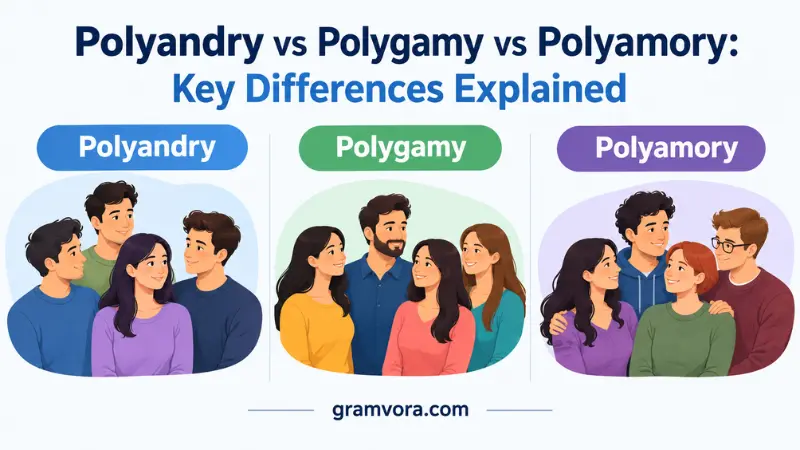
Polyandry, polygamy, and polyamory all describe relationships that involve more than two people, but the three terms do not mean the same thing.
The clearest distinction comes from what each word emphasizes. Polyandry specifically describes a woman having more than one husband. Polygamy describes marriage involving more than one spouse. Polyamory describes multiple romantic or sexual relationships in which the people involved know about the relationships and consent to them.
That difference makes word choice important.
Someone may have several romantic partners without marrying any of them. Another person may have multiple spouses. A woman with several husbands fits the more specific meaning of polyandry.
The words can overlap in some situations, but readers should not treat them as interchangeable.
For a quick memory aid, think of the terms this way:
Polyandry = multiple husbands.
Polygamy = multiple spouses.
Polyamory = multiple consensual romantic or sexual relationships.
Quick Answer
The best word depends on what you want to describe.
- Polyandry means having more than one husband at the same time.
- Polygamy means having more than one spouse at the same time.
- Polyamory means having multiple romantic or sexual relationships with the knowledge and consent of everyone involved.
Marriage separates the first two concepts from the third in many ordinary uses.
For example, if a woman has two husbands, polyandry describes that specific marriage arrangement. If someone has several spouses without specifying the gender arrangement, polygamy provides the broader marriage term.
Meanwhile, a person can practice polyamory without marrying any of their partners. The central idea involves multiple consensual romantic or sexual relationships rather than multiple marriages.
Therefore, the three terms answer slightly different questions:
- Who are the spouses? Polyandry can specify multiple husbands.
- How many spouses are there? Polygamy describes more than one spouse.
- How many consensual romantic relationships are involved? Polyamory describes multiple relationships.
Why People Confuse Them
The confusion makes sense because all three words contain the element poly-, which carries the idea of “many.”
The words then move in different directions.
Polyandry focuses specifically on multiple husbands. Polygamy focuses on marriage involving multiple spouses. Polyamory focuses on multiple romantic or sexual relationships.
Everyday conversation can make the distinction even harder because people sometimes use broad relationship terms loosely. A person might describe a relationship using more than one label, especially when marriage and romantic relationships overlap.
Still, the basic meanings remain different.
Another source of confusion comes from the common use of “polygamy” to describe a man with several wives. That arrangement falls under the broader concept of polygamy, but polygyny provides the more specific term for one man having multiple wives.
Likewise, polyandry does not simply mean “a woman dating several men.” The word specifically refers to a marriage arrangement involving more than one husband.
Polyamory also has its own defining feature: openness and consent among the people involved. Multiple secret relationships do not fit the ordinary meaning of polyamory.
Key Differences At A Glance
| Context | Best Choice | Why |
|---|---|---|
| One woman has more than one husband | Polyandry | It specifically identifies multiple husbands |
| A person has more than one spouse | Polygamy | It describes marriage to multiple spouses |
| Several people maintain consensual romantic relationships | Polyamory | It focuses on multiple consensual relationships |
| The relationship does not involve marriage | Polyamory | Polyamory does not require marriage |
| The main subject is plural marriage | Polygamy | Marriage defines the term |
| The main subject is a woman with multiple husbands | Polyandry | It gives the most specific description |
A second comparison helps show the difference:
| Feature | Polyandry | Polygamy | Polyamory |
|---|---|---|---|
| Multiple people involved | Yes | Yes | Yes |
| Multiple husbands specifically | Yes | Not necessarily | Not necessarily |
| Marriage is central | Yes | Yes | No |
| Multiple romantic relationships | May occur | May occur | Yes |
| Knowledge and consent define the term | No | No | Yes |
The key point is that polyandry and polygamy describe marriage structures, while polyamory describes a relationship structure centered on multiple consensual romantic or sexual connections.
Meaning and Usage Difference
Polyandry
Polyandry means the practice or condition of having more than one husband at the same time.
The term gives readers a specific piece of information: the relationship involves a woman and multiple husbands.
For example:
The anthropology course discussed polyandry as a form of plural marriage.
A writer should not use polyandry simply to describe a woman who dates several men. Dating does not automatically create a marriage relationship.
Polygamy
Polygamy refers to marriage involving more than one spouse at the same time.
This makes polygamy broader than polyandry. The word does not, by itself, identify which spouse has multiple partners.
For example:
The book examines the history of polygamy in different societies.
When a writer needs to specify one man with several wives, polygyny provides a more precise term. When the focus falls on one woman with several husbands, polyandry provides the more precise term.
Polyamory
Polyamory describes a relationship structure in which a person maintains multiple romantic or sexual relationships with the knowledge and consent of the people involved.
Marriage does not define polyamory.
A person can have two romantic partners without marrying either person and still use the word polyamory to describe the relationship structure.
For example:
They describe their relationship as polyamory because everyone involved understands the arrangement and agrees to it.
That example shows why polyamory should not simply replace polygamy. The first word emphasizes multiple consensual relationships, while the second emphasizes multiple marriages.
Tone, Context, and Formality
All three words are standard terms, but they appear in different types of conversations.
Polyandry often sounds more specialized because writers commonly use it in academic, historical, anthropological, or educational discussions. Someone discussing marriage systems may use the word when the presence of multiple husbands matters.
Polygamy has a broader public presence. News reports, books, educational material, and conversations about marriage can all use the term.
Polyamory appears frequently in modern discussions of relationships and dating. People may use it when describing their own relationship structure, while writers may use it in discussions about consensual non-monogamy.
The words also carry different amounts of information.
Consider these three statements:
She practices polyandry.
This tells the reader that multiple husbands form part of the marriage arrangement.
They practice polygamy.
This tells the reader that multiple spouses form part of the marriage arrangement but gives less specific information about the arrangement.
They practice polyamory.
This tells the reader that multiple consensual romantic or sexual relationships form part of the relationship structure.
Pronunciation can help readers recognize the terms:
- Polyandry: roughly “POL-ee-an-dree”
- Polygamy: roughly “puh-LIG-uh-mee”
- Polyamory: roughly “POL-ee-AM-uh-ree”
The words sound similar at the beginning, so careful pronunciation can help distinguish them in conversation.
Which One Should You Use?
Use polyandry when the specific fact you need to communicate is that a woman has more than one husband.
Use polygamy when the main subject is marriage involving more than one spouse.
Use polyamory when the main subject is multiple romantic or sexual relationships that everyone involved knows about and accepts.
Here are three simple examples:
The researcher studied polyandry in several marriage systems.
The documentary examined polygamy and its role in different communities.
The couple openly discussed their experience with polyamory.
The correct word depends on the relationship structure, not simply on the number of people involved.
For instance, saying “They have three partners” does not automatically tell you which term applies. You need to know whether those partners are spouses, romantic partners, or both.
That is why context matters.
When One Choice Sounds Wrong
Some sentences become unclear when writers substitute one term for another.
Consider:
She has two husbands, so she practices polyamory.
The statement might reflect how the person describes her relationships, but polyamory does not specifically tell the reader that she has multiple husbands. If that fact matters, polyandry provides the clearer term.
Now consider:
They have several romantic partners, so they practice polygamy.
That wording can mislead readers because polygamy specifically concerns multiple spouses. If marriage does not form part of the situation, polyamory may communicate the intended meaning more accurately.
Another common mistake looks like this:
Polygamy means having several romantic partners.
That definition leaves out the central marriage element.
A clearer explanation would say:
Polygamy refers to marriage involving more than one spouse.
Likewise, avoid defining polyandry as simply “having multiple male partners.” The term specifically concerns multiple husbands in its human relationship sense.
Precise wording helps readers understand the relationship instead of making them guess which arrangement you mean.
Common Mistakes (and Quick Fixes)
Mistake 1: Calling all three words synonyms
Polyandry, polygamy, and polyamory overlap, but they do not have identical meanings.
Quick fix: Identify whether the subject involves multiple husbands, multiple spouses, or multiple consensual romantic relationships.
Mistake 2: Saying polygamy always means multiple wives
People often use the word that way, but polygamy has a broader meaning.
Quick fix: Use polygamy for the general concept of multiple spouses. Use polygyny when you specifically mean one man with multiple wives.
Mistake 3: Using polyamory as another word for polygamy
Polyamory does not require marriage.
Quick fix: Choose polyamory when the focus is multiple consensual romantic or sexual relationships rather than multiple marriages.
Mistake 4: Using polyandry for dating
A woman who dates several men does not automatically practice polyandry.
Quick fix: Reserve polyandry for the specific multiple-husband marriage meaning.
Mistake 5: Assuming multiple partners always means polyamory
The word “partners” alone does not establish the full meaning.
Quick fix: Check whether the relationships involve consent and whether marriage plays a central role.
Mistake 6: Confusing consensual relationships with cheating
Polyamory specifically involves knowledge and consent among the people involved.
Quick fix: Do not use “polyamory” as a general label for secret relationships outside an existing relationship.
Mistake 7: Treating polyandry and polygyny as identical
Both fall within the broader concept of plural marriage, but they specify different spouse arrangements.
Quick fix: Use polyandry for multiple husbands and polygyny for multiple wives.
Everyday Examples
Realistic examples make the distinctions easier to remember.
Examples with polyandry
The professor used polyandry as an example of a marriage system involving multiple husbands.
The documentary explored the social structure of a community that practiced polyandry.
Her research focused on the history of polyandry.
Each example uses the word because the multiple-husband arrangement matters.
Examples with polygamy
The class discussed polygamy as a form of marriage involving more than one spouse.
The author compared monogamy and polygamy in different cultural settings.
The documentary examined the legal and social questions surrounding polygamy.
Here, the focus remains on plural marriage rather than on a specific gender arrangement.
Examples with polyamory
They talked openly about their polyamory with their friends.
The article explains how people in polyamorous relationships establish boundaries.
She identifies as polyamorous and has two romantic partners who know about each other.
These examples focus on multiple relationships and openness rather than multiple marriages.
The distinction becomes even clearer when you compare two sentences:
They are married to several people.
The word polygamy fits because marriage is the central fact.
They have several romantic partners who know about one another and agree to the arrangement.
The word polyamory fits because multiple consensual romantic relationships form the central fact.
Dictionary-Style Word Details
Verb
Polyandry: English does not commonly use polyandry as a verb. Natural expressions include practice polyandry, have multiple husbands, or enter a polyandrous marriage.
Polygamy: English does not commonly use polygamy as a verb. Natural expressions include practice polygamy or have multiple spouses.
Polyamory: English does not normally use polyamory as a standard verb. Natural expressions include practice polyamory and be polyamorous.
The adjective forms can appear naturally:
The community has a polyandrous marriage system.
The relationship is polygamous.
They are polyamorous.
Noun
Polyandry: A noun that describes the practice or condition of having more than one husband at the same time.
Polygamy: A noun that describes marriage involving more than one spouse at the same time.
Polyamory: A noun that describes the practice or relationship structure involving multiple romantic or sexual relationships with the knowledge and consent of the people involved.
All three terms normally function as nouns when writers discuss the general relationship practice.
Synonyms
These words do not have perfect everyday synonyms.
Polyandry: A closest plain alternative is marriage to multiple husbands. That phrase explains the meaning but does not function as a one-word replacement in every sentence.
Polygamy: Plural marriage can serve as a close descriptive alternative when the context specifically concerns marriage involving multiple spouses.
Polyamory: Consensual multi-partner relationships can explain the concept in plain language, but it is a descriptive phrase rather than an exact synonym.
Writers should avoid treating the three terms as synonyms because each one highlights a different aspect of the relationship structure.
Example Sentences
Polyandry:
The lecture introduced polyandry as a specific form of plural marriage.
Polygamy:
The article explains how polygamy differs from monogamous marriage.
Polyamory:
The couple describes their relationship as polyamory and emphasizes communication and consent.
These sentences demonstrate the most important usage difference: each term points readers toward a different relationship structure.
Word History
All three words contain poly-, a Greek-derived element associated with “many.”
Polyandry comes from Greek elements associated with “many” and “man.” Its modern human-relationship meaning centers on multiple husbands.
Polygamy comes from Greek elements associated with “many” and marriage. Its modern meaning centers on having more than one spouse.
Polyamory combines the idea of “many” with a word related to love. Modern English uses it for multiple consensual romantic or sexual relationships.
The shared beginning explains why the words look related. Their different endings help explain why their meanings differ.
Phrases Containing
Common phrases with polyandry include:
- practice polyandry
- polyandrous marriage
- history of polyandry
- forms of polyandry
Common phrases with polygamy include:
- practice polygamy
- polygamous marriage
- history of polygamy
- polygamous relationship
Common phrases with polyamory include:
- practice polyamory
- polyamorous relationship
- polyamorous partner
- polyamorous relationship structure
These phrases show how naturally each term fits different contexts.
FAQs
What is the difference between polyandry, polygamy, and polyamory?
Polyandry means having more than one husband. Polygamy means having more than one spouse in marriage. Polyamory means having multiple romantic or sexual relationships with the knowledge and consent of everyone involved.
Is polyandry a type of polygamy?
Yes. Polyandry is a specific form of plural marriage and therefore falls within the broader concept of polygamy.
Is polyamory the same as polygamy?
No. Polygamy centers on marriage to multiple spouses, while polyamory centers on multiple consensual romantic or sexual relationships. Polyamory does not require marriage.
What does polyandry mean in simple words?
Polyandry means that one woman has more than one husband at the same time.
What does polygamy mean in simple words?
Polygamy means being married to more than one spouse at the same time.
What does polyamory mean in simple words?
Polyamory means having multiple romantic or sexual relationships with the knowledge and consent of the people involved.
Does polyamory involve marriage?
Not necessarily. People can practice polyamory without marrying their partners.
Does polygamy always mean one man has multiple wives?
No. Polygamy is the broader term for marriage involving multiple spouses. Polygyny specifically refers to one man having multiple wives.
Can someone be both polygamous and polyamorous?
Yes. The concepts can overlap. Someone in a plural marriage may also describe their relationships as polyamorous, depending on how they understand and define their relationships.
Which word should I use: polyandry, polygamy, or polyamory?
Use polyandry for multiple husbands, polygamy for multiple spouses in marriage, and polyamory for multiple consensual romantic or sexual relationships.
Is polyandry the same as having several boyfriends?
No. Having several boyfriends does not automatically mean polyandry. Polyandry specifically refers to having multiple husbands.
Is polyamory the same as cheating?
No. Polyamory involves openness and consent among the people involved. Secret relationships that violate an existing partner’s agreement do not fit the ordinary meaning of polyamory.
Conclusion
Polyandry, polygamy, and polyamory describe related but distinct relationship concepts.
Polyandry specifically refers to a woman having more than one husband at the same time.
Polygamy refers more broadly to marriage involving more than one spouse.
Polyamory refers to multiple romantic or sexual relationships in which the people involved know about and consent to the arrangement.
The easiest way to remember the difference is:
Polyandry = multiple husbands.
Polygamy = multiple spouses.
Polyamory = multiple consensual romantic or sexual relationships.
Do not choose the word simply because more than two people are involved. Instead, identify the feature that matters in your sentence. If you are describing multiple husbands, polyandry gives the clearest meaning. If you are discussing multiple spouses, polygamy is the broader marriage term. If you are discussing multiple consensual romantic relationships, polyamory is the appropriate choice.
Using the right term makes the sentence more precise and prevents readers from confusing marriage arrangements with broader relationship structures.


