
Many people confuse bigamy and polygamy because both words relate to having more than one spouse. However, they do not mean exactly the same thing.
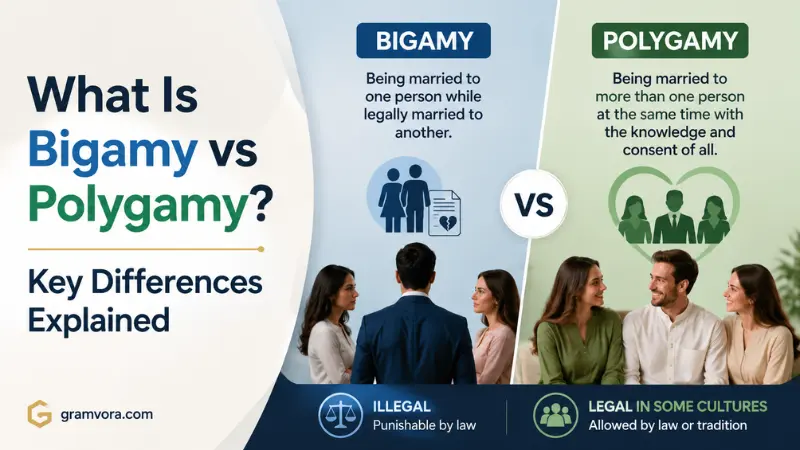
The main difference is simple: bigamy means being married to two people at the same time, usually without legal recognition of both marriages, while polygamy is a broader term for having multiple spouses.
In everyday conversations, these words are sometimes used as if they are interchangeable. However, they describe different situations. Bigamy focuses on the act of entering into multiple marriages, especially when a person is already legally married. Polygamy refers to a relationship structure involving more than one spouse.
Understanding the difference helps you use these terms correctly when discussing law, culture, religion, history, or relationships.
Quick Answer
Bigamy means a person has two spouses at the same time. The term is often connected with illegal marriage situations because many legal systems recognize only one spouse at a time.
Polygamy means having more than one spouse at the same time. It is a broader term that includes relationships where a person has multiple spouses.
The key difference is:
- Bigamy = two spouses
- Polygamy = multiple spouses (two or more)
All bigamy involves more than one marriage, but not every discussion of polygamy refers specifically to bigamy.
Why People Confuse Them
People often mix up bigamy and polygamy because both words describe marriages involving more than one spouse.
The confusion happens for several reasons:
First, both words contain the idea of multiple relationships. The prefixes help explain their meanings:
- Bi- generally means two.
- Poly- generally means many or multiple.
Because of this, bigamy specifically points to two marriages, while polygamy covers a wider range of multiple-spouse arrangements.
Second, media discussions sometimes use these words loosely. A news story about someone secretly marrying another person while already married may use the term bigamy, while discussions about cultural marriage practices may use polygamy.
Third, people sometimes assume that any person with multiple spouses is automatically committing bigamy. However, the words describe different concepts. Bigamy often focuses on the legal issue of having two marriages at once, while polygamy describes the broader relationship structure.
Key Differences At A Glance
| Feature | Bigamy | Polygamy |
|---|---|---|
| Meaning | Having two spouses at the same time | Having multiple spouses at the same time |
| Main focus | Multiple marriages, often involving legal conflict | A broader marriage arrangement |
| Number of spouses | Exactly two | Two or more |
| Common context | Legal discussions | Cultural, social, religious, and relationship discussions |
| Usage | Usually has a negative or illegal association | Can be neutral depending on context |
Extra Comparison
| Term | Simple Meaning | Example |
|---|---|---|
| Bigamy | A person marries someone while already married | Someone legally married to one person secretly marries another |
| Polygamy | A person has multiple spouses | A person has three spouses in a recognized relationship system |
Meaning and Usage Difference
Bigamy Meaning
Bigamy refers to the situation where someone is married to two people at the same time.
In many places, marriage laws allow only one legal spouse at a time. Because of this, bigamy is commonly discussed in connection with unlawful marriage.
Examples:
- Someone marries a second person without ending their first marriage.
- A person hides an existing marriage before marrying someone else.
The word usually appears in legal or formal discussions.
Example sentence:
The court investigated whether the person committed bigamy by marrying again while still legally married.
Polygamy Meaning
Polygamy refers to having more than one spouse at the same time.
It is a broader term and does not specifically focus on whether the arrangement violates a law. Instead, it describes a type of marriage structure involving multiple spouses.
Example sentence:
The documentary explored different cultural views of polygamy around the world.
Polygamy is often discussed in areas such as:
- anthropology
- history
- religion
- sociology
- marriage studies
Types Related to Polygamy
Polygamy can describe different arrangements, including:
- one person having multiple wives
- one person having multiple husbands
- multiple spouses in a marriage structure
These variations are separate concepts but fall under the broader idea of polygamy.
Tone, Context, and Formality
The two words have different common associations.
Bigamy: Legal and Negative Tone
Bigamy is most often used in legal contexts. It frequently suggests a violation of marriage laws.
Common situations where you may see the word:
- court cases
- legal documents
- news reports
- discussions about marriage fraud
Example:
The defendant faced charges related to bigamy.
The word usually carries a negative tone because it often involves deception or breaking legal rules.
Polygamy: Neutral or Descriptive Tone
Polygamy is generally more descriptive. It can be used neutrally when discussing social or cultural practices.
Examples:
Researchers studied polygamy in different societies.
The book examines historical examples of polygamy.
The tone depends on the speaker’s purpose and the surrounding discussion.
Which One Should You Use?
Choose bigamy when you are specifically talking about:
- two marriages at the same time
- someone marrying again while already married
- legal problems involving multiple marriages
Example:
The investigation focused on possible bigamy.
Choose polygamy when you are talking about:
- multiple-spouse marriage systems
- cultural practices
- social structures
- relationships involving more than one spouse
Example:
The class discussed polygamy as a historical marriage practice.
A simple way to decide:
- Talking about a legal violation involving two marriages? Use bigamy.
- Talking about multiple spouses generally? Use polygamy.
When One Choice Sounds Wrong
Using these words incorrectly can make your meaning unclear.
Mistake 1: Using Bigamy for Every Multiple-Spouse Situation
Incorrect:
The community practices bigamy.
Why it may sound wrong:
Bigamy specifically refers to two spouses and often has a legal meaning. If you are discussing a broader marriage structure, polygamy may be more accurate.
Better:
The community discusses polygamy as a cultural practice.
Mistake 2: Using Polygamy When Discussing a Specific Legal Case
Incorrect:
The person was arrested for polygamy after secretly marrying another person.
Why it may be unclear:
The situation describes someone having two marriages at once, which is more specifically described as bigamy.
Better:
The person was investigated for bigamy after marrying again while still married.
Mistake 3: Thinking Bigamy and Polygamy Are Exact Synonyms
Although they overlap, they are not identical.
Bigamy is narrower.
Polygamy is broader.
A person involved in bigamy has two spouses. A person described as practicing polygamy may have two or more spouses.
Common Mistakes (and Quick Fixes)
Mistake: Thinking “bi” means marriage between two people
The prefix bi- refers to two, but bigamy does not describe a normal two-person marriage. It refers to having two spouses at the same time.
Mistake: Assuming polygamy always means illegal behavior
Polygamy is a descriptive term. Whether it is legal depends on the laws and circumstances of a particular location.
Mistake: Using the terms without considering context
The best word depends on what you are describing.
Legal situation → bigamy
General multiple-spouse arrangement → polygamy
Everyday Examples
Example 1: Legal Situation
John was already married when he married another person. Authorities investigated him for bigamy.
The focus is the second marriage while the first marriage still existed.
Example 2: Cultural Discussion
The researcher wrote about different forms of polygamy throughout history.
The focus is the broader marriage system.
Example 3: Classroom Discussion
Students learned that bigamy and polygamy describe different types of multiple-spouse situations.
The sentence compares the terms directly.
Example 4: News Context
The report described allegations of bigamy involving a person who had two legal marriages.
Example 5: Academic Context
The sociology course examined polygamy as a topic related to family structures.
Dictionary-Style Word Details
Verb
Bigamy
Bigamy is not commonly used as a verb in standard US English.
The related verb phrase is usually:
- commit bigamy
- practice bigamy
Example:
The person was accused of committing bigamy.
Polygamy
Polygamy is generally not used as a verb.
People usually say:
- practice polygamy
- have a polygamous marriage
Example:
Some societies have practiced polygamy historically.
Noun
Bigamy
Bigamy is a noun meaning the act of having two marriages at the same time.
Example:
The law addresses bigamy involving multiple legal marriages.
Polygamy
Polygamy is a noun meaning a marriage system or relationship structure involving multiple spouses.
Example:
The article explored polygamy from a cultural perspective.
Synonyms
Exact synonyms for these words are limited because each term has a specific meaning.
Bigamy
Closest plain alternatives:
- having two marriages at once
- dual marriage
These phrases explain the idea but are not exact replacements in formal writing.
Polygamy
Closest plain alternatives:
- multiple-spouse marriage
- plural marriage
These alternatives describe the general concept but may not fit every context.
Antonyms
There are no perfect direct antonyms for these terms.
However, the opposite idea can be expressed as:
- monogamy: marriage involving one spouse at a time
Example Sentences
Bigamy Examples
- The legal case involved allegations of bigamy.
- He was accused of marrying twice without ending his first marriage.
- The investigation examined whether the second marriage created a bigamy issue.
Polygamy Examples
- The documentary discussed polygamy in different cultures.
- The book examined historical examples of polygamy.
- The researcher studied how polygamy affects family structures.
Word History
Both words come from Greek-based word parts.
Bigamy combines elements meaning “two” and “marriage.”
Polygamy combines elements meaning “many” and “marriage.”
The basic meanings of the words come from these roots, but modern usage depends heavily on legal, cultural, and social context.
Phrases Containing
Bigamy
Common phrases include:
- commit bigamy
- bigamy laws
- bigamy charge
- bigamy case
Polygamy
Common phrases include:
- practice polygamy
- polygamy laws
- polygamous marriage
- forms of polygamy
FAQs
What is the main difference between bigamy and polygamy?
Bigamy refers specifically to having two spouses at the same time, while polygamy refers generally to having multiple spouses.
Is bigamy a type of polygamy?
Yes, bigamy can be considered a narrower form of multiple-spouse marriage because it involves two spouses. However, the terms are not identical.
Does polygamy always mean someone has two spouses?
No. Polygamy can involve two or more spouses.
Why is bigamy usually discussed negatively?
Bigamy is often connected with legal problems because many places recognize only one legal spouse at a time.
Can bigamy and polygamy be used interchangeably?
Not always. They overlap, but bigamy is more specific and usually refers to two marriages, while polygamy is broader.
Which word should I use in everyday writing?
Use bigamy for a specific situation involving two marriages. Use polygamy when discussing multiple-spouse relationships generally.
Conclusion
The difference between bigamy and polygamy comes down to scope.
Bigamy is the narrower term. It describes having two spouses at the same time and is often used in legal discussions because it may involve breaking marriage laws.
Polygamy is the broader term. It describes having multiple spouses and is commonly used when discussing cultural, historical, or social relationship structures.
Remember the simple distinction:
Bigamy = two spouses.
Polygamy = multiple spouses.
Choosing the correct word depends on the situation you are describing. When the focus is a legal issue involving two marriages, bigamy is usually the better choice. When discussing the broader idea of multiple-spouse relationships, polygamy is the more accurate term.


