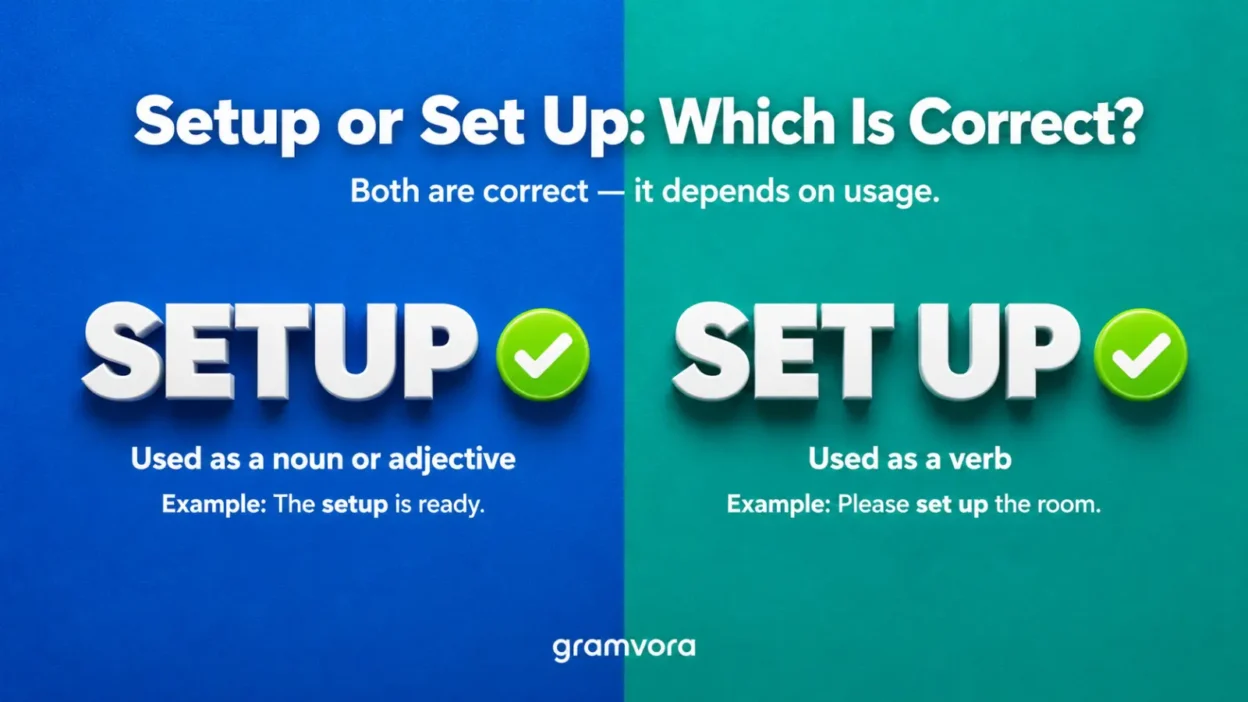
Both setup and set up are correct, but they are not used the same way.
Use setup as a noun, or as a noun-like word before another noun. Use set up as a verb phrase when someone arranges, prepares, installs, starts, or creates something.
The space changes the grammar.
You can have a setup.
You can set up something.
Quick Answer
Use setup when you mean an arrangement, system, plan, process, or equipment.
Use set up when you mean the action of arranging, preparing, installing, starting, or creating something.
Correct:
- The office setup works well for remote calls.
- Please set up the office before the client arrives.
- The app’s setup took five minutes.
- I need to set up the app on my phone.
The easiest test is this: if you can put the or a before it, you probably want setup. If you can put to before it, you probably want set up.
Why People Confuse Them
They look almost the same. They also sound the same in normal speech.
That makes the mistake easy to miss. In writing, though, the difference matters because the words do different jobs in the sentence.
Setup names something.
Set up shows action.
That is why “my desk setup” sounds right, but “I will setup my desk” does not.
Key Differences At A Glance
| Context | Best Choice | Why |
|---|---|---|
| Naming an arrangement | setup | It acts as a noun. |
| Describing an action | set up | It acts as a verb phrase. |
| Talking about equipment | setup | It names the whole arrangement. |
| Installing an account or device | set up | It describes what someone does. |
| Modifying another noun | setup | It works like a noun label before another noun. |
| After “to,” “will,” “can,” or “should” | set up | Those words need a verb after them. |
Meaning and Usage Difference
Setup is usually a noun. It means the way something is arranged, organized, or prepared.
Examples:
- Her home office setup is simple but comfortable.
- The camera setup looked professional.
- The payment setup was easier than I expected.
Set up is a verb phrase. It means to arrange, prepare, install, start, or create something.
Examples:
- She will set up her home office this weekend.
- The crew set up the cameras before the interview.
- We need to set up a payment plan.
A helpful way to see the difference is to ask what the sentence needs.
If the sentence needs a thing, use setup.
If the sentence needs an action, use set up.
Extra comparison:
- setup = a thing, arrangement, process, or system
- set up = an action someone does
- setup guide = a guide related to setup
- set up the guide = arrange or prepare the guide itself
Tone, Context, and Formality
Both forms are normal in modern US English. Neither one is more formal by itself.
The difference is grammar, not tone.
Setup is common in technology, offices, events, gaming, filming, payments, and workspaces.
Examples:
- laptop setup
- room setup
- account setup
- camera setup
- event setup
Set up is common when giving instructions or describing work.
Examples:
- set up your laptop
- set up the room
- set up an account
- set up the camera
- set up the event
In business writing, emails, product copy, and school writing, the same rule applies. Use the form that fits the sentence.
Which One Should You Use?
Choose setup when you are naming the arrangement or result.
Correct:
- The new checkout setup is faster.
- I like your desk setup.
- The stage setup took all morning.
Choose set up when you are describing the action.
Correct:
- We need to set up the new checkout page.
- Can you set up my desk?
- The team will set up the stage at 8 a.m.
Look at the word before the choice.
Use set up after:
- to
- will
- can
- should
- must
- need to
- going to
Examples:
- I need to set up my account.
- We should set up a call.
- They are going to set up the booth.
Use setup after:
- a
- the
- my
- your
- this
- new
- better
Examples:
- The setup was smooth.
- Your setup looks great.
- This setup saves time.
When One Choice Sounds Wrong
The wrong form usually sounds wrong when you test the sentence.
Wrong:
- I need to setup my account.
Why it is wrong: after “need to,” the sentence needs a verb. Use set up.
Correct:
- I need to set up my account.
Wrong:
- The set up was confusing.
Why it is wrong: after “the,” the sentence needs a noun. Use setup.
Correct:
- The setup was confusing.
Wrong:
- We hired a team to handle the event set up.
Better:
- We hired a team to handle the event setup.
In that sentence, the phrase names the event arrangement or preparation work. It is not acting as the verb.
Common Mistakes (and Quick Fixes)
Mistake: Using setup after “to.”
Wrong: Please setup your profile.
Correct: Please set up your profile.
Mistake: Using set up as a noun.
Wrong: The set up took an hour.
Correct: The setup took an hour.
Mistake: Using the noun form after “will.”
Wrong: I will setup the projector.
Correct: I will set up the projector.
Mistake: Treating the two forms as interchangeable.
Wrong: The new set up looks clean.
Correct: The new setup looks clean.
Mistake: Forgetting that setup can come before another noun.
Correct: The setup screen asked for my email.
Correct: The setup process was quick.
Correct: The setup instructions were clear.
Everyday Examples
Here are common US-English examples you might see at work, at home, or online.
Correct:
- I need to set up my new phone.
- The phone setup was fast.
- Can you set up a Zoom call for Tuesday?
- The meeting setup is already done.
- We should set up chairs before everyone arrives.
- The room setup gives people more space.
- I helped my dad set up his Wi-Fi.
- His Wi-Fi setup finally works.
- The band will set up after lunch.
- The stage setup looks great from the back row.
- She wants to set up a small business.
- Their business setup is simple.
The pattern stays the same: action takes set up; thing or arrangement takes setup.
Dictionary-Style Word Details
Verb
- setup: Not commonly used as a verb in standard US English. In regular edited writing, use set up for the verb.
- set up: A verb phrase. It means to arrange, prepare, install, establish, start, or create something.
Examples:
- Please set up the chairs.
- I’ll set up the new account.
- They set up a local nonprofit.
Noun
- setup: A noun. It can mean an arrangement, system, process, plan, or the equipment used for a purpose.
- set up: Not commonly used as a noun in standard US English for this comparison. Use setup when you need the noun.
Examples:
- The setup worked well.
- My streaming setup is basic.
- The setup took longer than expected.
Synonyms
- setup: closest plain alternatives include arrangement, layout, configuration, system, plan, and process, depending on context.
- set up: closest plain alternatives include arrange, prepare, install, start, create, organize, and establish, depending on context.
Antonyms do not fit every use cleanly. For set up, possible opposites in some contexts include take down, remove, cancel, close, or disassemble. For setup, there is no single clear opposite that works in all contexts.
Example Sentences
- setup: The studio setup made the podcast sound much better.
- setup: Our new checkout setup is easier for customers.
- setup: The classroom setup helped students work in groups.
- set up: The producer helped set up the microphones.
- set up: We need to set up a new password.
- set up: Maria will set up the classroom before the workshop.
Word History
- setup: This form developed as a compound noun from the verb phrase set up. In modern US English, the one-word noun is the usual choice.
- set up: This is the older verb phrase made from set plus up. It remains the standard verb form.
The hyphenated noun set-up may still appear, but it is not the main focus here. For general US writing, setup is the safer noun choice unless a specific style guide tells you otherwise.
Phrases Containing
- setup: desk setup, camera setup, account setup, payment setup, room setup, event setup, network setup, gaming setup, setup guide, setup process.
- set up: set up a meeting, set up an account, set up the room, set up a business, set up a call, set up the camera, set up Wi-Fi, set up shop.
Conclusion
Use setup when you mean a thing: an arrangement, system, process, layout, or prepared result.
Use set up when you mean an action: to arrange, prepare, install, start, or create something.