
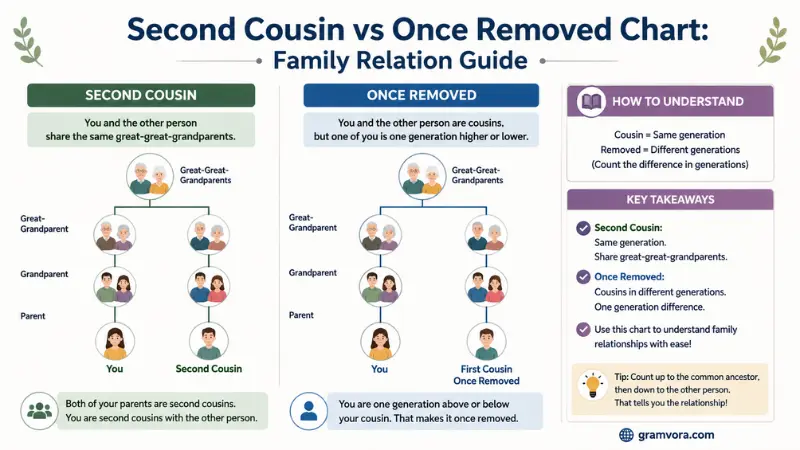
Family relationship terms can become confusing quickly, especially when words like second cousin and once removed appear together. Many people understand the basic idea of cousins but become unsure when generations are added to the explanation.
The easiest way to understand the difference is to remember that “second cousin” describes how closely two people are related through shared ancestors, while “once removed” describes a one-generation difference between two relatives.
A second cousin is usually someone who shares the same great-grandparents as you. A cousin once removed is someone who is either one generation above or below your cousin level, such as your parent’s cousin or your cousin’s child.
Understanding these terms helps when creating family trees, researching genealogy, or simply explaining family connections in everyday conversations.
Quick Answer
A second cousin is a person who shares the same great-grandparents with you but is not your sibling, first cousin, or direct ancestor.
A cousin once removed means there is a one-generation difference between two relatives. Your parent’s first cousin and your first cousin’s child are both examples of relatives who are once removed.
The word “removed” does not mean separated or unrelated. It only shows that two relatives belong to different generations.
Why People Confuse Them
People often confuse these terms because both describe relationships beyond immediate family. The word “second” sounds like it means a second-level cousin, while “removed” sounds like a measure of distance. However, they describe two different things.
The number before “cousin” tells you the shared ancestor level:
- First cousins share grandparents.
- Second cousins share great-grandparents.
- Third cousins share great-great-grandparents.
The word “removed” tells you whether both people are from the same generation.
For example:
- Two people who share the same great-grandparents and are from the same generation are second cousins.
- A person and their second cousin’s child have the same family connection but are separated by one generation, making them second cousins once removed.
The confusion usually happens because people mix the cousin number and generation difference together.
Key Differences At A Glance
| Context | Best Choice | Why |
|---|---|---|
| Two relatives share the same great-grandparents | Second cousin | They are in the same generation and share a common ancestor level |
| Your parent’s cousin | Once removed | The relationship crosses one generation |
| Your cousin’s child | Once removed | The child is one generation below you |
| Same generation, farther family connection | Second cousin | The cousin number explains the shared ancestor |
Quick Comparison
| Feature | Second Cousin | Once Removed |
| Main idea | Shared ancestor relationship | Generation difference |
| Same generation? | Usually yes | No |
| Shared ancestor | Great-grandparents | Depends on cousin relationship |
| Meaning of term | Cousin level | Generation gap |
Meaning and Usage Difference
What Is a Second Cousin?
A second cousin is someone who shares the same great-grandparents as you.
For example:
Your great-grandparents had two children. One child became your grandparent, and the other became your relative’s grandparent. Their grandchildren are second cousins.
The family connection looks like this:
Great-grandparents
↓
Grandparents
↓
Parents
↓
You
and:
Great-grandparents
↓
Grandparents
↓
Parents
↓
Second cousin
Both people connect through the same great-grandparents.
What Does Once Removed Mean?
“Once removed” means there is a difference of one generation between two relatives.
Examples:
- Your first cousin’s child is your first cousin once removed.
- Your parent’s first cousin is your first cousin once removed.
The cousin relationship remains the same, but the generations do not match.
A simple way to remember it:
- Same generation = cousin number only.
- Different generation = cousin number + removed.
Second Cousin vs Cousin Once Removed Chart
| Relationship | Shared Ancestor | Generation Difference |
| First cousin | Grandparents | Same generation |
| Second cousin | Great-grandparents | Same generation |
| First cousin once removed | Grandparents | One generation apart |
| Second cousin once removed | Great-grandparents | One generation apart |
Tone, Context, and Formality
These family terms are neutral and commonly used in American English. They are not formal or informal words; they are simply precise ways to describe family relationships.
You may hear these terms in:
- Family conversations
- Genealogy research
- Legal documents involving relatives
- Medical family history discussions
- Family tree websites
In casual conversation, many Americans simply say “cousin” unless the exact relationship matters.
For example:
“I met my cousin at the reunion.”
This may be enough for everyday conversation.
However, someone researching family history may need to specify:
“She is my second cousin once removed.”
The more detailed term helps explain the exact family connection.
Which One Should You Use?
Use second cousin when both relatives are from the same generation and share the same great-grandparents.
Example:
“My second cousin and I both traced our family back to the same great-grandparents.”
Use once removed when one person is one generation above or below the other.
Example:
“My first cousin’s daughter is my first cousin once removed.”
If you are unsure, identify the common ancestor first:
- Find the closest shared ancestor.
- Determine the cousin level.
- Check whether there is a generation difference.
When One Choice Sounds Wrong
Using “second cousin” when there is a generation difference can create confusion.
Incorrect:
“My grandfather’s cousin is my second cousin.”
Depending on the exact relationship, this may not be correct because your grandfather and that cousin are from different generations compared with you.
Better:
“My grandfather’s cousin is my first cousin twice removed.”
Another mistake is thinking “removed” means the person is less related.
Incorrect:
“My cousin once removed is barely related to me.”
Correct:
“Once removed only describes the generation difference.”
A cousin once removed can still share a meaningful family connection.
Common Mistakes (and Quick Fixes)
Mistake 1: Thinking “once removed” means divorced from the family
The word does not mean someone has been separated from the family.
Fix: Remember that “removed” means one generation apart.
Mistake 2: Counting cousins by family distance only
Some people think second cousins are simply cousins who are farther away.
Fix: Count the shared ancestor.
Mistake 3: Forgetting the generation rule
Two people may share the same family line but have different cousin relationships because they are from different generations.
Fix: Check both the ancestor and generation level.
Mistake 4: Using “second cousin” for every distant cousin
Not every distant relative is a second cousin.
Fix: The cousin number depends on the closest shared ancestor.
Everyday Examples
Example 1: Two People in the Same Generation
Emma and Noah share the same great-grandparents.
Emma’s grandmother and Noah’s grandmother were sisters.
Emma and Noah are:
Second cousins
They are from the same generation.
Example 2: A Parent’s Cousin
Sarah’s mother has a first cousin named Mike.
Mike is Sarah’s:
First cousin once removed
Mike and Sarah’s mother are first cousins. Sarah is one generation below them.
Example 3: A Cousin’s Child
David has a first cousin named Laura.
Laura has a daughter named Lily.
David and Lily are:
First cousins once removed
Lily is one generation below David.
Example 4: Second Cousin Once Removed
Alex and Ben are second cousins.
Ben has a daughter named Mia.
Alex and Mia are:
Their relationship keeps the second cousin connection, but they are separated by one generation.
Dictionary-Style Word Details
Verb
Second cousin:
Not commonly used as a verb in standard US English. It functions as a family relationship noun.
Once removed:
“Removed” can appear as a past participle in other contexts, but in family relationship terms it is part of a fixed phrase describing generations.
Example:
“She is my cousin once removed.”
Noun
Second cousin:
A noun phrase describing a person who shares the same great-grandparents with another person.
Example:
“My second cousin lives in California.”
Once removed:
Not normally a standalone noun. It modifies a cousin relationship.
Example:
“My first cousin once removed attended the reunion.”
Synonyms
Exact synonyms are not available because these terms describe specific family relationships.
Closest plain alternatives:
Second cousin:
- distant cousin
- extended family member
Once removed:
- one generation apart
- generational difference
These alternatives are broader and do not always carry the exact meaning.
Example Sentences
Second cousin:
- My second cousin and I discovered that our families share the same great-grandparents.
- I met my second cousin during a large family gathering.
Once removed:
- My cousin’s son is my cousin once removed.
- She learned that her grandmother’s cousin was actually her cousin once removed.
Word History
The exact development of modern cousin terminology comes from traditional family relationship naming systems. The terms are used to describe connections through shared ancestors and generations.
The word “removed” in genealogy refers to the number of generations separating two relatives.
Phrases Containing
Common phrases include:
- first cousin once removed
- second cousin once removed
- third cousin once removed
- second cousin twice removed
The number before “cousin” identifies the shared ancestor level, while “removed” identifies the generation gap.
FAQs
What is the difference between a second cousin and a cousin once removed?
A second cousin and a cousin once removed describe different parts of a family relationship. A second cousin is someone who shares the same great-grandparents as you and is usually from the same generation.
A cousin once removed means there is a one-generation difference between two relatives. For example, your first cousin’s child is your first cousin once removed, and your parent’s first cousin is also your first cousin once removed.
The key difference is that “second” describes the shared ancestor level, while “once removed” describes the generation gap.
Are second cousins more closely related than cousins once removed?
Not always. The level of relatedness depends on the exact family connection.
A second cousin shares great-grandparents with you and is usually in the same generation. A cousin once removed may be closer or farther depending on whether the relationship involves a first cousin, second cousin, or another cousin level.
For example, a first cousin once removed is generally a closer family relationship than a second cousin because the shared ancestor is closer.
Is my parent’s cousin my second cousin or my cousin once removed?
Your parent’s cousin is usually your first cousin once removed, not your second cousin.
Your parent and their cousin share the same grandparents, making them first cousins. Because you are one generation below your parent, that relationship becomes “once removed” when compared with you.
Is my second cousin’s child my second cousin once removed?
Yes. Your second cousin’s child is your second cousin once removed.
You and your second cousin share the same great-grandparents. Their child is one generation below your second cousin, creating a one-generation difference between you and that child.
The cousin level stays the same, while “once removed” shows the generation difference.
What does “once removed” mean in a family tree?
In a family tree, once removed means one generation apart.
It can describe a relative who is either:
- One generation above you, such as your parent’s cousin
- One generation below you, such as your cousin’s child
The word “removed” does not mean the person is separated from the family. It only explains the difference in generations.
Conclusion
The difference between a second cousin and a cousin once removed is simple once you separate the two ideas.
A second cousin describes a shared ancestor relationship. Two second cousins usually share the same great-grandparents and belong to the same generation.
A cousin once removed describes a generation difference. The relatives may be first cousins, second cousins, or another cousin level, but one person is one generation above or below the other.
The easiest method is to check two things: the shared ancestor and the generation difference. Once you understand those two points, family relationship charts become much easier to read and explain.


[…] second cousin once removed is a relative who is one generation above or below you while still having the same second-cousin relationship […]