
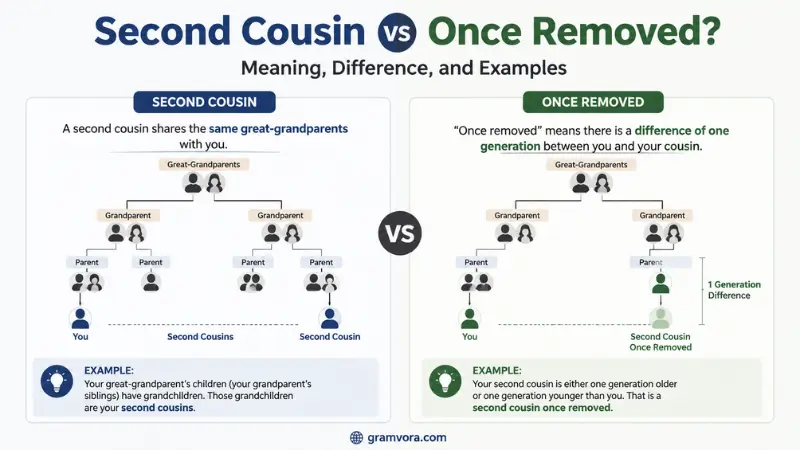
Family relationships can become confusing when people use terms like second cousin and once removed. Many people understand what a cousin is, but they are often unsure what numbers like “second” mean or why the phrase “once removed” appears after a cousin relationship.
These terms are commonly used when discussing family trees, genealogy, ancestry research, and extended relatives. However, they describe two different parts of a family connection.
The term second cousin explains the cousin level between two people. It tells you how far back the shared ancestor is.
The phrase once removed explains a difference in generations. It tells you that two relatives are not from the same generation.
Understanding this difference makes it easier to describe relatives correctly and avoid common family relationship mistakes.
Quick Answer
A second cousin is someone who shares your great-grandparents and is normally in the same generation as you.
A person who is once removed is one generation above or below another cousin relationship.
For example:
- Your second cousin’s child is your second cousin once removed.
- Your parent’s second cousin is your second cousin once removed.
The simple difference is:
- Second cousin = cousin level
- Once removed = generation difference
A second cousin and a second cousin once removed are related, but they describe different positions in a family tree.
Why People Confuse Them
People often confuse these terms because both describe extended family members. The words “second” and “once” sound like they are measuring the same thing, but they measure different parts of a relationship.
The word second tells you the distance from the shared ancestor.
The phrase once removed tells you how many generations separate the two relatives.
For example, imagine two people who share the same great-grandparents.
If they are in the same generation, they are second cousins.
However, if one person is the child of one of those second cousins, there is now a generation difference. The relationship becomes second cousin once removed.
Many mistakes happen because people think “removed” means less related. It does not. It only describes the generation gap.
Key Differences At A Glance
| Context | Best Choice | Why |
|---|---|---|
| Someone shares your great-grandparents and is your generation | Second cousin | It describes the cousin relationship |
| Someone is one generation older or younger | Once removed | It describes the generation difference |
| Your second cousin has a child | Second cousin once removed | The child is one generation below you |
| Your parent has a second cousin | Second cousin once removed | The person is one generation above you |
| Feature | Second Cousin | Once Removed |
| Main purpose | Identifies cousin level | Identifies generation gap |
| Same generation | Usually yes | No |
| Used by itself | Yes | Usually no |
| Shows shared ancestor | Yes | No |
Meaning and Usage Difference
What Does Second Cousin Mean?
A second cousin is a person who shares your great-grandparents but is not your sibling, parent, or first cousin.
To understand this, it helps to look at generations.
Your:
- parents are one generation above you
- grandparents are two generations above you
- great-grandparents are three generations above you
When two people share the same great-grandparents, they are generally second cousins.
Example:
“John and Sarah are second cousins because their grandparents were siblings.”
Second cousins are usually from the same generation, although families can have different ages and family structures.
What Does Once Removed Mean?
The phrase once removed means there is a one-generation difference between two relatives.
It does not create a new cousin level by itself. Instead, it modifies another relationship term.
Examples:
- first cousin once removed
- second cousin once removed
A person can be once removed because they are:
- one generation older than you
- one generation younger than you
For example:
Your mother’s second cousin is your second cousin once removed because that person is one generation above you.
Your second cousin’s child is your second cousin once removed because that person is one generation below you.
Tone, Context, and Formality
Both second cousin and once removed are neutral family relationship terms in American English.
They are most commonly used in:
- genealogy research
- family history projects
- ancestry discussions
- family reunions
- legal family documentation
In everyday conversation, many people do not use exact cousin terms unless the relationship matters.
For example:
Casual:
“My cousin from Ohio visited.”
More specific:
“My second cousin from Ohio visited.”
Genealogy conversations usually require more precise terms because family trees can include many generations and branches.
Which One Should You Use?
Use second cousin when the person is in your generation and shares the correct ancestor connection.
Use once removed when there is a one-generation difference.
Examples:
Correct:
- “My second cousin lives in Florida.”
- “My second cousin once removed lives in New York.”
- “My grandfather’s cousin is my first cousin once removed.”
Incorrect:
- “My second cousin’s daughter is my second cousin.”
The last example is incomplete because it ignores the generation difference.
When One Choice Sounds Wrong
Some uses sound incorrect because they leave out important relationship information.
For example:
“My father’s second cousin is my second cousin.”
This is usually incorrect because your father’s second cousin is one generation above you. The more accurate term is second cousin once removed.
Another example:
“My second cousin’s daughter is my second cousin.”
This misses the fact that the daughter belongs to a younger generation.
The phrase “once removed” helps explain why two relatives may share the same family branch but not belong to the same generation.
Common Mistakes (and Quick Fixes)
Mistake 1: Thinking Removed Means Less Related
Some people believe a removed cousin is less connected or less important.
Fix:
Removed does not describe emotional closeness or family importance. It only describes a generation difference.
Mistake 2: Using Once Removed Alone
Incorrect:
“She is my once removed.”
Correct:
“She is my second cousin once removed.”
The phrase needs another relationship term before it.
Mistake 3: Confusing Cousin Numbers With Generations
The number in cousin relationships and the word removed answer different questions.
The cousin number explains the shared ancestor.
The removed term explains the generation gap.
Mistake 4: Assuming Second Cousins Are Always Distant
Second cousins can have close relationships, especially in large families where relatives grow up together.
Everyday Examples
Example 1: Same Generation
“My cousin Emily and I share the same great-grandparents, so Emily is my second cousin.”
Example 2: Younger Generation
“Emily’s son is my second cousin once removed because he is one generation younger than me.”
Example 3: Older Generation
“My grandfather’s second cousin is my second cousin once removed because that person is one generation older than me.”
Example 4: Family Reunion
“At our family reunion, I met my second cousin and several second cousins once removed.”
Example 5: Family Research
“While creating my family tree, I discovered relatives who were first cousins once removed and second cousins.”
Dictionary-Style Word Details
Verb
Second cousin: Not used as a verb in standard US English.
Once removed: Not used as a standalone verb in family relationship terminology.
These terms function as relationship descriptions rather than action words.
Noun
Second cousin: A noun that describes a family member connected through shared great-grandparents.
Example:
“My second cousin sent me old family pictures.”
Once removed: Not normally a noun by itself. It works as part of a larger family relationship phrase.
Example:
“My second cousin once removed attended the reunion.”
Synonyms
Second cousin:
There is no exact synonym for second cousin.
Closest plain alternatives:
- distant cousin
- extended family member
These alternatives are broader and may include other relationships.
Once removed:
There is no exact synonym.
Closest plain alternative:
- one generation apart
This describes the idea but does not replace the official relationship term.
Example Sentences
Second Cousin
- “My second cousin lives near my hometown.”
- “I met my second cousin during a family gathering.”
- “My second cousin shared information about our ancestors.”
Once Removed
- “My second cousin once removed joined the family celebration.”
- “I discovered that my aunt’s cousin was my first cousin once removed.”
- “My cousin’s child is my cousin once removed.”
Word History
Family relationship terms developed as a way to describe connections between relatives across multiple generations.
The meaning of cousin numbers and removed relationships comes from how families are organized through shared ancestors and generations.
The exact relationship depends on where two people connect on a family tree.
Phrases Containing
Common phrases include:
- first cousin
- second cousin
- first cousin once removed
- second cousin once removed
- cousin twice removed
FAQs
Is a second cousin closer than a second cousin once removed?
A second cousin is usually considered closer in terms of generation because both people are normally in the same generation. However, both relationships describe family connections, and closeness depends on the family.
What does once removed mean?
Once removed means two relatives are separated by one generation.
Is my parent’s second cousin my second cousin?
Your parent’s second cousin is generally your second cousin once removed because that person is one generation above you.
Is my second cousin’s child my second cousin?
No. Your second cousin’s child is your second cousin once removed because the child is one generation younger.
What does twice removed mean?
Twice removed means there are two generations between relatives.
Example:
Your grandparent’s cousin may be your cousin twice removed.
Are second cousins blood relatives?
Yes, second cousins share common ancestors. The exact biological connection depends on the family tree.
Conclusion
The difference between second cousin vs once removed becomes easy to understand when you separate the two ideas.
A second cousin describes the cousin level based on a shared ancestor. A once removed relationship describes a difference of one generation.
If someone shares your great-grandparents and is in your generation, they are your second cousin.
If someone is one generation above or below that relationship, they are your second cousin once removed.
Understanding these terms helps you describe family relationships more accurately and makes reading family trees much easier.


