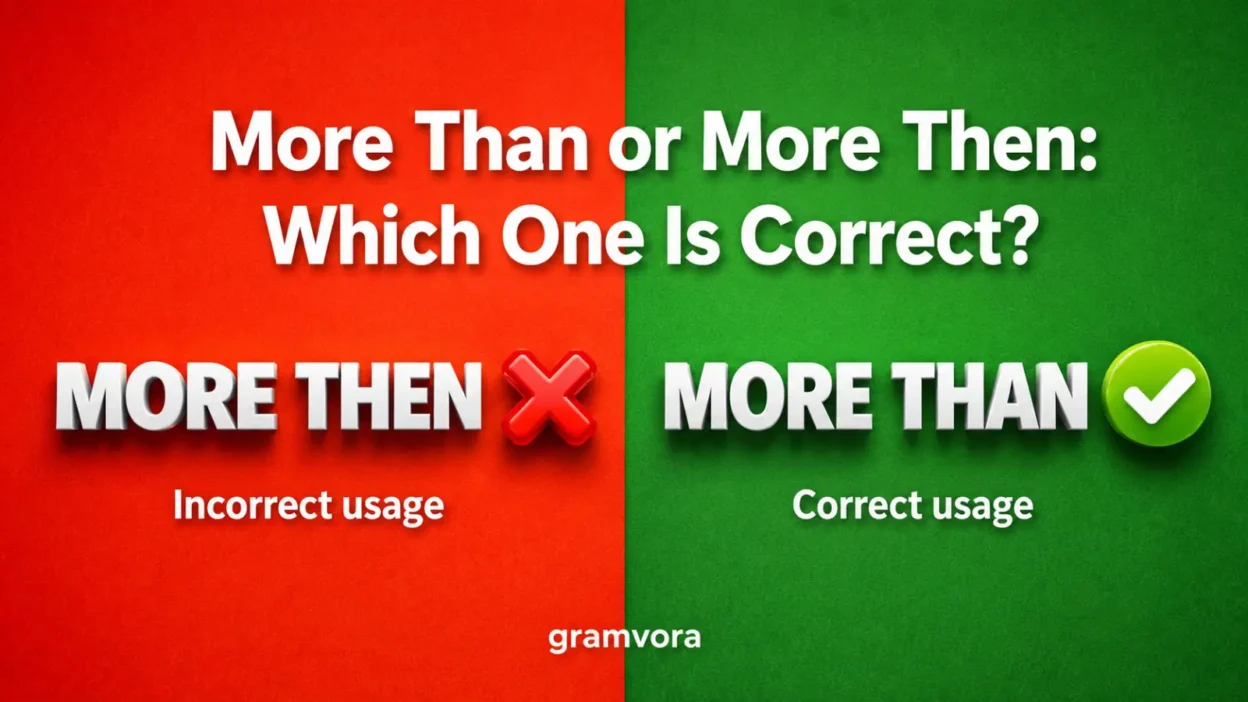
More than is the correct choice when you compare amounts, numbers, people, actions, or ideas. More then is usually incorrect when writers mean “greater than,” “over,” “extra,” or “to a greater degree.”
The confusion comes from than and then. They look close and often sound close in quick speech. However, they do different jobs. Than belongs in comparisons. Then points to time, order, result, or “at that time.”
So, write more than 20 people, more than happy, and I trust her more than anyone. Do not write more then 20 people or more then happy when you mean comparison or emphasis.
Quick Answer
Use more than for comparisons.
Correct: We waited more than an hour.
Incorrect: We waited more then an hour.
Correct: She is more than ready for the interview.
Incorrect: She is more then ready for the interview.
Use more then only when more and then are separate ideas. In that rare case, then means “at that time.”
Correct: He worked more then because rent was cheaper.
Meaning: He worked more at that time.
Even there, the sentence may sound clearer if you rewrite it: He worked more back then because rent was cheaper.
Why People Confuse Them
People confuse more than and more then because than and then differ by only one letter. In fast speech, many Americans pronounce them very similarly. That makes the mistake easy to miss while typing.
The phrase more than is also very common. It appears before numbers, amounts, adjectives, nouns, and full ideas. Because it appears so often, writers sometimes type the wrong familiar-looking word without noticing.
The best test is simple: ask whether the sentence compares something. If yes, choose than.
More than compares.
Then places something in time or order.
Key Differences At A Glance
| Context | Best Choice | Why |
|---|---|---|
| Greater amount | more than | It compares one amount with another. |
| Number above a limit | more than | It means “over” or “in excess of.” |
| Strong feeling or emphasis | more than | It means “very” or “extremely” before some adjectives. |
| Preference | more than | It compares what someone likes, trusts, or values. |
| Time meaning | more then | Possible only when “then” means “at that time.” |
| Step-by-step order | not a set phrase | Use “then” separately after a comma or new clause. |
Meaning and Usage Difference
More than is a comparison phrase. It can mean “greater than,” “over,” “extra,” or “to a greater degree.”
Examples:
The repair cost more than $500.
She reads more than her brother does.
We are more than willing to help.
More then is not a standard comparison phrase. In most sentences, it is a mistake. Still, the two words can appear next to each other when they do separate jobs.
Example:
He exercised more then than he does now.
That sentence means he exercised more at that time. However, many readers may pause at it. A smoother version is: He exercised more back then than he does now.
Pronunciation adds a little value here. Than often sounds like “thun” in unstressed speech. Then sounds like “then.” Because the sounds can blur, the spelling matters.
Tone, Context, and Formality
More than works in casual, professional, academic, and business writing. It is the normal choice in US English whenever you compare.
Examples:
More than 300 students attended.
The update took more than two hours.
She cares more than she admits.
More then does not sound professional when used by mistake. It can make a sentence look careless because readers expect than after more in comparisons.
Still, then itself is not informal. It is a normal word when you mean time, order, or result.
Examples:
Finish the report, then email it.
We lived in Dallas then.
If that is true, then we need a new plan.
Which One Should You Use?
Choose more than almost every time you are deciding between more than or more then.
Use more than when you mean:
- over a number
- greater in amount
- stronger in degree
- beyond what is expected
- compared with another person, thing, or idea
Examples:
The drive took more than three hours.
This job needs more than basic experience.
I like the final draft more than the first one.
Use more then only when then clearly means “at that time.” Even then, consider adding back before then for clarity.
Clearer: I traveled more back then.
Less clear: I traveled more then.
When One Choice Sounds Wrong
More then sounds wrong when the sentence has a number right after it.
Wrong: The phone costs more then $900.
Right: The phone costs more than $900.
It also sounds wrong before an adjective that shows strong feeling.
Wrong: I am more then grateful.
Right: I am more than grateful.
The same problem appears in comparisons of actions.
Wrong: She texts more then she calls.
Right: She texts more than she calls.
However, then is correct when it means “next.”
Correct: She asked for more, then paid the bill.
Here, more means an additional amount. Then starts the next action.
Common Mistakes (and Quick Fixes)
Wrong: We need more then one option.
Right: We need more than one option.
Wrong: He is more then ready.
Right: He is more than ready.
Wrong: I miss you more then ever.
Right: I miss you more than ever.
Wrong: This matters more then money.
Right: This matters more than money.
Quick fix: replace than with “in comparison with.” If the idea still works, use than.
This matters more in comparison with money.
So the correct phrase is: This matters more than money.
For time, try “at that time.”
He worked more at that time.
So then can work, but back then is usually clearer.
Everyday Examples
Correct examples with more than:
I spent more than I planned at Target.
She has more than enough time to finish.
The meeting lasted more than 45 minutes.
He likes coffee more than tea.
We need more than a quick apology.
That movie was more than a simple comedy.
Her answer helped more than she knows.
The new laptop costs more than my old one.
I trust Maya more than anyone on the team.
The recipe needs more than salt to taste good.
Correct examples where more and then are separate:
He studied more then than he does now.
She saved more then, before prices went up.
They walked more then because they did not own a car.
Clearer rewrites:
He studied more back then than he does now.
She saved more at that time, before prices went up.
They walked more back then because they did not own a car.
Dictionary-Style Word Details
Verb
more than: Not commonly used as a verb in standard US English. It is a phrase used in comparisons, not an action word.
more then: Not commonly used as a verb in standard US English. More and then may appear near verbs, but the phrase itself is not a verb.
Noun
more than: Not commonly used as a noun. It usually works as a comparison phrase before a number, noun, adjective, or clause.
more then: Not commonly used as a noun. Then can sometimes work as a noun meaning “that time,” as in until then, but more then is not a normal noun phrase.
Synonyms
more than: Closest plain alternatives include over, greater than, in excess of, beyond, and to a greater degree than. Use the one that fits the sentence.
more then: No exact synonym exists as a comparison phrase because it is usually not the correct phrase. If then means time, closest plain alternatives include back then, at that time, or during that period.
Antonym for comparison: less than is the clearest opposite of more than.
Example Sentences
more than:
We have more than enough chairs.
The project took more than six months.
She respects honesty more than charm.
more then:
He practiced more then than he does today.
Better: He practiced more back then than he does today.
Word History
more than: The phrase comes from ordinary English comparison structure: more shows a greater amount or degree, and than introduces the second part of the comparison.
more then: There is no separate word history for more then as a standard comparison phrase. The confusion comes from the long-standing similarity between than and then in spelling and sound.
Phrases Containing
more than:
more than enough
more than ever
more than happy
more than likely
more than one
more than anything
more then:
No common standard phrases use more then as a fixed comparison phrase. When the words appear together, they usually need punctuation, rewriting, or a clearer time phrase such as back then.
FAQs
Is it more than or more then?
Use more than when you compare amounts, numbers, actions, or ideas. For example, write “more than 50 people,” “more than enough,” and “I like this more than that.” More then is usually incorrect in comparison sentences.
Is more then ever correct?
No. The correct phrase is more than ever. It means something is stronger, greater, or more true now than before. Example: “I need your support more than ever.”
Can more then ever be correct in any sentence?
Almost never as a fixed phrase. If then means “at that time,” you would usually rewrite the sentence for clarity. For example, “I worked more back then than I do now” sounds much clearer than “I worked more then.”
Why do people write more then instead of more than?
People mix them up because than and then look similar and can sound similar in fast speech. The difference is simple: than compares, while then shows time, order, or result.
What is an easy way to remember more than?
Use more than if you can replace it with over, greater than, or in comparison with. For example, “more than $100” means “over $100.” That confirms than is correct.
Is more than one word or two words?
More than is two words. Do not combine it into one word. It works as a comparison phrase, as in “more than one person,” “more than ready,” and “more than I expected.”
What are examples of more than in sentences?
Here are natural examples: “The meeting lasted more than an hour.” “She is more than happy to help.” “We need more than one idea.” “He trusts her more than anyone else.”
When is then correct?
Use then for time, order, or result. For example: “We ate dinner, then watched a movie.” “I lived in Chicago then.” “If you agree, then we can start.”
Conclusion
Use more than when you compare amounts, numbers, actions, feelings, or ideas. It is the correct phrase in sentences like more than $100, more than ready, and more than ever.
Avoid more then when you mean comparison. It is usually a mistake. The only real exception is when more and then work separately, and then means “at that time.” Even in that case, back then often reads better.
Final rule: if the sentence compares, choose more than.