
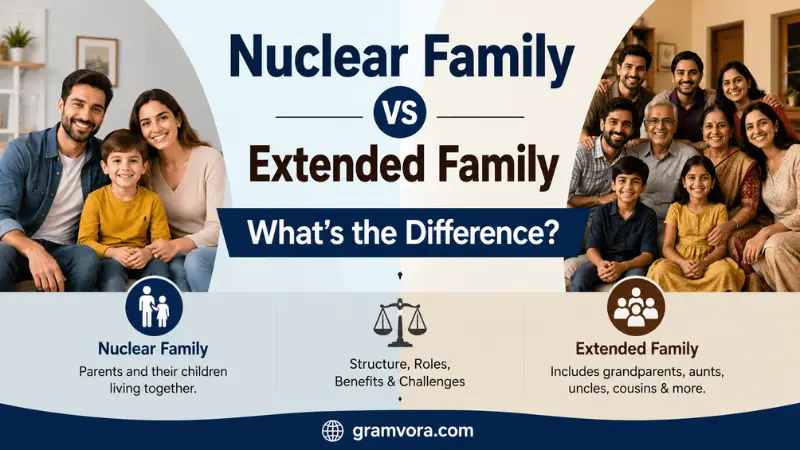
Nuclear family and extended family are both correct terms, but they describe different scopes of family relationships.
A nuclear family generally refers to the core family unit of parents and their children. An extended family reaches beyond that core to include relatives such as grandparents, aunts, uncles, and cousins.
The difference is therefore not simply that one family is “small” and the other is “large.” What matters is who is included.
You can also be part of both at the same time. Your parents and siblings may form your nuclear family unit, while your grandparents, aunts, uncles, and cousins belong to your wider extended family.
Quick Answer
Use nuclear family when you mean the core unit of parents and their children.
Use extended family when you mean a broader family group that includes relatives beyond the parent-child unit, such as grandparents, aunts, uncles, and cousins.
Both expressions are correct. The right choice depends on which family members you are describing.
Why People Confuse Them
The phrases are easy to confuse because both describe family structure, and an extended family often includes a nuclear family within it.
For example, imagine two parents and two children. That group can be described as a nuclear family. Add a grandparent, aunt, uncle, or cousin to the family group being discussed, and extended family becomes the more accurate expression.
Another source of confusion is living arrangement. An extended family can describe relatives who share a home, but everyday use can also refer to the broader group of relatives even when they live separately.
So, nuclear identifies the core unit, while extended widens the circle.
Key Differences At A Glance
| Feature | nuclear family | extended family |
|---|---|---|
| Core meaning | Parents and their children | Family beyond the core parent-child unit |
| Common members | Parents and children | Grandparents, aunts, uncles, cousins, and other relatives |
| Scope | Narrower | Broader |
| Living arrangement | Often discussed as one household | May describe one household or a wider family network |
| Grammar | Noun phrase | Noun phrase |
The safest distinction is based on family membership, not assumptions about whether one arrangement is better, happier, richer, or more traditional.
Meaning and Usage Difference
A nuclear family is the core parent-and-child family unit. In common definitions, it usually involves two parents and their children.
Example:
Maria lives with her parents and younger brother in a nuclear family household.
An extended family includes relatives outside that core group.
Example:
Maria’s extended family includes her grandparents, three aunts, two uncles, and several cousins.
Notice that Maria does not have to choose one family label for every purpose. Her household may be nuclear while her wider network of relatives is her extended family.
Both expressions function as noun phrases. They name types or scopes of family groups rather than actions.
Tone, Context, and Formality
Both terms are standard and neutral, but their everyday feel is slightly different.
Nuclear family often sounds more analytical because it is commonly used when discussing family structure, education, sociology, demographics, or household composition.
Extended family is also used in those settings, but it sounds very natural in everyday conversation:
We’re visiting my extended family over Thanksgiving.
Neither phrase is inherently more polite or formal than the other. The important issue is accuracy.
Also, avoid treating nuclear family as a judgment about what a family should look like. In word choice, the phrase simply identifies a particular family structure.
Which One Should You Use?
Choose the term according to the relatives you mean.
| Context | Best Choice | Why |
| Parents and their children as one family unit | nuclear family | Refers to the core parent-child unit |
| Grandparents, aunts, uncles, or cousins are included | extended family | Goes beyond the core unit |
| Discussing a household containing only parents and children | nuclear family | Describes the narrower household structure |
| Discussing several generations of relatives together | extended family | Includes relatives beyond parents and children |
| Talking about cousins and grandparents who live elsewhere | extended family | Everyday usage can describe the wider kin network |
| Comparing core relatives with the wider family | Both | Each phrase identifies a different scope |
A useful question is: Am I talking only about parents and children, or am I including other relatives?
That usually gives you the correct choice.
When One Choice Sounds Wrong
Use extended family instead of nuclear family when grandparents, aunts, uncles, cousins, or comparable relatives are central to the group you mean.
Wrong:
My nuclear family includes my parents, my aunt, my uncle, and six cousins.
Better:
My extended family includes my parents, my aunt, my uncle, and six cousins.
The reverse mistake also changes the meaning.
If a school assignment asks specifically about a household made up of parents and their children, calling it an extended family would normally suggest that additional relatives are included.
The phrases are therefore related, but they are not interchangeable.
Common Mistakes (and Quick Fixes)
Mistake: Thinking “nuclear” refers to nuclear energy.
Fix: In this phrase, nuclear relates to the idea of a central or core unit.
Mistake: Assuming an extended family must be extremely large.
Fix: Size alone does not decide the term. Adding relatives beyond the core parent-child unit creates the relevant distinction.
Mistake: Assuming all extended family members must live together.
Fix: Shared housing is one important use, but extended family can also describe the wider group of relatives.
Mistake: Using the two phrases as exact opposites.
Fix: They describe different scopes. An extended family can include a nuclear family within the broader family network.
Mistake: Calling grandparents part of the nuclear family simply because they are very close.
Fix: Emotional closeness does not change the usual structural meaning. Grandparents are normally discussed as extended family.
Everyday Examples
Nuclear family:
After the move, their nuclear family consisted of the parents and their two children.
Extended family:
Their extended family came from several states for the wedding.
Nuclear family:
The survey asked whether the child lived only with members of the nuclear family.
Extended family:
Jordan stays in regular contact with his extended family, especially his grandparents and cousins.
Nuclear family:
They wanted an apartment with enough space for their nuclear family.
Extended family:
During the holidays, the house fills up with members of their extended family.
These examples show why context matters. One phrase focuses on the core family unit, while the other expands the reference to additional relatives.
Dictionary-Style Word Details
Verb
- nuclear family: Not commonly used as a verb in standard US English. It functions as a noun phrase.
- extended family: Not commonly used as a verb in standard US English. It also functions as a noun phrase.
Do not create verb forms from either expression.
Noun
- nuclear family: A noun phrase referring to the core family unit of parents and their children.
- extended family: A noun phrase referring to a broader family group that includes relatives beyond the core unit.
Plural forms are straightforward:
- nuclear families
- extended families
Synonyms
Neither expression has a perfect synonym that works in every context.
- nuclear family — closest plain alternatives: core family unit, parent-and-child family unit
- extended family — closest plain alternatives: wider family, wider family network
There are no useful exact antonyms. Although the two expressions are commonly contrasted, they are not strict opposites because an extended family can contain a nuclear family as part of the larger group.
Example Sentences
- nuclear family: Their nuclear family moved from Ohio to Arizona last year.
- nuclear family: The discussion focused on responsibilities within the nuclear family.
- extended family: Mia invited her extended family to the graduation party.
- extended family: His grandparents are an important part of his extended family.
The choice changes according to which relatives the sentence includes, not simply the number of people present.
Word History
Nuclear family uses nuclear in the sense of something forming a central core. The expression is older than the popular association of “nuclear” with atomic weapons and nuclear power. Merriam-Webster records its first known use in 1924.
Extended family developed as a label for a family group extending beyond the nuclear unit. Merriam-Webster records its first known use at about 1935.
The history supports the modern contrast: one phrase identifies a core, while the other describes a family group that extends beyond that core.
Phrases Containing
Common combinations with nuclear family include:
- nuclear family household
- nuclear family structure
- nuclear family unit
- traditional nuclear family
Common combinations with extended family include:
- extended family members
- extended family household
- large extended family
- extended family network
These combinations can help show the intended meaning. Household emphasizes living arrangements, while members or network can refer more broadly to relatives.
FAQs
What is the main difference between a nuclear family and an extended family?
A nuclear family usually consists of parents and their children. An extended family includes additional relatives, such as grandparents, aunts, uncles, cousins, and other family members beyond the core parent-child unit.
Are grandparents part of a nuclear family?
Usually, no. Grandparents are considered part of the extended family because they are outside the immediate parent-and-child unit. If grandparents live in the same household, the household may be described as an extended or multigenerational family household.
Can someone belong to both a nuclear family and an extended family?
Yes. A person can have a nuclear family made up of parents and children while also belonging to a larger extended family that includes grandparents, cousins, aunts, and uncles.
Does an extended family have to live in the same house?
No. Extended family members do not always have to live together. The phrase can refer broadly to relatives outside the nuclear family, even when they live in different homes, cities, or states.
Is a nuclear family always smaller than an extended family?
Usually, but family size is not the main difference. The important distinction is which relatives are included. A nuclear family centers on parents and children, while an extended family includes relatives beyond that core group.
Which term should I use: nuclear family or extended family?
Use nuclear family when discussing parents and their children as the core family unit. Use extended family when grandparents, aunts, uncles, cousins, or other relatives beyond that core group are included.
Conclusion
The difference between nuclear family vs extended family comes down to scope.
A nuclear family refers to the core family unit of parents and their children. An extended family includes relatives beyond that unit, such as grandparents, aunts, uncles, and cousins.
Both terms are correct, and neither automatically describes a better type of family. When choosing between them, focus on who is included in the family group you are describing.
If the reference stays within parents and children, choose nuclear family. If it expands to additional relatives, extended family is usually the clearer choice.


