
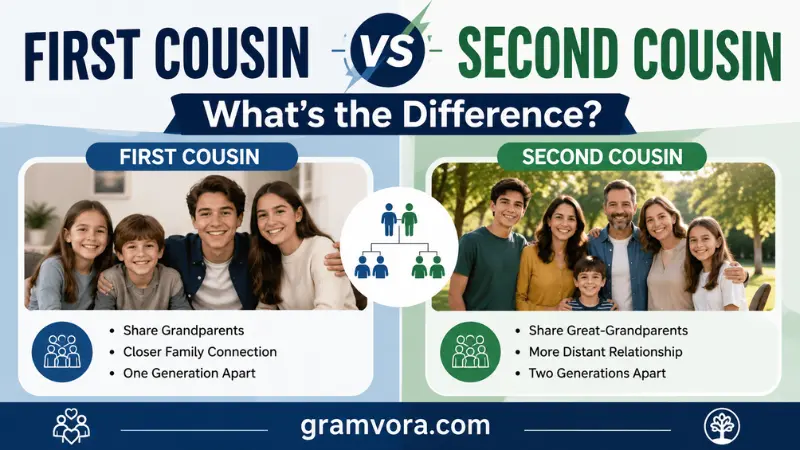
Both first cousin and second cousin are correct family terms, but they describe different positions in a family tree.
A first cousin is usually the child of your aunt or uncle. You and that person have grandparents in common through that family line.
A second cousin is one generation farther out in the cousin pattern. Your parents are first cousins, and you and their children are second cousins. Your closest shared ancestors are great-grandparents.
The easiest way to choose the right term is to identify the closest ancestors you share and check whether both relatives are in the same generation.
Quick Answer
Use first cousin when you and another person are children of siblings. In the usual family structure, you share grandparents.
Use second cousin when your parents are first cousins. You and the other person share great-grandparents rather than grandparents through that relationship.
Both terms are correct. They are not interchangeable.
A useful shortcut is:
- First cousin: your parents are siblings; you share grandparents.
- Second cousin: your parents are first cousins; you share great-grandparents.
Your first cousin’s child is not your second cousin. That relationship involves a generation difference and is called a first cousin once removed.
Why People Confuse Them
The confusion usually comes from treating second cousin as if it simply meant “a more distant cousin.”
That is not how the numbered system works.
The words first and second describe a specific family-tree relationship. They do not describe how close you feel to the person, how often you see them, or how old they are.
Another common problem involves children. People sometimes assume that the child of a first cousin automatically becomes their second cousin.
Instead, the generation gap matters. Your first cousin’s child is one generation below you. Your child and your first cousin’s child, however, are second cousins to each other.
Key Differences At A Glance
| Context | Best Choice | Why |
|---|---|---|
| Your parents are siblings | First cousin | You belong to the next generation of the same sibling branches |
| You share grandparents | First cousin | Grandparents are the closest shared ancestors in the usual first-cousin relationship |
| Your parents are first cousins | Second cousin | You are one cousin degree farther out |
| You share great-grandparents | Second cousin | Great-grandparents are the closest shared ancestors in the usual second-cousin relationship |
| The person is your aunt’s or uncle’s child | First cousin | That is the standard first-cousin relationship |
| The person is your parent’s first cousin’s child | Second cousin | Your parents are first cousins, placing you in the next matching generation |
Meaning and Usage Difference
A first cousin is the child of your parent’s sibling. In everyday terms, that means the child of your aunt or uncle.
For example, suppose your mother and Lisa’s father are brother and sister. You and Lisa are first cousins.
A second cousin is the child of your parent’s first cousin.
Suppose your father and Marcus’s mother are first cousins. You and Marcus are second cousins. Your family lines connect through great-grandparents rather than grandparents.
Both expressions function as noun phrases. Their plurals are first cousins and second cousins.
The important distinction is ancestry, not age. A second cousin could be older than your first cousin, and that would not change either relationship.
Tone, Context, and Formality
Both terms are standard and neutral in American English. Neither is especially formal or informal.
In ordinary conversation, Americans often use the shorter word cousin when the exact family-tree degree does not matter.
You might say, “My cousin is visiting from Chicago,” even if that person is technically your first cousin or second cousin.
When the exact relationship matters, such as when describing a family tree or introducing a less familiar relative, first cousin and second cousin provide more precision.
The numbered terms describe genealogy. They do not imply emotional closeness. Someone may be very close to a second cousin and barely know a first cousin.
Which One Should You Use?
Start with the parents.
If your parent and the other person’s parent are siblings, use first cousin.
If your parent and the other person’s parent are first cousins, use second cousin.
You can also work backward to the shared ancestors.
If the closest shared ancestors are grandparents and you are in corresponding generations, first cousin is the right choice.
If the closest shared ancestors are great-grandparents and you are in corresponding generations, use second cousin.
Do not decide based on age, family closeness, or how distant the relationship feels.
When One Choice Sounds Wrong
First cousin is wrong when the two people do not have the standard first-cousin relationship.
For example, if your grandmothers are sisters, you are not first cousins. Your parents are first cousins, making you second cousins.
Second cousin is wrong when the person is simply the child of your aunt or uncle. That person is your first cousin.
It is also inaccurate to call your parent’s first cousin your second cousin. That person is one generation above you, so the relationship uses once removed rather than changing from first to second.
Likewise, your first cousin’s child does not become your second cousin simply because the child belongs to a younger generation.
Common Mistakes (and Quick Fixes)
Mistake: “My mom’s cousin is my second cousin.”
Quick fix: If the person is your mother’s first cousin, the precise relationship is first cousin once removed.
Mistake: “My first cousin’s daughter is my second cousin.”
Quick fix: She is your first cousin once removed. Your children and her children would be second cousins only when their family-tree positions line up that way.
Mistake: “Second cousin just means a distant cousin.”
Quick fix: Second cousin identifies a particular genealogical relationship. It is not a general label for any distant relative.
Mistake: “We are the same age, so we must be second cousins.”
Quick fix: Age does not determine cousin degree. Shared ancestry and generational position do.
Mistake: “All cousins share grandparents.”
Quick fix: First cousins normally trace the relationship through grandparents. Second cousins trace it through great-grandparents.
Everyday Examples
- “Maya is my first cousin. Her mother and my father are siblings.”
- “I’m meeting my second cousin at our family reunion this weekend.”
- “Ryan and I share grandparents, so we’re first cousins.”
- “Our grandfathers were brothers, which makes Claire and me second cousins.”
- “My dad and Olivia’s mom are first cousins, so Olivia is my second cousin.”
- “I used to call Noah my second cousin, but he is actually my first cousin once removed.”
- “My first cousin and I each have a son. Our sons are second cousins.”
- “We usually just say cousin, but technically she is my second cousin.”
Dictionary-Style Word Details
Verb
- first cousin: Not commonly used as a verb in standard US English. It functions as a noun phrase.
- second cousin: Not commonly used as a verb in standard US English. It also functions as a noun phrase.
Noun
- first cousin: A countable noun phrase for the child of your aunt or uncle. The plural is first cousins.
- second cousin: A countable noun phrase for the child of one of your parent’s first cousins. The plural is second cousins.
Both identify specific extended-family relationships.
Synonyms
Neither expression has a perfect synonym that preserves the same degree of genealogical precision.
- first cousin: Closest plain alternatives include cousin and relative, but both are broader.
- second cousin: Closest plain alternatives include cousin and relative, but they do not identify the exact degree.
There is no useful direct antonym for either family term.
Example Sentences
- first cousin: “My first cousin and I spent every summer at our grandparents’ house.”
- first cousin: “Daniel is my first cousin because our mothers are sisters.”
- second cousin: “I met a second cousin while researching our family history.”
- second cousin: “Emma and I are second cousins because our fathers are first cousins.”
Word History
Both expressions have been used in English for centuries.
First cousin is documented from the 1600s, with records dating to 1649. Second cousin is likewise documented from the 1600s, with records dating to 1660.
The numbered expressions developed as precise ways to identify different degrees within the broader category of cousins.
For modern readers, the important point is not the date of origin but the stable distinction: first and second identify different family-tree positions.
Phrases Containing
- first cousin once removed: a first-cousin relationship with a one-generation difference
- first cousin twice removed: a first-cousin relationship with a two-generation difference
- second cousin once removed: a second-cousin relationship with a one-generation difference
- second cousin twice removed: a second-cousin relationship with a two-generation difference
The word removed measures a difference in generations. It does not turn a first cousin into a second cousin.
FAQs
What is the difference between a first cousin and a second cousin?
A first cousin shares grandparents with you, while a second cousin shares great-grandparents with you. First cousins are typically the children of siblings. Second cousins are typically the children of first cousins.
Is my cousin’s child my second cousin?
No. Your first cousin’s child is your first cousin once removed, not your second cousin. The word removed shows that you are from different generations in the family tree.
Are second cousins considered family?
Yes. Second cousins are relatives who share great-grandparents. They are farther apart on the family tree than first cousins, but they are still part of the same extended family.
Is my parent’s cousin my second cousin?
Usually, no. If that person is your parent’s first cousin, they are your first cousin once removed. You are one generation below your parent, which creates the “once removed” relationship.
Do first cousins and second cousins share grandparents?
First cousins normally share grandparents. Second cousins do not normally share grandparents as their closest common ancestors. Instead, second cousins share great-grandparents.
Can a second cousin be closer to me than a first cousin?
Yes, socially. Cousin degree describes your genealogical relationship, not your emotional bond. You may know a second cousin very well while rarely speaking to a first cousin.
How can I quickly tell if someone is my first or second cousin?
Look at your closest shared ancestors. If you share grandparents and are in the same generation, you are first cousins. If you share great-grandparents and are in the same generation, you are second cousins.
Conclusion
The difference between first cousin vs second cousin comes down to where the two people connect in the family tree.
First cousins are children of siblings and normally share grandparents. Second cousins are children of first cousins and normally share great-grandparents.
When you are unsure, find the nearest shared ancestors. Grandparents point to a first-cousin relationship; great-grandparents point to a second-cousin relationship when both people occupy corresponding generations.
Most importantly, do not use second cousin simply for someone who feels more distant. Your parent’s first cousin or your first cousin’s child involves a generation difference, so a removed relationship is needed instead.


