
“First cousin” and “second cousin” are both correct family terms, but they describe different relationships. The difference depends on the closest generation of ancestors you and the other person share.
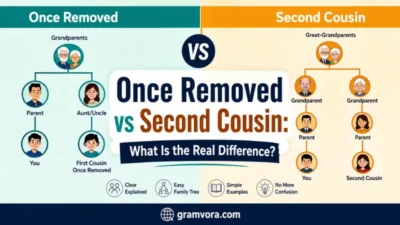
First cousins share grandparents. Second cousins share great-grandparents. That one-generation shift is the key to choosing the right term.
The labels can become confusing because everyday conversation often uses “cousin” for many relatives. Family trees use the more precise terms when the exact relationship matters.
Quick Answer
Use first cousin for the child of your aunt or uncle. You and a first cousin share at least one grandparent.
Use second cousin for the child of one of your parent’s first cousins. You and a second cousin share at least one great-grandparent, but you do not share a grandparent through that cousin relationship.
A parent’s first cousin is not your second cousin. That person is your first cousin once removed because you are one generation apart.
Why People Confuse Them
The numbers “first” and “second” can sound as if they describe how close you feel to someone or which cousin came first in the family. They do not. The number identifies the degree of the cousin relationship.
Another common source of confusion is the word “removed.” Cousin degree and removal describe two different things. First versus second tells you how far back the shared ancestor is. “Removed” tells you that the two relatives are in different generations.
That is why your parent’s first cousin does not automatically become your second cousin. The generation difference changes the removal, not the cousin degree.
Key Differences At A Glance
- First cousin: You usually share grandparents and are in the same generation.
- Second cousin: You usually share great-grandparents and are in the same generation.
- First cousin route: Your parent and your cousin’s parent are siblings.
- Second cousin route: Your parent and your cousin’s parent are first cousins.
- Main test: Find the closest shared ancestors, then count how many generations each person is below them.
Meaning and Usage Difference
A first cousin is the son or daughter of your parent’s sibling. In ordinary family language, people often shorten this to simply “cousin.”
Example: Your mother’s sister has a son named Eric. Eric is your first cousin because you and Eric share grandparents.
A second cousin is the son or daughter of your parent’s first cousin. Put another way, second cousins are people in the same generation whose parents are first cousins.
Example: Your father and Maya’s mother are first cousins. You and Maya are second cousins because your closest shared ancestors in that line are great-grandparents.
Both expressions are countable noun phrases. You can say “a first cousin,” “two first cousins,” “a second cousin,” or “several second cousins.” Neither expression normally works as a verb.
Tone, Context, and Formality
Both terms are standard and neutral in American English. Neither one is inherently more formal than the other.
In casual conversation, people often say “cousin” when the exact degree does not matter. More precise labels are useful when discussing a family tree, genealogy, inheritance records, historical relationships, or a large extended family.
The full phrase can also prevent misunderstanding. Saying “She’s my second cousin” gives more information than simply saying “She’s my cousin.”
Pronunciation does not add an important distinction here. The difference is in meaning, not sound.
Which One Should You Use?
Choose the term by identifying the closest shared ancestors.
| Context | Best Choice | Why |
|---|---|---|
| Your parent and the other person’s parent are siblings | First cousin | You share grandparents |
| Your parent and the other person’s parent are first cousins | Second cousin | You share great-grandparents |
| The other person is your aunt’s or uncle’s child | First cousin | That is the standard first-cousin relationship |
| The other person is your parent’s first cousin’s child | Second cousin | You are in the same generation and share great-grandparents |
| The other person is your parent’s first cousin | Neither by itself | The precise term includes “once removed” because you are one generation apart |
A fast family-tree test is to look upward. If the shared ancestors are grandparents, use first cousin. If they are great-grandparents, use second cousin, assuming both people are in the same generation.
When One Choice Sounds Wrong
“First cousin” sounds wrong when the relationship goes back one generation farther than shared grandparents.
For example, if your grandfather and someone else’s grandfather were brothers, you and that person are not first cousins. Your parents are first cousins, so you are second cousins.
“Second cousin” sounds wrong when the person is simply your aunt’s or uncle’s child. That person is your first cousin.
It is also inaccurate to call your parent’s first cousin your second cousin. The family connection may feel more distant, but the precise relationship is first cousin once removed.
Common Mistakes (and Quick Fixes)
Mistake: “My mom’s cousin is my second cousin.”
Quick fix: If your mom and that person are first cousins, the person is your first cousin once removed.
Mistake: “My cousin’s child is my second cousin.”
Quick fix: Your first cousin’s child is your first cousin once removed. Your child and your first cousin’s child would be second cousins.
Mistake: “Second cousin means a more distant first cousin.”
Quick fix: The terms describe different family-tree positions. First cousins share grandparents; second cousins share great-grandparents.
Mistake: “The older person must be my first cousin and the younger one my second cousin.”
Quick fix: Age does not determine cousin degree. Generational position and shared ancestry do.
Everyday Examples
- Family reunion: “Jordan is my first cousin. His dad and my mom are brother and sister.”
- Wedding introduction: “Alyssa is my second cousin. Our grandmothers were sisters.”
- Family-tree project: “I first thought Noah was my first cousin, but our shared ancestors are great-grandparents, so he is my second cousin.”
- Explaining a parent’s relative: “My dad’s first cousin is my first cousin once removed, not my second cousin.”
- Talking about children: “My first cousin and I both have daughters, and our daughters are second cousins.”
- Large family gathering: “Most people call everyone a cousin, but technically Mia and I are second cousins.”
- School assignment: “First cousins share grandparents, while second cousins share great-grandparents.”
- Checking a family tree: “Once I found our shared great-grandparents, I knew we were second cousins.”
These examples show why the shared ancestor matters more than age, closeness, or how often the relatives see each other.
Dictionary-Style Word Details
Verb
- first cousin: Not commonly used as a verb in standard US English. It functions as a noun phrase.
- second cousin: Not commonly used as a verb in standard US English. It functions as a noun phrase.
Noun
- first cousin: A countable noun phrase for the child of one’s aunt or uncle. First cousins share grandparents through the relationship being described.
- second cousin: A countable noun phrase for the child of one’s parent’s first cousin. Second cousins share great-grandparents through the relationship being described.
Plural forms are first cousins and second cousins.
Synonyms
Neither term has a perfect everyday synonym that keeps the same level of family-tree precision.
- first cousin: Closest plain alternatives are cousin and relative, but both are broader. The older term cousin-german can mean first cousin, but it is uncommon in modern everyday US English.
- second cousin: Closest plain alternatives are cousin, distant cousin, and relative, but each is less precise than second cousin.
Clear antonyms do not fit these kinship labels, so none are needed.
Example Sentences
- first cousin: “My first cousin lives in Denver, and we see each other every Thanksgiving.”
- first cousin: “Renee is my first cousin because our mothers are sisters.”
- second cousin: “I met my second cousin at a family reunion in Ohio.”
- second cousin: “Caleb and I share great-grandparents, so we are second cousins.”
Word History
Both phrases have a long history in English kinship vocabulary.
- first cousin: The phrase is documented in English from the 17th century. It developed as a more precise label for the relationship commonly called simply “cousin.”
- second cousin: This phrase is also documented from the 17th century and extends the numbered cousin system one generation farther from the shared ancestors.
The base word cousin is much older in English and comes through French from Latin. For modern usage, the important point is that first and second mark different degrees of cousin relationship.
Phrases Containing
- first cousin once removed: A first-cousin relationship with a one-generation difference, such as your first cousin’s child or your parent’s first cousin.
- first cousin twice removed: A first-cousin relationship with a two-generation difference.
- second cousin once removed: A second-cousin relationship with a one-generation difference.
- second cousin twice removed: A second-cousin relationship with a two-generation difference.
“Removed” changes the generation gap. It does not change a first cousin into a second cousin.
FAQs
What is the main difference between a first cousin and a second cousin?
A first cousin shares grandparents with you, while a second cousin shares great-grandparents with you. The difference depends on how far back your closest shared ancestors are.
Is my parent’s cousin my second cousin?
No. Your parent’s first cousin is your first cousin once removed because you are one generation apart. Their child, however, is your second cousin.
Are my cousin’s children my second cousins?
Not usually. Your first cousin’s child is your first cousin once removed. Your children and your first cousin’s children are second cousins to each other.
Do second cousins share grandparents?
Second cousins generally do not share grandparents through that cousin relationship. They share great-grandparents, while their parents share grandparents and are first cousins.
Are first cousins closer relatives than second cousins?
Yes, in family-tree terms. First cousins share more recent ancestors—grandparents—while second cousins share great-grandparents. Personal closeness, however, depends on the family.
How can I tell if someone is my first or second cousin?
Find your closest shared ancestors. If you share grandparents and are in the same generation, you are first cousins. If you share great-grandparents and are in the same generation, you are second cousins.
Conclusion
The difference between first cousin vs second cousin is based on the closest shared ancestors. First cousins share grandparents. Second cousins share great-grandparents.
If you are unsure, trace both people back to the nearest shared ancestors. Shared grandparents point to first cousins; shared great-grandparents point to second cousins when both relatives are in the same generation.
The most important correction is simple: your parent’s first cousin is not your second cousin. That relationship is first cousin once removed. Your parent’s first cousin’s child, however, is your second cousin.