
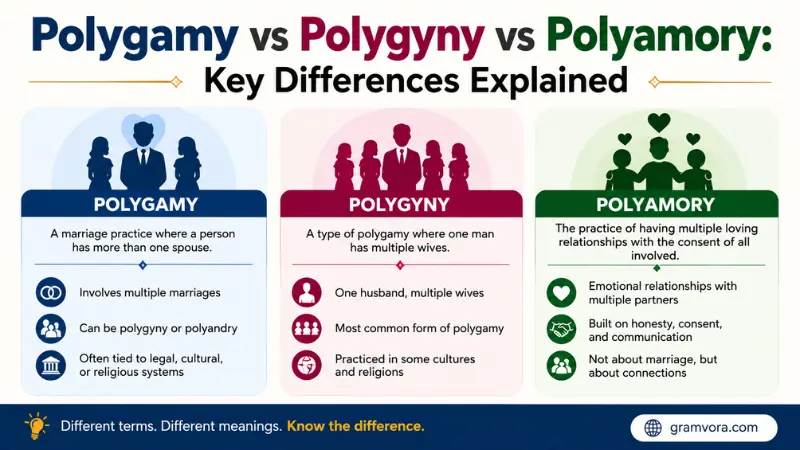
Polygamy, polygyny, and polyamory all describe relationships involving more than two people, but they do not mean the same thing.
The biggest distinction is simple: polygamy is specifically about having multiple spouses through marriage, polygyny is a form of polygamy involving one man and multiple wives, and polyamory refers to having multiple romantic or intimate relationships with the knowledge and consent of everyone involved.
Because the three words share the prefix poly-, they are easy to mix up. Their meanings become much clearer when you focus on marriage, gender structure, and consent.
Quick Answer
Here is the shortest way to remember the difference:
- Polygamy: marriage involving more than two spouses.
- Polygyny: a form of polygamy in which one man has multiple wives.
- Polyamory: having multiple romantic or intimate relationships with the knowledge and consent of everyone involved.
So, polygyny is a type of polygamy, but polygamy is broader than polygyny. Polyamory is different because it does not require marriage.
For example, a man married to three women is in a polygynous marriage, which is also polygamous. A person who has two committed romantic partners with everyone’s knowledge may be polyamorous, but that does not make the relationship polygamous.
Why People Confuse Them
The confusion comes partly from the shared poly- element, which relates to “many.” The words then add different concepts to that basic idea.
Polygamy centers on marriage and multiple spouses.
Polygyny narrows that idea by specifying the gender arrangement: one husband with multiple wives.
Polyamory centers on multiple romantic or intimate relationships and mutual knowledge and consent. Marriage is not required.
Another source of confusion is everyday usage. People sometimes use polygamy as a general word for any relationship involving several partners. In precise usage, however, polyamory and polygamy describe different relationship structures.
Key Differences At A Glance
| Context | Best Choice | Why |
|---|---|---|
| Marriage to multiple spouses | Polygamy | The term specifically refers to multiple-spouse marriage. |
| One man with multiple wives | Polygyny | It identifies a particular form of polygamous marriage. |
| Multiple romantic relationships with mutual consent | Polyamory | Marriage is not required, and the focus is on multiple consensual relationships. |
| General term for a man with several wives | Polygamy or polygyny | Polygamy is broader; polygyny is more specific. |
| Several committed partners who are not married to one another | Polyamory | The arrangement does not depend on multiple marriages. |
The three terms can overlap in limited contexts, but they should not be treated as interchangeable.
Meaning and Usage Difference
Polygamy is the broadest of the three marriage-related terms. It describes a marriage arrangement in which a person has more than one spouse at the same time.
Polygyny is more specific. It describes a marriage in which one man has multiple wives. In other words, polygyny falls under the broader category of polygamy.
Polyamory describes a consensual relationship structure involving multiple romantic or intimate relationships. The people involved know about the relationships and agree to the arrangement.
A useful distinction is:
Marriage: polygamy → polygyny
Multiple consensual romantic relationships: polyamory
A second comparison
| Feature | Polygamy | Polygyny | Polyamory |
|---|---|---|---|
| Multiple spouses | Yes | Yes | Not required |
| Marriage is central | Yes | Yes | No |
| One man with multiple wives | Can describe it | Specifically describes it | Not the definition |
| Multiple romantic relationships | Not necessarily | No | Yes |
| Consent is central to the definition | Not the defining feature | Not the defining feature | Yes |
The terms also differ grammatically. Polygamy, polygyny, and polyamory are nouns. Related adjective forms such as polygamous, polygynous, and polyamorous can describe people, relationships, or arrangements.
Tone, Context, and Formality
All three terms are established vocabulary, but they appear in somewhat different contexts.
Polygamy is the most general marriage-related term. It commonly appears in discussions of marriage, law, religion, history, anthropology, and family structures.
Polygyny is more specialized. It is useful when the gender arrangement matters and you specifically mean one man with multiple wives.
Polyamory is commonly used when discussing contemporary relationship structures in which people openly maintain multiple romantic or intimate relationships.
The choice of word should therefore follow the structure you are describing rather than the number of people alone.
For example:
- “The study examines polygamous marriages.”
- “The researchers focused specifically on polygyny.”
- “They describe their relationship as polyamorous.”
Which One Should You Use?
Use polygamy for marriage involving multiple spouses when the specific gender arrangement is not important.
Choose polygyny when you specifically mean one man married to multiple women.
For multiple romantic or intimate relationships that are openly known about and consensual, polyamory is the appropriate term, whether or not marriage is involved.
If you are unsure which word fits, ask what the relationship structure actually involves:
Is marriage to multiple spouses the point? Choose polygamy.
Is one man married to multiple wives the specific arrangement? Choose polygyny.
Are multiple romantic relationships involved without marriage being essential to the definition? Choose polyamory.
When One Choice Sounds Wrong
Calling every polyamorous relationship polygamy can be misleading because polyamory does not require marriage.
For example:
“They are married to three people, so they are polygamous.”
This uses polygamous appropriately if the people are actually married to multiple spouses.
But:
“She has two romantic partners, so she is polygamous.”
That sentence may be inaccurate if there is no multiple-spouse marriage. Polyamorous is the more precise choice for a consensual arrangement involving multiple romantic relationships.
Similarly, polygyny should not be used for every form of polygamy. The word specifically describes the one-man/multiple-wives arrangement.
Common Mistakes (and Quick Fixes)
Mistake: Treating polygamy and polyamory as exact synonyms
Fix: Use polygamy for multiple-spouse marriage and polyamory for multiple consensual romantic or intimate relationships.
Mistake: Using polygyny as a general synonym for polygamy
Fix: Remember that polygyny is a specific form of polygamy involving one man and multiple wives.
Mistake: Assuming polyamory always means marriage to multiple people
Fix: Polyamory does not require marriage.
Mistake: Assuming multiple partners automatically means polyamory
Fix: The term polyamory generally involves openly negotiated and consensual multiple romantic or intimate relationships. A secret relationship outside an agreed relationship is not made polyamorous simply because more than two people are involved.
Everyday Examples
Polygamy:
“The article discusses the legal history of polygamy and multiple-spouse marriage.”
Here, the focus is on marriage involving more than one spouse.
Polygyny:
“The anthropologist studied communities in which polygyny was practiced.”
The specific marriage structure is one man with multiple wives.
Polyamory:
“They describe their relationship as polyamorous because both partners are free to develop other romantic relationships with everyone’s knowledge.”
Here, marriage to multiple spouses is not the defining feature.
Another useful contrast:
“The family practiced polygamy.”
This tells the reader that multiple-spouse marriage is involved, but it does not by itself specify the gender arrangement.
“The family practiced polygyny.”
This gives the reader the more specific information that the marriage involved one man and multiple wives.
“The couple practices polyamory.”
This points to a consensual relationship structure involving multiple romantic or intimate connections rather than multiple-spouse marriage.
Dictionary-Style Word Details
Verb
- Polygamy: Not commonly used as a verb in standard US English. The noun refers to the practice or condition of having multiple spouses.
- Polygyny: Not commonly used as a verb in standard US English. It is a noun describing a specific form of multiple-spouse marriage.
- Polyamory: Not commonly used as a verb in standard US English. The noun describes a relationship practice involving multiple consensual romantic or intimate relationships.
Related adjectives are more natural in ordinary sentences:
- “a polygamous marriage”
- “a polygynous marriage”
- “a polyamorous relationship”
Noun
- Polygamy: A marriage arrangement involving more than one spouse at the same time.
- Polygyny: A form of polygamy in which one man has multiple wives.
- Polyamory: A relationship practice involving multiple romantic or intimate relationships with the knowledge and consent of the people involved.
Synonyms
These words do not have perfect one-word synonyms, so close alternatives should be used carefully.
- Polygamy: closest plain alternative — multiple-spouse marriage.
- Polygyny: closest plain alternative — one-man, multiple-wife marriage.
- Polyamory: closest plain alternative — consensual multiple-partner relationships.
These alternatives explain the concepts, but they are not always interchangeable with the original terms.
Example Sentences
- Polygamy: “The book examines different forms of polygamy.”
- Polygyny: “The researcher distinguished polygyny from other forms of marriage.”
- Polyamory: “The couple openly discussed their polyamorous relationship with their friends.”
Word History
All three words are built from Greek-derived elements associated with the idea of “many,” but they developed into terms describing different relationship structures.
Polygamy combines the idea of “many” with marriage.
Polygyny combines the idea of “many” with the concept of women or females, producing the more specific meaning of one man with multiple wives.
Polyamory combines the idea of “many” with amor, a Latin-derived word associated with love, to describe multiple loving or romantic relationships.
The important point for modern usage is the distinction in meaning, not a claimed first-use date.
Phrases Containing
Common phrases include:
- polygamous marriage
- polygamous family
- polygamy laws
- polygynous marriage
- polygynous family structure
- polyamorous relationship
- polyamorous partnership
- polyamorous relationship structure
These combinations make the intended meaning clearer by showing whether the discussion concerns multiple-spouse marriage, a specific marriage structure, or multiple consensual romantic relationships.
FAQs
1. What is the difference between polygamy, polygyny, and polyamory?
Polygamy means being married to more than one spouse at the same time. Polygyny is a specific form of polygamy in which one man has multiple wives. Polyamory involves multiple consensual romantic or intimate relationships and does not require marriage.
2. Is polygyny the same as polygamy?
No. Polygyny is a type of polygamy. Polygamy is the broader term for marriage involving multiple spouses, while polygyny specifically refers to one man having multiple wives.
3. Is polyamory the same as polygamy?
No. Polyamory and polygamy are not exact synonyms. Polygamy centers on multiple-spouse marriage, while polyamory centers on multiple consensual romantic or intimate relationships.
4. Can a person be both polygamous and polyamorous?
Yes, depending on the relationship structure. A person could be involved in a multiple-spouse marriage while also having other consensual romantic relationships. The two terms describe different aspects of a relationship structure.
5. Does polyamory involve marriage?
Not necessarily. Marriage is not required for polyamory. The defining idea is having multiple romantic or intimate relationships with the knowledge and consent of the people involved.
6. What is an example of polygyny?
A marriage in which one man has multiple wives is an example of polygyny. Because it involves multiple spouses, it is also a form of polygamy.
7. What is an example of polyamory?
A person who has two or more romantic partners, with everyone aware of and consenting to those relationships, may describe the arrangement as polyamorous.
8. Which term is broader, polygamy or polygyny?
Polygamy is broader. Polygyny identifies one particular form of polygamy: one man with multiple wives.
9. Does polygamy always mean one man with multiple wives?
No. Polygamy is the broader term for multiple-spouse marriage. When you specifically mean one man married to multiple women, polygyny is the more precise term.
Conclusion
Polygamy, polygyny, and polyamory are related but distinct terms.
Polygamy means marriage involving multiple spouses. Polygyny is a specific form of polygamy in which one man has multiple wives. Polyamory refers to multiple romantic or intimate relationships that are openly known about and consensual, without requiring marriage.
The easiest way to choose correctly is to focus on the relationship structure: multiple spouses = polygamy; one man with multiple wives = polygyny; multiple consensual romantic relationships = polyamory.


