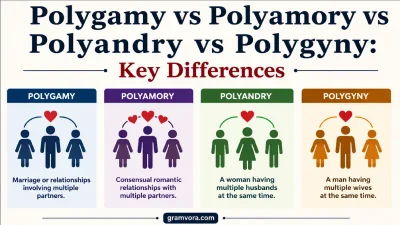
Polyamory, polygamy, and open relationship all describe relationship structures involving more than one person in some way, but they do not mean the same thing.
The biggest difference is what each term focuses on.
Polyamory generally refers to having or being open to multiple romantic or intimate relationships with the knowledge and consent of everyone involved.
Polygamy refers specifically to marriage involving more than two spouses.
An open relationship usually describes a committed relationship in which partners agree that sexual or romantic contact outside the relationship is allowed under mutually agreed boundaries.
These terms can overlap in real life, but choosing the right word depends on the relationship structure being described.
Quick Answer
If you are wondering which term fits a particular situation, use this basic distinction:
- Polyamory: Multiple consensual romantic or intimate relationships.
- Polygamy: Marriage to more than one spouse at the same time.
- Open relationship: A relationship in which partners agree that outside sexual or romantic connections are permitted.
For example, someone who has two romantic partners may describe their relationship as polyamorous. Someone who is legally or socially married to multiple spouses may describe the arrangement as polygamous. A married or committed couple who permit outside sexual relationships may describe themselves as being in an open relationship.
The important point is that these words describe different relationship structures rather than three interchangeable labels.
Why People Confuse Them
People often confuse these terms because all three can involve relationships that extend beyond a traditional two-person partnership.
There is also some overlap in everyday conversations. A person in an open relationship might have feelings for someone outside their primary relationship, while a person practicing polyamory may have several romantic partners.
However, the central focus differs.
Polygamy is about marriage. The defining feature is having multiple spouses.
Polyamory is about multiple consensual romantic or intimate relationships. Marriage is not required.
An open relationship is about agreed permission for outside relationships or sexual connections. The couple or partners establish their own boundaries.
Another source of confusion is the assumption that everyone involved must follow the same structure. In reality, relationship agreements can vary considerably.
Key Differences At A Glance
| Feature | Polyamory | Polygamy | Open Relationship |
|---|---|---|---|
| Main focus | Multiple romantic or intimate relationships | Multiple marriages or spouses | Agreed outside relationships or sexual connections |
| Marriage required? | No | Yes, by definition | No |
| Multiple romantic relationships | Commonly central | May or may not be central | May or may not be allowed |
| Consent between partners | Essential | Varies by cultural or legal context; ethical practice requires informed consent | Essential to the agreed arrangement |
| Relationship structure | Can involve several connected partners | Involves multiple spouses | Usually begins with a committed partnership that permits outside connections |
| Main word to remember | Multiple relationships | Multiple spouses | Relationship openness |
The table gives the simplest distinction, but individual relationships can be more complicated than these categories suggest.
Meaning and Usage Difference
Polyamory
Polyamory describes the practice or possibility of having multiple consensual romantic or intimate relationships.
The word is often used as a noun to describe a relationship orientation or practice.
For example:
Jordan identifies as polyamorous and has two committed partners who know about each other.
Polyamory does not require marriage. The people involved may be dating, committed partners, spouses, or part of another consensual arrangement.
The central idea is that multiple relationships can exist openly and with the knowledge and consent of those involved.
Polygamy
Polygamy specifically concerns marriage involving more than two spouses.
It is therefore narrower than polyamory in one important respect: marriage is central to the definition.
For example:
The documentary examined different cultural practices involving polygamy.
A person can practice polyamory without being married to multiple people. Likewise, simply having more than one romantic partner does not automatically make a relationship polygamous.
Open Relationship
An open relationship generally refers to a committed relationship in which the partners agree that outside sexual or romantic connections are permitted.
The exact boundaries depend on the people involved.
For example:
The couple described their relationship as open and agreed to communicate about outside partners.
An open relationship does not automatically mean that both partners have multiple romantic relationships. Some couples may permit sexual relationships outside the partnership while keeping their primary emotional relationship separate.
The phrase therefore emphasizes permission and agreed boundaries rather than a specific number of romantic partners.
Tone, Context, and Formality
The three terms also differ in where they are most useful.
Polyamory is commonly used when discussing contemporary consensual relationship structures. It is a specific term, so it can be useful when the people involved have multiple romantic relationships rather than simply allowing outside sexual activity.
Polygamy is more closely connected to marriage, family structures, law, religion, history, and anthropology. It is not a general synonym for having several romantic partners.
Open relationship is a broad everyday phrase. People may use it when explaining that a committed relationship allows some form of outside romantic or sexual involvement.
Context matters because these terms can carry different assumptions.
For instance, saying “They are in an open relationship” does not necessarily tell you that they have multiple romantic partners. Saying “They practice polyamory” gives more information about the possibility of multiple consensual romantic relationships.
Similarly, saying someone is “polygamous” specifically brings marriage into the discussion.
Which One Should You Use?
The best term depends on what you want to emphasize. Polyamory fits when a person has, or is open to having, multiple consensual romantic or intimate relationships. Polygamy is the more precise choice when the situation involves marriage to multiple spouses. Meanwhile, open relationship works when partners have mutually agreed to allow outside romantic or sexual connections.
A simple way to choose is to ask what you are actually describing:
- Multiple romantic relationships? → Polyamory
- Multiple spouses? → Polygamy
- A committed relationship with agreed outside connections? → Open relationship
These are useful starting points, but real relationships can contain overlapping characteristics.
For example, someone could be married and also practice polyamory. Another couple might have an open relationship without considering themselves polyamorous.
When One Choice Sounds Wrong
Calling every relationship with multiple partners polygamy can be inaccurate because polygamy specifically concerns multiple marriages or spouses.
For example:
❌ “They are polygamous because they are dating three people.”
If none of those relationships involves multiple marriage, polyamory may be the more appropriate term.
Likewise, calling every polyamorous relationship an open relationship can lose an important distinction.
An open relationship often emphasizes permission for outside relationships or sexual activity, while polyamory emphasizes the possibility of multiple romantic relationships.
Another common mistake is assuming that polygamy and polyamory are simply different words for the same thing. They overlap in the broad idea of having more than one relationship, but marriage is the defining feature of polygamy.
Common Mistakes (and Quick Fixes)
Mistake 1: Using polygamy for any relationship with multiple partners
Better:
“They practice polyamory.”
Use polygamy when multiple spouses or marriages are actually being discussed.
Mistake 2: Assuming an open relationship always means multiple romantic partners
Better:
“They are in an open relationship.”
The phrase does not necessarily tell you how many outside partners someone has or whether those connections are romantic.
Mistake 3: Treating polyamory and open relationships as exact synonyms
Better: recognize the difference in emphasis. Polyamory centers on multiple consensual romantic relationships, while an open relationship emphasizes an agreed opening of an otherwise committed relationship.
Mistake 4: Assuming polygamy and polyamory are interchangeable
Better: check whether marriage is part of the situation.
Mistake 5: Assuming every person uses these labels in exactly the same way
Better: when precision matters, use the person’s own description and ask what relationship structure they mean.
Everyday Examples
Here are some simple examples showing how the terms work in context.
Polyamory:
Alex has two committed romantic partners, and everyone involved knows about the other relationships.
This is a straightforward example of polyamory because multiple romantic relationships are central.
Polygamy:
The article discusses a marriage structure in which one person has multiple spouses.
Here, polygamy is the appropriate term because multiple spouses are the defining feature.
Open relationship:
Taylor and Morgan are committed to each other but have agreed that they can date or have sexual relationships with other people.
“Open relationship” fits because the couple has mutually agreed to outside connections.
A possible overlap:
Sam is married and also has other consensual romantic partners.
Depending on the exact arrangement, more than one label may be relevant. The marriage aspect can relate to polygamy, while multiple consensual romantic relationships can relate to polyamory. The exact label depends on the relationship structure and how the people involved describe it.
Dictionary-Style Word Details
Verb
- Polyamory: Not commonly used as a standard verb in US English. You would normally say that someone practices polyamory or is polyamorous.
- Polygamy: Not commonly used as a standard verb. Natural constructions include practice polygamy or be polygamous.
- Open relationship: This is a noun phrase rather than a verb. Natural wording includes be in an open relationship or have an open relationship.
Noun
- Polyamory: A noun referring to the practice or relationship structure involving multiple consensual romantic or intimate relationships.
- Polygamy: A noun referring to marriage involving more than two spouses.
- Open relationship: A noun phrase referring to a committed relationship in which partners agree that outside romantic or sexual connections are permitted.
Synonyms
- Polyamory: There is no exact everyday synonym that preserves all of its meaning. “Multiple consensual relationships” can serve as a plain descriptive alternative.
- Polygamy: “Plural marriage” can function as a close descriptive alternative in contexts where multiple marriage is the focus.
- Open relationship: “Consensually nonexclusive relationship” can describe the idea more formally, although it is not always a perfect replacement.
These alternatives should not automatically be treated as interchangeable in every sentence.
Example Sentences
- Polyamory: “Chris explained that polyamory allows people to maintain multiple consensual romantic relationships.”
- Polygamy: “The book examines the history and social structure of polygamy.”
- Open relationship: “The couple decided that an open relationship worked for them after discussing their boundaries.”
- Polyamory: “Her two partners are aware of each other and have discussed the arrangement openly.”
- Polygamy: “The discussion focused on a marriage involving multiple spouses.”
- Open relationship: “They agreed on clear boundaries before opening their relationship.”
Word History
- Polyamory: The word is formed from elements associated with “many” and “love.” Its modern use developed around the idea of consensual multiple romantic relationships.
- Polygamy: The word comes from Greek roots associated with “many” and “marriage.” Its meaning is directly connected to having multiple spouses.
- Open relationship: This is a transparent English phrase combining open with relationship. Its meaning comes from the idea that the relationship is not sexually or romantically exclusive under the partners’ agreed terms.
The exact historical development of these modern relationship labels is more complicated than their basic word parts, so the safest distinction is based on their current meanings.
Phrases Containing
- Polyamory: “practice polyamory,” “polyamorous relationship,” “polyamorous partner”
- Polygamy: “practice polygamy,” “polygamous marriage,” “polygamous relationship”
- Open relationship: “be in an open relationship,” “have an open relationship,” “open relationship boundaries”
These phrases show how the terms normally appear in natural sentences.
FAQs
Is polyamory the same as polygamy?
No. Polyamory generally refers to having multiple consensual romantic or intimate relationships, while polygamy specifically refers to marriage involving more than one spouse.
Is an open relationship the same as polyamory?
Not necessarily. An open relationship usually means partners have agreed that outside romantic or sexual connections are permitted. Polyamory more specifically centers on having multiple consensual romantic relationships.
Can someone be both polyamorous and in an open relationship?
Yes. A person or couple may use both descriptions if their relationship includes multiple consensual romantic relationships and an agreement allowing outside connections. The labels can overlap depending on the arrangement.
Does polygamy always mean having multiple romantic relationships?
Not necessarily. The defining feature of polygamy is having multiple spouses or being involved in multiple marriages. The term itself does not describe every emotional or romantic aspect of those relationships.
Is an open relationship always sexual?
No. The specific boundaries of an open relationship depend on the agreement between the partners. Some arrangements allow sexual connections outside the relationship, while others may include different forms of romantic or intimate involvement.
Are polyamory and polygamy interchangeable?
No. Although both can involve more than two people, they emphasize different things. Polyamory focuses on multiple consensual romantic or intimate relationships, whereas polygamy focuses specifically on multiple spouses or marriages.
Conclusion
Polyamory, polygamy, and open relationship are related but distinct terms.
Polyamory is the best choice when the focus is on multiple consensual romantic or intimate relationships.
Polygamy is the precise choice when the focus is marriage involving multiple spouses.
Open relationship is useful when partners have agreed that outside romantic or sexual connections are allowed.
The easiest distinction to remember is:
Polyamory = multiple consensual romantic relationships.
Polygamy = multiple spouses or marriages.
Open relationship = an agreed relationship that permits outside connections.
When a real relationship does not fit neatly into one category, the most accurate approach is to describe the specific arrangement rather than forcing it into a label.