First cousin and second cousin are both standard family-relationship terms, but they describe different levels of kinship.
The easiest way to tell them apart is to look at the closest shared ancestor.
If two people share grandparents, they are first cousins. If they share great-grandparents, they are second cousins.
The family-tree difference is only one generation, but that one generation changes the relationship label.
Quick Answer
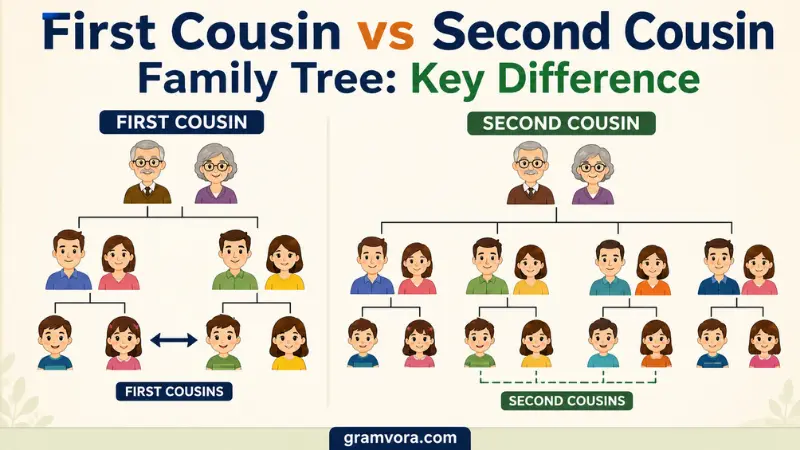
First cousins share grandparents.
For example, your aunt’s or uncle’s child is your first cousin. You and that person have the same grandparents.
Second cousins share great-grandparents.
Your parent’s first cousin’s child is your second cousin. You and that person have the same great-grandparents but different grandparents.
So, on a family tree:
Grandparents → first cousins
Great-grandparents → second cousins
Both relationships normally place the two cousins in the same generation.
Why People Confuse Them
The words “first” and “second” can make the relationship sound like it is based on how many family members separate two people. That is not the best way to think about it.
Instead, look upward on the family tree and find the closest ancestor you both share.
Suppose your mother and another person’s mother are sisters. Their children are first cousins because those children share grandparents.
Now move one generation down. If each first cousin has a child, those children are second cousins because they share great-grandparents.
This is why the cousin number changes as the family branches move farther from the shared ancestor.
Key Differences At A Glance
| Context | Best Choice | Why |
|---|---|---|
| Your aunt’s or uncle’s child | First cousin | You share grandparents |
| Your parent’s first cousin’s child | Second cousin | You share great-grandparents |
| Two people share the same grandparents | First cousins | They are both grandchildren of the same couple |
| Two people share the same great-grandparents | Second cousins | They are both great-grandchildren of the same couple |
A quick comparison:
- First cousin: shared grandparents.
- Second cousin: shared great-grandparents.
- First cousins: their parents are siblings.
- Second cousins: their parents are first cousins.
- Both are normally in the same generation.
Meaning and Usage Difference
First cousin identifies the child of your aunt or uncle. On a family tree, you and your first cousin have a common set of grandparents.
For example, if your mother’s sister has a daughter, that daughter is your first cousin.
Second cousin identifies a person whose parent is your parent’s first cousin. On a family tree, you and your second cousin have a common set of great-grandparents.
For example, your mother’s first cousin has a son. That son is your second cousin.
The important point is that “second” does not mean one generation below a first cousin. It identifies a different cousin degree based on the shared ancestor.
That is also why a second cousin should not automatically be called a first cousin once removed. “Removed” describes a generation difference, while the cousin number identifies the cousin level.
Tone, Context, and Formality
There is no major difference in tone or formality between first cousin and second cousin.
Both are neutral, standard family terms used in everyday American English.
You might say:
“My first cousin lives in Chicago.”
Or:
“My second cousin lives in Denver.”
In casual conversation, people sometimes use cousin without specifying the degree. That is perfectly natural when the exact relationship is not important.
When discussing a family tree, genealogy, or a DNA relationship, specifying first cousin or second cousin is more useful because the exact relationship matters.
Which One Should You Use?
Use first cousin when the person is the child of your aunt or uncle.
Use second cousin when the person is the child of your parent’s first cousin.
A simple test is to check the parents.
If your parents and the other person’s parents are siblings, you are first cousins.
If your parents and the other person’s parents are first cousins, you are second cousins.
That parent test can make a complicated family tree much easier to understand.
When One Choice Sounds Wrong
Calling your aunt’s daughter your second cousin is incorrect under the standard family relationship system. She is your first cousin because you share grandparents.
Likewise, calling your parent’s first cousin’s daughter your first cousin is incorrect if you are describing the precise relationship. She is your second cousin because you share great-grandparents.
Another common mistake is assuming that every younger relative in the cousin branch is a second cousin. Age does not determine the cousin number.
For example, your first cousin could be younger than you. They are still your first cousin because the relationship is determined by ancestry, not age.
Common Mistakes (and Quick Fixes)
Mistake: “My cousin’s child is automatically my second cousin.”
Fix: Your first cousin’s child is your first cousin once removed, not your second cousin.
Mistake: “Second cousins share grandparents.”
Fix: Second cousins share great-grandparents.
Mistake: “First cousins are one generation apart.”
Fix: First cousins are normally in the same generation. A one-generation difference creates a “once removed” relationship.
Mistake: “The older cousin is the first cousin.”
Fix: Age does not determine the cousin number. The family-tree connection does.
Mistake: “Second cousin means your parent’s cousin.”
Fix: Your parent’s first cousin is your first cousin once removed. Your parent’s first cousin’s child is your second cousin.
Everyday Examples
Imagine that your grandmother has two children: your mother and your mother’s brother.
Your mother’s brother has a daughter named Emma.
Emma is your first cousin because you and Emma share the same grandparents.
Now imagine Emma has a son named Noah, and you also have a child named Ava.
Noah and Ava are second cousins because their parents, Emma and Ava’s parent, are first cousins. Noah and Ava share great-grandparents.
Here is another simple example:
- Your grandparents have two children.
- Those two children are siblings.
- Their children are your first cousins.
- Those first cousins’ children are your second cousins.
The family tree moves outward by generation, while the cousin number increases.
Dictionary-Style Word Details
Verb
- First Cousin: Not commonly used as a verb in standard US English.
- Second Cousin: Not commonly used as a verb in standard US English.
Both terms function primarily as family-relationship nouns.
Noun
- First Cousin: A child of your aunt or uncle.
- Second Cousin: A child of your parent’s first cousin.
Both are countable nouns.
Examples include:
- “I have three first cousins.”
- “She met two second cousins at the family reunion.”
Synonyms
- First Cousin: cousin is the closest plain alternative when the exact degree does not need to be stated.
- Second Cousin: cousin is also the closest plain alternative when the exact degree is not important.
Neither term has a true everyday antonym. They identify specific family relationships rather than describing qualities that naturally have opposites.
Example Sentences
- First Cousin: “My first cousin and I grew up visiting the same grandparents.”
- First Cousin: “My uncle’s daughter is my first cousin.”
- Second Cousin: “I met my second cousin at a family reunion.”
- Second Cousin: “My parent’s first cousin has a daughter who is my second cousin.”
Word History
- First Cousin: The term is an established English family-relationship expression. Merriam-Webster records an early known use of “first cousin” in 1649.
- Second Cousin: The term is also an established English family-relationship expression. Collins traces “second cousin” to the mid-17th century.
The exact historical development is less important for modern usage than the relationship system the terms describe today.
Phrases Containing
- First Cousin: first cousin, first cousins, first cousin once removed, first cousin twice removed
- Second Cousin: second cousin, second cousins, second cousin once removed, second cousin twice removed
The added phrase “once removed” changes the relationship by indicating a generation difference. It should not be treated as another way to say second cousin.
FAQs
What is the difference between a first cousin and a second cousin?
First cousins share the same grandparents, while second cousins share the same great-grandparents. A first cousin is usually the child of your aunt or uncle, while a second cousin is usually the child of your parent’s first cousin.
Are first cousins closer than second cousins?
Yes. First cousins are one generation closer to the shared ancestor than second cousins. First cousins share grandparents, while second cousins share great-grandparents.
What does a first cousin look like on a family tree?
A first cousin appears on a parallel branch of your family tree. You and your first cousin have parents who are siblings and therefore share the same grandparents.
What does a second cousin look like on a family tree?
A second cousin is farther out on the family tree. Your parents and your second cousin’s parents are first cousins, so you and your second cousin share great-grandparents.
Do first cousins share grandparents?
Yes. First cousins have at least one set of grandparents in common. Their parents are siblings.
Do second cousins share great-grandparents?
Yes. Second cousins share at least one set of great-grandparents. Their parents are first cousins.
Is my cousin’s child my second cousin?
Not necessarily. If you mean your first cousin’s child, that person is your first cousin once removed, not your second cousin.
Is my parent’s cousin my second cousin?
No. Your parent’s first cousin is your first cousin once removed. That person’s child is your second cousin.
Can first cousins be different ages?
Yes. Age does not determine whether someone is your first or second cousin. The relationship depends on how you are connected through your family tree.
Can second cousins have the same grandparents?
Under the standard relationship system, second cousins share great-grandparents rather than grandparents. If two people share grandparents, they are generally first cousins.
Are first cousins and second cousins in the same generation?
Usually, yes. First cousins are generally in the same generation as each other, and second cousins are generally in the same generation as each other. A generation difference is described with “once removed.”
How can I tell if someone is my first or second cousin?
Find your closest shared ancestor. If you share grandparents, you are first cousins. If you share great-grandparents, you are second cousins.
What is the easiest way to remember first cousin vs second cousin?
Remember this simple family-tree rule: first cousins share grandparents; second cousins share great-grandparents.
Is a second cousin still a close relative?
A second cousin is a family relative, but the relationship is more distant than a first cousin. The exact closeness can vary depending on the family and how frequently relatives interact.
What is the difference between a second cousin and a first cousin once removed?
A second cousin normally shares great-grandparents with you and is in your same generation. A first cousin once removed is one generation above or below you in relation to your first cousin.
Conclusion
The difference between a first cousin and a second cousin is straightforward once you look at the shared ancestor.
First cousins share grandparents.
Second cousins share great-grandparents.
On a family tree, first cousins are one branch closer to the shared ancestor, while second cousins are one generation farther out.
When you are unsure, start with the parents: if the parents are siblings, the children are first cousins. If the parents are first cousins, their children are second cousins.