
Family relationships can become confusing when cousins are described by numbers. Terms such as first cousin, second cousin, and third cousin do not refer to how close you feel to someone. They describe how many generations separate you from a shared ancestor.
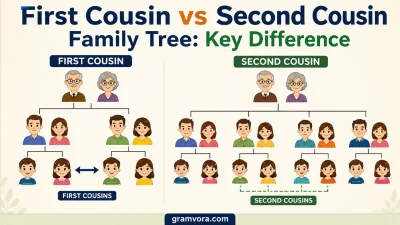
The basic pattern is simple: first cousins share grandparents, second cousins share great-grandparents, and third cousins share great-great-grandparents.
Once you understand the family-tree pattern, these terms become much easier to use.
Quick Answer
A first cousin is the child of your aunt or uncle. You and your first cousin share grandparents.
A second cousin is someone who shares your great-grandparents but not your grandparents. In most cases, your second cousin is the child of your parent’s first cousin.
A third cousin shares your great-great-grandparents with you. A third cousin is generally the child of your parent’s second cousin.
Here is the easiest way to remember the difference:
- First cousins → shared grandparents
- Second cousins → shared great-grandparents
- Third cousins → shared great-great-grandparents
The number tells you the cousin relationship’s generation level.
Why People Confuse Them
People often assume that “second cousin” means a cousin who is somehow less related or farther away in a general sense. While second and third cousins are more distantly related than first cousins, the terms have a specific family-tree meaning.
Another common source of confusion is the difference between cousin number and “removed.” For example, a first cousin once removed is not the same relationship as a second cousin.
The word removed describes a difference in generation. The numbers—first, second, and third—describe the cousin level.
So, when identifying a cousin, it helps to look at the shared ancestor first.
Key Differences At A Glance
| Feature | First Cousin | Second Cousin | Third Cousin |
|---|---|---|---|
| Shared ancestors | Grandparents | Great-grandparents | Great-great-grandparents |
| Typical relationship | Child of your aunt or uncle | Child of your parent’s first cousin | Child of your parent’s second cousin |
| Relative distance | Closest of the three | More distant | More distant than a second cousin |
| Common family-tree level | One generation below shared grandparents | One generation below shared great-grandparents | One generation below shared great-great-grandparents |
The key difference is the generation of the shared ancestor.
Meaning and Usage Difference
First Cousin
Your first cousin is the child of your parent’s sibling.
For example, suppose your mother has a brother named Mark. Mark has a daughter named Sarah. Sarah is your first cousin.
You and Sarah share the same grandparents.
Second Cousin
Your second cousin is someone who shares your great-grandparents with you.
For example, your parent and another person’s parent may be first cousins. Their children are second cousins to each other.
You and your second cousin have the same great-grandparents, but you do not share grandparents.
Third Cousin
Your third cousin is someone who shares your great-great-grandparents with you.
If your parent and another person’s parent are second cousins, their children are generally third cousins.
This makes third cousins one generation level farther removed from the shared ancestor than second cousins.
The Family-Tree Pattern
A useful pattern is:
Grandparents → first cousins
Great-grandparents → second cousins
Great-great-grandparents → third cousins
The relationship becomes more distant as the shared ancestor moves farther back in the family tree.
Tone, Context, and Formality
There is no major difference in tone or formality among first cousin, second cousin, and third cousin. All three are standard family-relationship terms in American English.
The difference is primarily genealogical and relational, not stylistic.
In everyday conversation, people are most likely to mention first cousins because that relationship is closer and easier to identify. Second and third cousins may come up more often when discussing genealogy, family history, ancestry, or a large extended family.
For example:
- “My first cousin lives in Chicago.”
- “She’s my second cousin.”
- “We discovered that we’re third cousins while researching our family tree.”
All three expressions are natural when the relationship is correctly identified.
When One Choice Sounds Wrong
Calling a first cousin a second cousin is incorrect if you share grandparents.
For example, if your mother’s sister has a son, that son is your first cousin—not your second cousin.
Likewise, if two people share great-grandparents but not grandparents, calling them first cousins does not accurately describe the relationship.
A third cousin should not be called a second cousin simply because the two people are both part of the same extended family.
The exact relationship depends on the family tree, not on how close the relatives are socially.
Common Mistakes (and Quick Fixes)
Mistake 1: Thinking “second cousin” means your cousin’s cousin.
Not necessarily. A second cousin is defined by a shared great-grandparent relationship.
Mistake 2: Assuming a first cousin’s child is your second cousin.
A first cousin’s child is generally your first cousin once removed, not your second cousin.
Mistake 3: Thinking third cousins are unrelated.
Third cousins are still cousins. They simply share a more distant common ancestor.
Mistake 4: Using “second cousin” for any distant cousin.
The term has a specific family-tree meaning and should not simply mean “not a close cousin.”
Mistake 5: Confusing cousin numbers with “removed.”
The number identifies the cousin level, while “removed” indicates a difference in generations.
Everyday Examples
Here are some simple examples that show how the terms work.
Example 1: First cousin
Your dad and his sister are siblings. His sister has a daughter. That daughter is your first cousin.
You share grandparents.
Example 2: Second cousin
Your grandmother and another person’s grandmother are sisters. Their children are first cousins, and you and that person’s child are second cousins.
You share great-grandparents.
Example 3: Third cousin
Your great-grandparent and another person’s great-grandparent were siblings. Their descendants at your generation can be third cousins.
You share great-great-grandparents.
Example 4: Comparing all three
Imagine three people from different branches of one family.
- Person A shares grandparents with you → first cousin
- Person B shares great-grandparents with you → second cousin
- Person C shares great-great-grandparents with you → third cousin
The farther back the shared ancestor is, the higher the cousin number becomes.
Dictionary-Style Word Details
Verb
First cousin: Not commonly used as a verb in standard US English.
Second cousin: Not commonly used as a verb in standard US English.
Third cousin: Not commonly used as a verb in standard US English.
These expressions function primarily as nouns when identifying a family relationship.
Noun
First cousin: A person who is the child of one of your parent’s siblings.
Second cousin: A person who shares great-grandparents with you but is not your first cousin.
Third cousin: A person who shares great-great-grandparents with you but is not your first or second cousin.
The three terms are nouns when they identify a person in relation to you.
Synonyms
There are no exact synonyms that can replace first cousin, second cousin, or third cousin while preserving the same precise family relationship.
Closest plain alternatives include:
- first cousin: cousin, when the exact level is already clear
- second cousin: distant cousin, in less precise everyday speech
- third cousin: distant cousin, in less precise everyday speech
However, “distant cousin” does not specify the exact relationship, so it should not be treated as an exact replacement.
Example Sentences
First cousin:
“My first cousin is visiting us this weekend.”
Second cousin:
I met my second cousin at a family reunion.
Third cousin:
“We learned that he is my third cousin after looking at our family tree.”
Comparison:
“My first cousin is related to me through our grandparents, while my second and third cousins share ancestors farther back in the family tree.”
Word History
The terms first cousin, second cousin, and third cousin are established English family-relationship terms. Their meanings are based on genealogical relationships and generations of descent.
The important distinction for everyday use is not the history of the words but the family-tree structure they describe.
Phrases Containing
Common phrases include:
- my first cousin
- your first cousin
- a second cousin
- my second cousin
- her third cousin
- a third cousin once removed
- first cousin once removed
- second cousin once removed
The phrase once removed adds a generation difference to the cousin relationship, so it should not be confused with simply moving from first cousin to second cousin.
FAQs
1. What is the difference between a first cousin, second cousin, and third cousin?
A first cousin shares grandparents with you, a second cousin shares great-grandparents, and a third cousin shares great-great-grandparents.
2. Is a second cousin more closely related than a third cousin?
Yes. A second cousin is more closely related than a third cousin because you share a more recent common ancestor.
3. Who is considered a first cousin?
A first cousin is the child of your aunt or uncle. You and your first cousin share the same grandparents.
4. Who is considered a second cousin?
A second cousin is someone with whom you share great-grandparents but not grandparents. Their parent is generally your parent’s first cousin.
5. Who is considered a third cousin?
A third cousin is someone with whom you share great-great-grandparents but not great-grandparents.
6. Is my cousin’s child my second cousin?
Usually, no. Your first cousin’s child is your first cousin once removed, not your second cousin.
7. Are third cousins actually related?
Yes. Third cousins share common ancestors, specifically great-great-grandparents.
8. What does “once removed” mean in a cousin relationship?
“Once removed” means there is a one-generation difference between two people. It is different from the number used to identify the cousin relationship.
9. Are second cousins considered close family?
Second cousins are part of the extended family, but they are more distantly related than first cousins.
10. How can I tell if someone is my first, second, or third cousin?
Find your closest shared ancestor. Shared grandparents indicate first cousins, shared great-grandparents indicate second cousins, and shared great-great-grandparents indicate third cousins.
Conclusion
The difference between first cousin, second cousin, and third cousin comes down to the generation of the shared ancestor.
A first cousin shares grandparents with you. A second cousin shares great-grandparents. A third cousin shares great-great-grandparents.
Remember the pattern:
First cousin → grandparents
Second cousin → great-grandparents
Third cousin → great-great-grandparents
When you’re unsure, trace both family lines backward until you find the closest shared ancestor. That will help you identify the correct cousin relationship without relying on guesswork.