
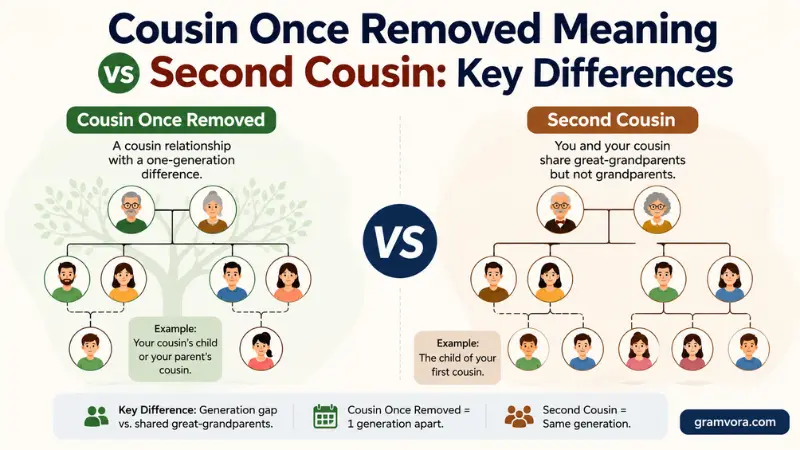
The difference between cousin once removed and second cousin is easier to understand once you separate two ideas: cousin degree and generation.
A second cousin describes a specific cousin relationship. A cousin once removed describes a one-generation difference between relatives.
So these terms do not mean the same thing, and they are not normally interchangeable.
Quick Answer
Use second cousin when two people are in the same generation and share the same great-grandparents.
Use cousin once removed when two relatives are one generation apart in a cousin relationship. For complete precision, the cousin degree is usually included, such as first cousin once removed or second cousin once removed.
The easiest way to remember the difference is:
- Second cousin = tells you the cousin degree.
- Once removed = tells you there is a one-generation gap.
Why People Confuse Them
The confusion often comes from the way family generations connect.
For example, your first cousin is in your generation. Your first cousin’s child is one generation below you. That child is your first cousin once removed, not your second cousin.
A second cousin is different. You and a second cousin are generally in the same generation and share great-grandparents.
The word second therefore does not mean “one generation after my first cousin.” It identifies a particular cousin degree.
Key Differences At A Glance
| Context | Best Choice | Why |
|---|---|---|
| Same generation, shared great-grandparents | Second cousin | Identifies the cousin degree |
| One generation above or below you in a cousin line | Cousin once removed | Identifies a one-generation difference |
| Your first cousin’s child | First cousin once removed | The child is one generation below you |
| Your parent’s second cousin | Second cousin once removed | The relative is one generation above you |
Extra comparison:
- Cousin once removed: focuses on the generation gap and does not, by itself, specify the cousin degree.
- Second cousin: specifies the cousin degree and normally refers to relatives at the same generation level.
- Second cousin once removed: combines both ideas: second-cousin degree plus a one-generation difference.
Meaning and Usage Difference
A second cousin is someone who shares your great-grandparents, while your grandparents and that person’s grandparents are siblings. You and the other person are generally at the same generational level relative to those shared ancestors.
For example, suppose your grandmother and another person’s grandmother were sisters. Their children are first cousins, and their grandchildren are second cousins.
Cousin once removed works differently. “Once removed” means that the two people are one generation apart.
For example, your parent’s cousin can be your cousin once removed. Your cousin’s child can also be your cousin once removed. The direction can be upward or downward.
This is why cousin once removed is less specific by itself. You still need to know which cousin degree is involved.
A complete relationship can therefore be second cousin once removed. In that expression, “second cousin” identifies the cousin degree, while “once removed” identifies the one-generation gap.
Tone, Context, and Formality
Both expressions are neutral and standard family-relationship terms.
They are especially useful in genealogy, family trees, ancestry records, and conversations where the exact relationship matters.
In everyday US conversation, people often simply say cousin when the precise relationship is not important.
If you are explaining a family tree, however, the more specific term is clearer.
For example:
“She’s my cousin.”
is perfectly natural when the exact relationship does not matter.
But:
“She’s my second cousin once removed.”
gives much more precise information about where the person fits in the family tree.
Which One Should You Use?
Start by asking two questions.
First: Are you and the other person in the same generation?
Second: How far back is your closest shared ancestor?
If you are in the same generation and share great-grandparents, second cousin is the appropriate term.
If you are one generation apart, you have a once removed relationship. Then determine the cousin degree to make the description precise.
For example, your first cousin’s child is your first cousin once removed.
Your second cousin’s child is your second cousin once removed.
Your parent’s second cousin is also your second cousin once removed.
When One Choice Sounds Wrong
Calling your first cousin’s child your second cousin is a common mistake.
The child is one generation below you, so the relationship is first cousin once removed.
Likewise, calling someone your cousin once removed when you actually mean a second cousin can be too vague if you are trying to describe a family tree precisely.
Another mistake is assuming that “removed” means the relative is less closely related. It does not. The term describes a generation difference, not a judgment about how close the family members are.
It is also important not to assume that “once removed” always means first cousin. It can apply to different cousin degrees.
Common Mistakes (and Quick Fixes)
Mistake: “My first cousin’s daughter is my second cousin.”
Fix: She is your first cousin once removed.
Mistake: “Second cousin means one generation after first cousin.”
Fix: Second cousin is a specific cousin degree based on the shared ancestry.
Mistake: “Once removed means less related.”
Fix: “Once removed” describes a one-generation difference.
Mistake: “Cousin once removed” always means first cousin once removed.
Fix: The cousin degree should be stated when precision matters.
Mistake: Treating the two expressions as interchangeable.
Fix: Remember that one identifies cousin degree, while the other identifies generation difference.
Everyday Examples
Example 1: Same generation
Maria and David share the same great-grandparents. Their grandparents were siblings.
Correct: Maria and David are second cousins.
Example 2: One generation below
Maria’s second cousin has a daughter named Emma.
Correct: Emma is Maria’s second cousin once removed.
Example 3: One generation above
Maria’s mother has a second cousin named Robert.
Correct: Robert is Maria’s second cousin once removed.
Example 4: A first cousin’s child
Maria has a first cousin named James. James has a son named Tyler.
Correct: Tyler is Maria’s first cousin once removed.
Example 5: Why the terms can appear together
Maria and Emma are connected through the second-cousin line, but Emma is one generation below Maria.
Correct: Emma is Maria’s second cousin once removed.
The important point is that second cousin and once removed measure different aspects of the relationship.
Dictionary-Style Word Details
Verb
- Cousin once removed: Not commonly used as a verb in standard US English. It is a family-relationship noun phrase.
- Second cousin: Not commonly used as a verb in standard US English. It is also a family-relationship noun phrase.
Noun
- Cousin once removed: A noun phrase describing a cousin relationship in which the two people are one generation apart. The phrase alone does not specify the cousin degree.
- Second cousin: A noun phrase describing a cousin relationship between people who share great-grandparents and are normally in the same generation relative to those ancestors.
Synonyms
Neither expression has a perfect one-word synonym.
- Cousin once removed: Closest plain alternative: a cousin one generation apart.
- Second cousin: Closest plain alternative: a cousin who shares your great-grandparents.
These alternatives explain the relationships but are not replacements for the standard family terms.
There are no clear direct antonyms for either expression.
Example Sentences
- Cousin once removed: “My dad’s cousin is my cousin once removed.”
- Cousin once removed: “My first cousin’s daughter is my cousin once removed.”
- Second cousin: “Lena and Mark are second cousins because they share great-grandparents.”
- Second cousin: “I met my second cousin at our family reunion.”
Word History
Both expressions belong to established family and genealogy terminology.
The important meaning of removed is its relationship to generations: “once removed” indicates a one-generation difference. Second cousin identifies the cousin degree associated with shared great-grandparents.
The exact historical development of every family-relationship label is more complicated than these basic definitions require, so there is no need to assign a specific origin date to either expression.
Phrases Containing
- first cousin once removed — a first-cousin relationship with a one-generation gap.
- second cousin once removed — a second-cousin relationship with a one-generation gap.
- third cousin once removed — a third-cousin relationship with a one-generation gap.
- second cousin — a second-cousin relationship without a generational removal.
These phrases show why once removed is a separate measurement rather than a replacement for the cousin number.
FAQs
1. What does “cousin once removed” mean?
“Cousin once removed” means two relatives are one generation apart in a cousin relationship. For example, your first cousin’s child is your first cousin once removed.
2. What is a second cousin?
A second cousin is generally someone who shares your great-grandparents. You and your second cousin are normally in the same generation.
3. Is a second cousin the same as a cousin once removed?
No. A second cousin identifies the cousin relationship, while once removed indicates a one-generation difference. They describe different aspects of a family relationship.
4. Is my first cousin’s child my second cousin?
No. Your first cousin’s child is your first cousin once removed. The child is one generation below you.
5. Is my parent’s cousin my second cousin?
Your parent’s first cousin is your first cousin once removed, not your second cousin. The relationship is one generation above you.
6. What is a second cousin once removed?
A second cousin once removed is someone who is your second cousin by family relationship but is one generation above or below you.
7. Does “once removed” mean one generation apart?
Yes. In standard cousin terminology, once removed means there is a one-generation difference between the two relatives.
8. Can two people be second cousins and once removed?
Yes. Second cousin identifies the cousin degree, while once removed describes the generation difference. Together, “second cousin once removed” gives a more precise relationship.
9. What is the difference between second cousin and first cousin once removed?
A second cousin is normally in your generation and shares your great-grandparents. A first cousin once removed is one generation above or below you in a first-cousin relationship.
10. How can I remember the difference?
A simple way to remember it is: the cousin number tells you the relationship level, while “removed” tells you the generation gap.
Conclusion
The difference between cousin once removed and second cousin comes down to what each part tells you.
Second cousin identifies a cousin degree. Two second cousins normally share great-grandparents and are in the same generation.
Cousin once removed identifies a one-generation difference. For a fully precise relationship, you normally include the cousin degree too.
So, if you remember only one rule, remember this: the cousin number identifies the relationship level, while “once removed” identifies the generation gap.


