
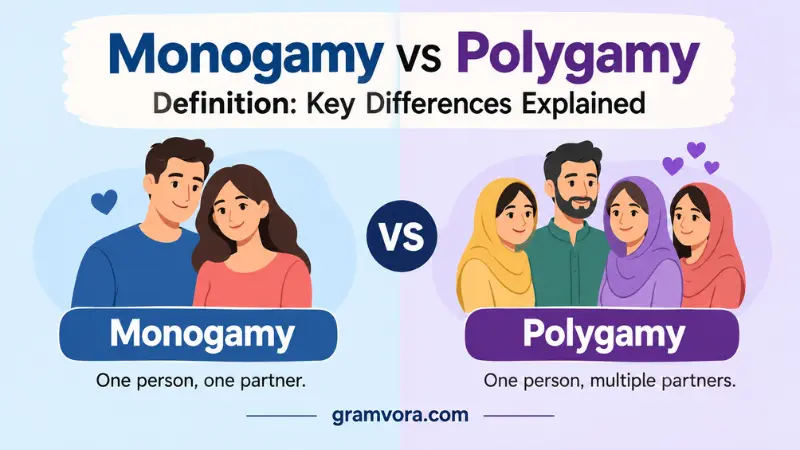
The words monogamy and polygamy describe two different relationship and marriage structures. The main difference is the number of spouses or partners involved at the same time.
Monogamy refers to having one spouse or one sexual partner at a time. Polygamy refers specifically to being married to more than one person at the same time.
Both are standard English nouns, and both are commonly used when discussing marriage, relationships, anthropology, sociology, religion, and human behavior. The terms are not interchangeable because they describe different arrangements.
The simplest distinction is this: monogamy involves one spouse at a time, while polygamy involves multiple spouses at the same time.
It is also important not to treat every form of having multiple romantic or sexual relationships as polygamy. The word polygamy specifically relates to marriage involving more than one spouse. Other relationship arrangements can require different vocabulary.
Quick Answer
Monogamy means being married to one person at a time or having one sexual partner at a time.
Polygamy means being married to more than one person at the same time.
| Context | Best Choice | Why |
|---|---|---|
| Marriage to one person at a time | Monogamy | The relationship has one spouse at a time. |
| Marriage to multiple people at the same time | Polygamy | The arrangement involves more than one spouse. |
| Describing a one-partner relationship | Monogamy | It identifies a one-partner structure. |
| Describing marriage with multiple spouses | Polygamy | It identifies a multiple-spouse marriage structure. |
| Describing a person with one spouse | Monogamous | This is the adjective form related to monogamy. |
| Describing a person married to multiple spouses | Polygamous | This is the adjective form related to polygamy. |
So, if you are asking “What is the definition of monogamy vs polygamy?”, the answer is straightforward: monogamy means one spouse at a time, whereas polygamy means more than one spouse at the same time.
Why People Confuse Them
People often confuse these words because both describe relationship and marriage structures. They also share the ending -gamy, which relates to marriage.
The first parts help distinguish them.
In monogamy, mono- means one. The word therefore describes a one-spouse or one-partner arrangement.
In polygamy, poly- means many. The word describes marriage involving multiple spouses.
The confusion becomes greater when people use everyday language rather than technical definitions. Someone might describe a person as having several romantic partners and call that polygamy. That is not necessarily accurate.
The word polygamy concerns marriage. A person can have multiple romantic or sexual relationships without being legally or socially married to those people. That broader situation may be described using other terms depending on the arrangement.
Another source of confusion is the difference between monogamy and serial monogamy. A person may marry one person, later divorce, and then marry another person. At any particular time, the person has one spouse. That can still fit a monogamous marriage structure.
The important point is that monogamy and polygamy describe different relationship structures. They should not be used as general labels for every type of romantic behavior.
Key Differences At A Glance
The easiest way to understand the difference is to focus on the number of spouses at the same time.
| Feature | Monogamy | Polygamy |
|---|---|---|
| Basic meaning | One spouse or partner at a time | More than one spouse at the same time |
| Main grammatical form | Noun | Noun |
| Adjective | Monogamous | Polygamous |
| Marriage structure | One spouse at a time | Multiple spouses at the same time |
| Pronunciation | /mə-NOG-ə-mee/ | /pə-LIG-ə-mee/ |
| Typical context | Marriage, relationships, biology | Marriage, anthropology, sociology, religion |
| Number emphasized | One | More than one |
Neither word is a spelling variant of the other. They identify different concepts.
For example:
“Their marriage follows a monogamous structure.”
This describes a marriage involving one spouse at a time.
By contrast:
“The community has a history of polygamy.”
This describes a marriage system in which a person may have multiple spouses at the same time.
Meaning and Usage Difference
What Does Monogamy Mean?
Monogamy is a noun describing the condition or practice of having one spouse or sexual partner at a time.
In ordinary relationship discussions, it often refers to a committed relationship in which the partners agree to have only one romantic or sexual partner at a time.
For example:
“They chose monogamy when they got married.”
Here, monogamy describes the relationship structure.
The adjective is monogamous:
“They have a monogamous marriage.”
The adverb is monogamously:
“They have lived monogamously for many years.”
The exact meaning can depend slightly on context. In discussions of human relationships, the term may refer to marriage or sexual partnership. In biology, it can describe a species or animal that has one mate at a time.
What Does Polygamy Mean?
Polygamy is a noun describing marriage to more than one person at the same time.
For example:
“The article discusses the history of polygamy in different societies.”
The adjective is polygamous:
“The study examined polygamous marriages.”
The word is more specific than simply saying that someone has multiple romantic partners. Its central meaning concerns marriage.
That distinction matters when choosing between the two terms.
The Core Contrast
The clearest way to remember the difference is:
Monogamy = one spouse at a time.
Polygamy = more than one spouse at the same time.
The number of spouses is the central distinction. There is no need to create a more complicated rule.
Tone, Context, and Formality
Both monogamy and polygamy are formal, standard nouns. They commonly appear in educational, academic, legal, social, religious, and general informational writing.
In everyday conversation, people may use simpler expressions such as “being married to one person” or “having multiple spouses.” However, the nouns monogamy and polygamy are completely natural in ordinary English as well.
Monogamy in Context
You might see monogamy in conversations about:
- marriage
- dating
- relationships
- family structures
- human behavior
- anthropology
- sociology
- animal behavior
Examples include:
“They decided that monogamy was important to their relationship.”
“The book examines monogamy in modern American relationships.”
Polygamy in Context
Polygamy can appear in discussions of:
- marriage systems
- cultural practices
- history
- anthropology
- sociology
- religion
- family structures
- law
For example:
“The documentary examines polygamy in several societies.”
The word itself is not inherently casual or slang. It is a standard descriptive term.
Which One Should You Use?
Use monogamy when you mean a relationship or marriage involving one spouse or sexual partner at a time.
Use polygamy when you specifically mean marriage involving more than one spouse at the same time.
Consider these examples:
Correct:
“They practice monogamy.”
This means their relationship structure involves one spouse or partner at a time.
Correct:
“The community has practiced polygamy.”
This means the marriage structure permits or involves multiple spouses.
The choice is based on the structure being described, not on whether the writer personally approves or disapproves of it.
When writing about a particular community, culture, historical period, or legal system, it is useful to use the term that accurately describes the marriage arrangement being discussed.
When One Choice Sounds Wrong
A word can sound wrong when it does not match the relationship structure being described.
For example:
“He is married to three people, so he practices monogamy.”
This conflicts with the usual definition of monogamy because the statement describes multiple spouses at the same time.
A more accurate sentence would be:
“He is married to three people, so the arrangement is polygamous.”
Another example involves dating:
“She has two romantic partners, so she is definitely practicing polygamy.”
This statement may be inaccurate because polygamy specifically refers to marriage involving multiple spouses. Having multiple romantic partners does not automatically establish that a person is in a polygamous marriage.
Similarly, someone who has been married several times is not automatically polygamous.
For example:
“He married once, divorced, and later married someone else.”
This describes different marriages at different times. It does not by itself mean that he was married to multiple people simultaneously.
The timing matters.
Common Mistakes (and Quick Fixes)
Mistake 1: Treating the words as synonyms
Incorrect idea: Monogamy and polygamy mean roughly the same thing.
Fix: They describe opposite marriage structures concerning the number of spouses at the same time.
Mistake 2: Calling every multiple-partner relationship polygamy
Problem: The term polygamy specifically refers to marriage involving more than one spouse.
Fix: Use polygamy when marriage is part of the situation being described.
Mistake 3: Assuming several marriages automatically mean polygamy
A person may have several marriages during their lifetime without being married to more than one person simultaneously.
Fix: Focus on whether the marriages overlap.
Mistake 4: Confusing the noun and adjective forms
Monogamy and polygamy are nouns.
Use monogamous and polygamous when an adjective is needed.
For example:
“They value monogamy.”
But:
“They have a monogamous relationship.”
Likewise:
“The study examines polygamy.”
But:
“The study examines polygamous families.”
Mistake 5: Assuming the terms describe only romantic feelings
These words primarily describe relationship or marriage structures. They do not simply describe how strongly someone loves another person.
A person can have strong feelings in either type of relationship structure.
Everyday Examples
Here are natural examples showing how the terms work in American English.
Examples with Monogamy
“The couple agreed that monogamy was important to them.”
“Their relationship is based on monogamy.”
“The counselor discussed expectations around monogamy.”
“She prefers a monogamous relationship.”
“They have been in a monogamous marriage for several years.”
“The class discussed different forms of marriage, including monogamy.”
Each example uses monogamy or monogamous to describe a one-partner relationship structure.
Examples with Polygamy
“The documentary explores polygamy in different societies.”
“The book discusses the social structure of polygamous families.”
“He was researching the history of polygamy.”
“The article explains how polygamous marriages differ from monogamous marriages.”
“The researcher interviewed people from communities where polygamous marriage is practiced.”
These examples use polygamy because the subject is marriage involving multiple spouses.
Side-by-Side Examples
Monogamy: “They chose monogamy when they married.”
Polygamy: “The community permits polygamy.”
Monogamous: “They are in a monogamous relationship.”
Polygamous: “The study examined polygamous households.”
The grammatical pattern is simple: -gamy forms are nouns, while -gamous forms function as adjectives.
Dictionary-Style Word Details
Verb
Monogamy: Not commonly used as a verb in standard US English. You would normally use a verb such as practice, choose, or follow with the noun.
“They practice monogamy.”
Polygamy: Not commonly used as a verb in standard US English. Use a verb such as practice or allow with the noun.
“The society allows polygamy.”
The related adjectives are more natural when describing people or relationships:
“They are monogamous.”
“The marriage is polygamous.”
Noun
Monogamy: A noun referring to the condition or practice of having one spouse or sexual partner at a time.
“Monogamy is common in their family tradition.”
Polygamy: A noun referring to the condition or practice of being married to more than one person at the same time.
“The lecture covered polygamy as a form of marriage.”
Both nouns are generally treated as uncountable in these meanings. You normally would not say “two monogamies” or “three polygamies” when simply referring to the practices themselves.
Synonyms
Monogamy: There is no perfect everyday synonym that captures every use. One-spouse marriage can serve as a plain descriptive alternative when the meaning is specifically about marriage.
Polygamy: Multiple-spouse marriage can serve as a plain descriptive alternative when explaining the term to readers who may not know it.
The related adjectives are:
- monogamous — involving one spouse or partner at a time
- polygamous — involving multiple spouses at the same time
These adjective forms are often more useful than trying to replace the nouns with loose synonyms.
Example Sentences
Monogamy
“Monogamy means having one spouse at a time.”
“Their marriage is monogamous.”
“She said monogamy was the relationship structure she wanted.”
“The article examines changing attitudes toward monogamy.”
Polygamy
“Polygamy involves marriage to more than one person at the same time.”
“The community has a history of polygamous marriage.”
“The professor explained the concept of polygamy to the class.”
“The report compares monogamous and polygamous marriage structures.”
Word History
Both terms are built from Greek elements associated with marriage.
Monogamy combines a form related to one with a word element related to marriage.
Polygamy combines a form related to many with the same marriage-related element.
The word structures therefore provide a useful memory aid: mono- points to one, while poly- points to many.
The exact historical development of a word can be more detailed than this simple explanation, so it is best not to treat the prefixes alone as a complete history of either term.
Phrases Containing
Common phrases and expressions include:
Monogamy
- monogamous relationship
- monogamous marriage
- practice monogamy
- choose monogamy
- serial monogamy
Polygamy
- polygamous marriage
- polygamous relationship
- practice polygamy
- history of polygamy
- polygamous family
The adjective forms are especially common when the word directly modifies a noun.
For example:
“They have a monogamous relationship.”
and:
“The study examines polygamous marriage.”
FAQs
What is the definition of monogamy vs polygamy?
Monogamy means having one spouse or sexual partner at a time. Polygamy means being married to more than one person at the same time. The key difference is the number of spouses involved.
Is monogamy the opposite of polygamy?
In terms of the number of spouses in a marriage, they describe contrasting structures. Monogamy involves one spouse at a time, while polygamy involves multiple spouses at the same time.
What is an example of monogamy?
A married couple in which each person has one spouse at a time is an example of monogamy. For example, someone who is married to one person and does not have another spouse is in a monogamous marriage.
What is an example of polygamy?
A marriage arrangement in which one person has multiple spouses at the same time is an example of polygamy. The important point is that the relationships involve marriage rather than simply having multiple dating partners.
Are monogamy and polygamy nouns?
Yes. Monogamy and polygamy are nouns. Their common adjective forms are monogamous and polygamous.
For example:
- “They practice monogamy.”
- “They have a monogamous marriage.”
- “The book discusses polygamy.”
- “The study examines polygamous families.”
Does having multiple partners mean someone is practicing polygamy?
Not necessarily. Polygamy specifically refers to marriage involving more than one spouse. Having multiple romantic or sexual partners does not automatically mean that the person is in a polygamous marriage.
Can someone have several marriages and still be monogamous?
Yes. If the marriages occur one after another rather than at the same time, the person can still have a monogamous relationship structure. The important distinction is whether multiple spouses are involved simultaneously.
What is the adjective for monogamy?
The adjective is monogamous. It describes a person, relationship, or marriage involving one spouse or partner at a time.
Example: “They have a monogamous relationship.”
What is the adjective for polygamy?
The adjective is polygamous. It describes a marriage or relationship structure involving multiple spouses.
Example: “The documentary examines polygamous marriages.”
What is the easiest way to remember monogamy vs polygamy?
Remember the prefixes:
Mono = one → monogamy = one spouse at a time
Poly = many → polygamy = multiple spouses at the same time
This simple distinction can help you choose the correct word in most contexts.
Conclusion
The definition of monogamy vs polygamy is easier to understand once you focus on the number of spouses involved at the same time.
Monogamy describes marriage or a sexual relationship involving one person at a time. Polygamy describes marriage involving more than one person at the same time.
The two terms are not interchangeable. They also should not be confused with simply having multiple romantic relationships, because polygamy specifically refers to marriage involving multiple spouses.
Use monogamy when describing a one-spouse relationship structure. Use polygamy when describing a marriage structure involving multiple spouses. When an adjective is needed, use monogamous for the first and polygamous for the second.
A quick memory trick is simple:
Mono = one → monogamy = one spouse at a time.
Poly = many → polygamy = multiple spouses at the same time.
That distinction is enough to choose the correct term in most everyday and formal US-English contexts.


